Department of Medical Laboratory Sciences and Pathology, College of Public Health and Medical Sciences, Jimma University, Jimma, Ethiopia.
PLoS Negl Trop Dis. 2013 May 16;7(5):e2189. doi: 10.1371/journal.pntd.0002189. Print 2013.
In veterinary parasitology samples are often pooled for a rapid assessment of infection intensity and drug efficacy. Currently, studies evaluating this strategy in large-scale drug administration programs to control human soil-transmitted helminths (STHs; Ascaris lumbricoides, Trichuris trichiura, and hookworm), are absent. Therefore, we developed and evaluated a pooling strategy to assess intensity of STH infections and drug efficacy.
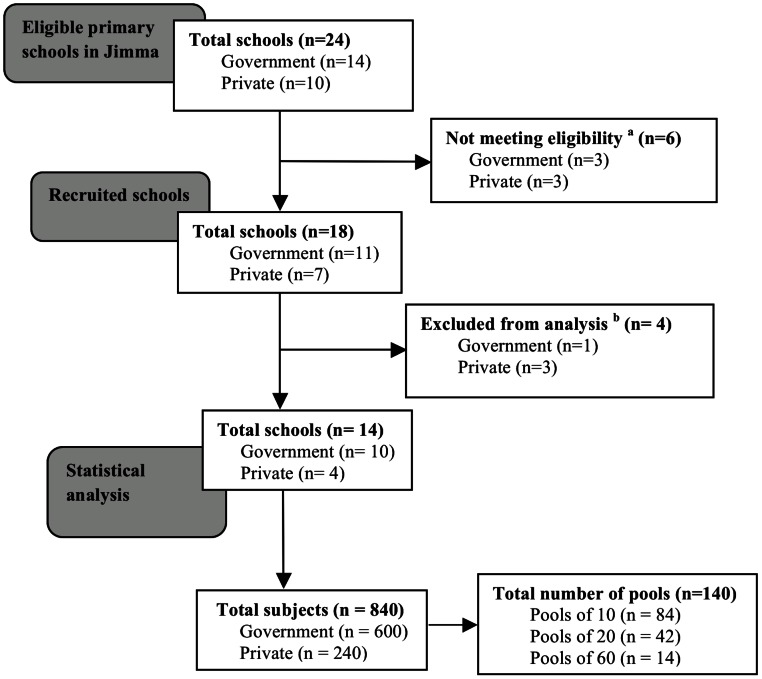
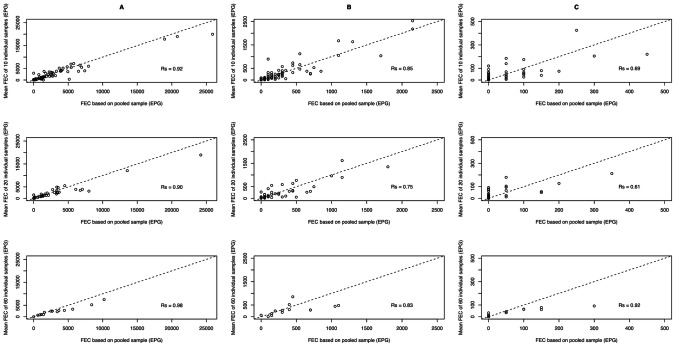
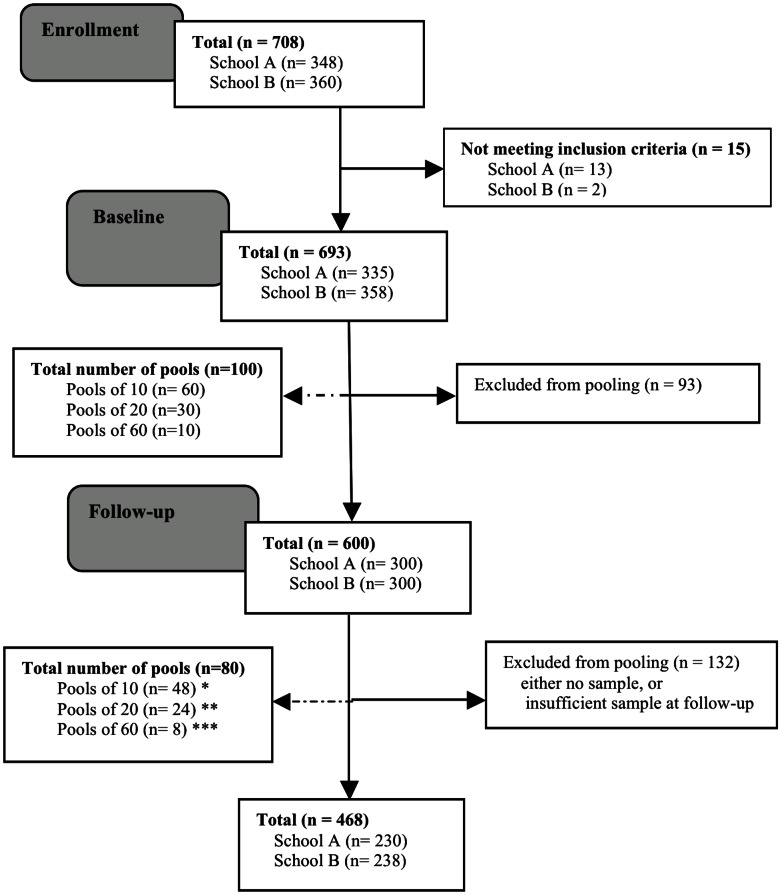
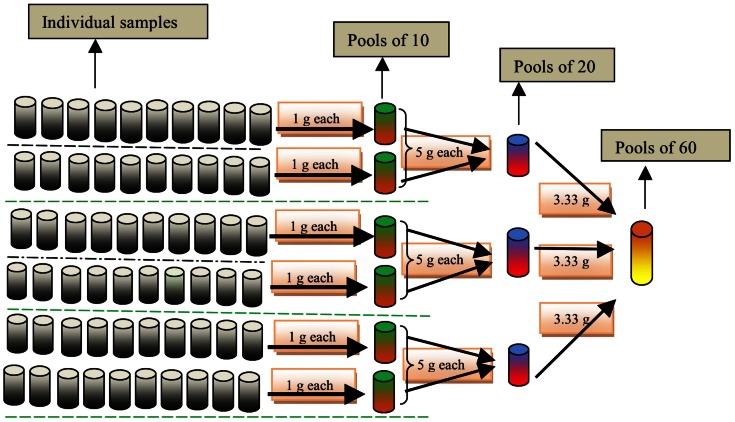
METHODS/PRINCIPAL FINDINGS: Stool samples from 840 children attending 14 primary schools in Jimma, Ethiopia were pooled (pool sizes of 10, 20, and 60) to evaluate the infection intensity of STHs. In addition, the efficacy of a single dose of mebendazole (500 mg) in terms of fecal egg count reduction (FECR; synonym of egg reduction rate) was evaluated in 600 children from two of these schools. Individual and pooled samples were examined with the McMaster egg counting method. For each of the three STHs, we found a significant positive correlation between mean fecal egg counts (FECs) of individual stool samples and FEC of pooled stool samples, ranging from 0.62 to 0.98. Only for A. lumbricoides was any significant difference in mean FEC of the individual and pooled samples found. For this STH species, pools of 60 samples resulted in significantly higher FECs. FECR for the different number of samples pooled was comparable in all pool sizes, except for hookworm. For this parasite, pools of 10 and 60 samples provided significantly higher FECR results.
CONCLUSION/SIGNIFICANCE: This study highlights that pooling stool samples holds promise as a strategy for rapidly assessing infection intensity and efficacy of administered drugs in programs to control human STHs. However, further research is required to determine when and how pooling of stool samples can be cost-effectively applied along a control program, and to verify whether this approach is also applicable to other NTDs.
在兽医寄生虫学中,通常会对样本进行合并,以快速评估感染强度和药物疗效。目前,尚无研究评估这种策略在大规模药物管理方案中用于控制人体土壤传播性蠕虫(STHs;蛔虫、鞭虫和钩虫)的效果。因此,我们开发并评估了一种合并策略,以评估 STH 感染的强度和药物疗效。
方法/主要发现:从埃塞俄比亚吉姆马的 14 所小学中,840 名儿童的粪便样本被合并(合并样本大小为 10、20 和 60),以评估 STH 的感染强度。此外,在其中两所学校的 600 名儿童中,评估了单次服用 500 毫克甲苯咪唑的疗效(粪便卵计数减少率[FECR]的同义词)。使用麦克马斯特粪便卵计数法检查个体和合并样本。对于这三种 STH 中的每一种,我们发现个体粪便样本的平均粪便卵计数(FEC)与合并粪便样本的 FEC 之间存在显著的正相关,相关系数为 0.62 至 0.98。仅在 A. lumbricoides 中发现个体和合并样本的平均 FEC 存在显著差异。对于这种 STH 物种,60 个样本的合并样本导致的 FEC 显著更高。在所有样本合并大小中,除了钩虫外,不同样本合并数量的 FECR 相当。对于这种寄生虫,10 个和 60 个样本的合并样本提供了更高的 FECR 结果。
结论/意义:本研究强调,合并粪便样本作为一种策略,有希望用于快速评估人体 STH 感染强度和药物疗效。然而,需要进一步研究确定何时以及如何在控制方案中以具有成本效益的方式应用粪便样本合并,以及验证这种方法是否也适用于其他 NTDs。