Institute of Neuroscience and Brain Research Center, National Yang-Ming University, Taipei, Taiwan.
J Child Psychol Psychiatry. 2013 Sep;54(9):1016-27. doi: 10.1111/jcpp.12076. Epub 2013 May 23.
Although a general consensus holds that emotional reactivity in youth with conduct disorder (CD) symptoms arises as one of the main causes of successive aggression, it remains to be determined whether automatic emotional processing is altered in this population.
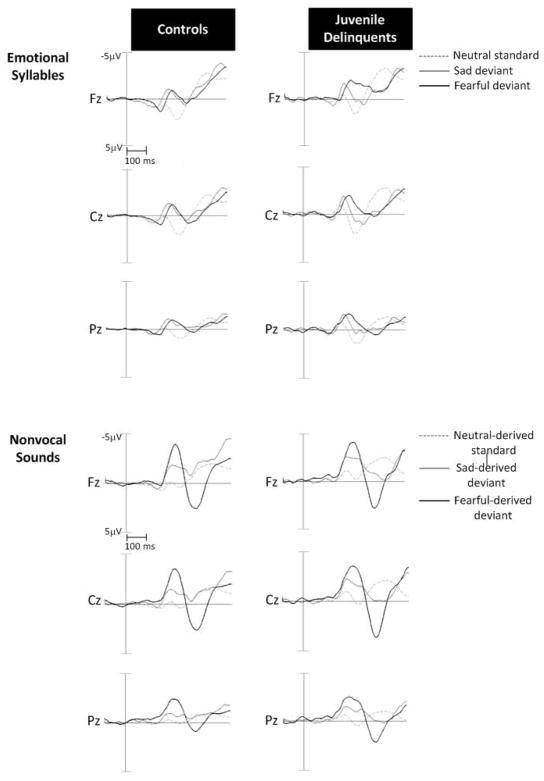
We measured auditory event-related potentials (ERP) in 20 young offenders and 20 controls, screened for DSM-IV criteria of CD and evaluated using the youth version of Hare Psychopathy Checklist (PCL:YV), State-Trait Anxiety Inventory (STAI) and Barrett Impulsiveness Scale (BIS-11). In an oddball design, sadly or fearfully spoken 'deviant' syllables were randomly presented within a train of emotionally neutral 'standard' syllables.
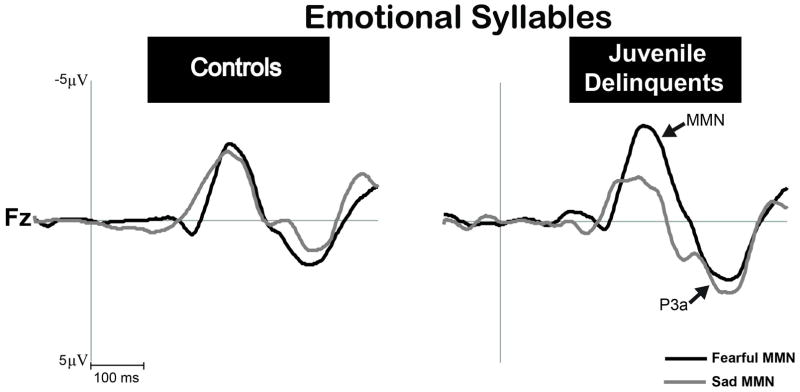
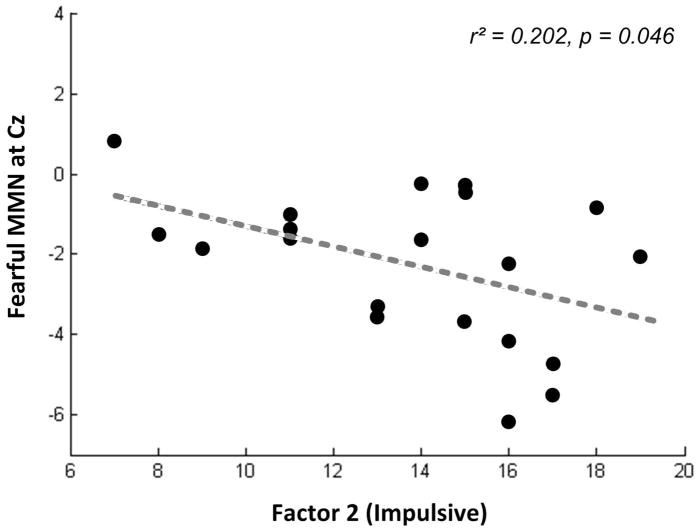
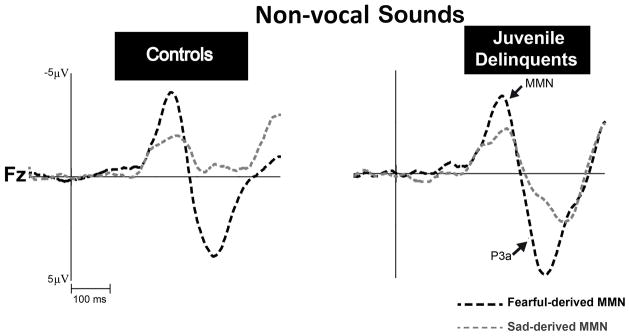
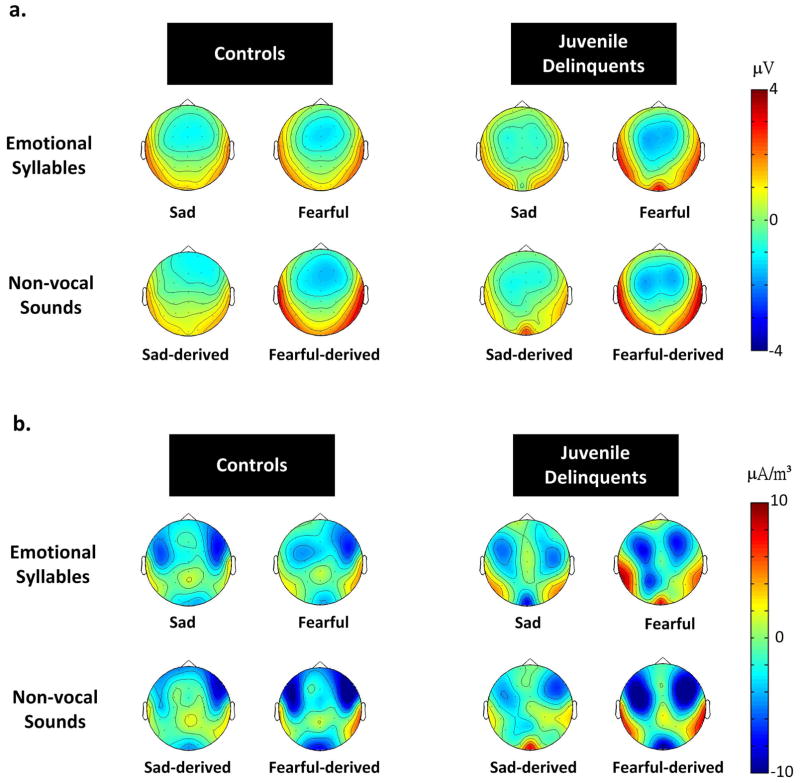
In young offenders meeting with CD criteria, the ERP component mismatch negativity (MMN), presumed to reflect preattentive auditory change detection, was significantly stronger for fearful than sad syllables. No MMN differences for fearful versus sad syllables were observed in controls. Analyses of nonvocal deviants, matched spectrally with the fearful and sad sounds, supported our interpretation that the MMN abnormalities in juvenile offenders were related to the emotional content of sounds, instead of purely acoustic factors. Further, in the young offenders with CD symptoms, strong MMN amplitudes to fearful syllables were associated with high impulsive tendencies (PCL:YV, Factor 2). Higher trait and state anxiety, assessed by STAI, were positively correlated with P3a amplitudes to fearful and sad syllables, respectively. The differences in group-interaction MMN/P3a patterns to emotional syllables and nonvocal sounds could be speculated to suggest that there is a distinct processing route for preattentive processing of species-specific emotional information in human auditory cortices.
Our results suggest that youths with CD symptoms may process distressful voices in an atypical fashion already at the preattentive level. This auditory processing abnormality correlated with increased impulsivity and anxiety. Our results may help to shed light on the neural mechanisms of aggression.
尽管普遍认为,患有品行障碍(CD)症状的年轻人的情绪反应是继发生成攻击性的主要原因之一,但仍需要确定该人群的自动情绪处理是否发生改变。
我们对 20 名年轻罪犯和 20 名对照者进行了听觉事件相关电位(ERP)测量,这些人符合 DSM-IV 品行障碍标准,并使用青少年版 Hare 精神病态检查表(PCL:YV)、状态特质焦虑量表(STAI)和 Barrett 冲动量表(BIS-11)进行了评估。在一种偶发事件设计中,悲伤或恐惧的“偏离”音节随机出现在一系列情绪中性的“标准”音节中。
在符合 CD 标准的年轻罪犯中,假设反映非注意听觉变化检测的 ERP 成分失匹配负波(MMN)对于恐惧音节比对悲伤音节更强。在对照组中,没有观察到恐惧音节与悲伤音节之间的 MMN 差异。对与恐惧和悲伤声音频谱匹配的非言语偏离的分析支持了我们的解释,即青少年罪犯的 MMN 异常与声音的情绪内容有关,而不是纯粹的声学因素。此外,在具有 CD 症状的年轻罪犯中,对恐惧音节的强烈 MMN 幅度与高冲动倾向(PCL:YV,第 2 因子)相关。STAI 评估的较高特质和状态焦虑与恐惧和悲伤音节的 P3a 幅度呈正相关。对情绪音节和非言语声音的组间交互 MMN/P3a 模式的差异可以推测为,在人类听觉皮层中,存在一种用于处理特定于物种的情绪信息的独特的非注意处理途径。
我们的结果表明,具有 CD 症状的年轻人可能已经在非注意水平上以非典型的方式处理痛苦的声音。这种听觉处理异常与增加的冲动性和焦虑有关。我们的结果可能有助于阐明攻击性的神经机制。