School of Medical Sciences, University of New South Wales, Wallace Wurth Building, Office #203, Sydney, NSW 2052, Australia.
Lipids Health Dis. 2013 May 28;12:79. doi: 10.1186/1476-511X-12-79.
In recent years the physiological and pathological importance of fatty acids in both the periphery and central nervous system (CNS) has become increasingly apparent. However surprisingly limited research has been conducted comparing the fatty acid composition of central and peripheral lipid stores.
The present study compared the distribution of polyunsaturated (PUFA), as well as specific saturated (SFA) and monounsaturated (MUFA) fatty acids in the whole blood and cerebrospinal fluid (CSF) of humans. Gas chromatography with flame ionization detection was used to determine the fatty acid profiles of twenty-eight matched CSF and whole blood samples. Multiple linear regression modeling, controlling for age, was used to identify significant relationships.
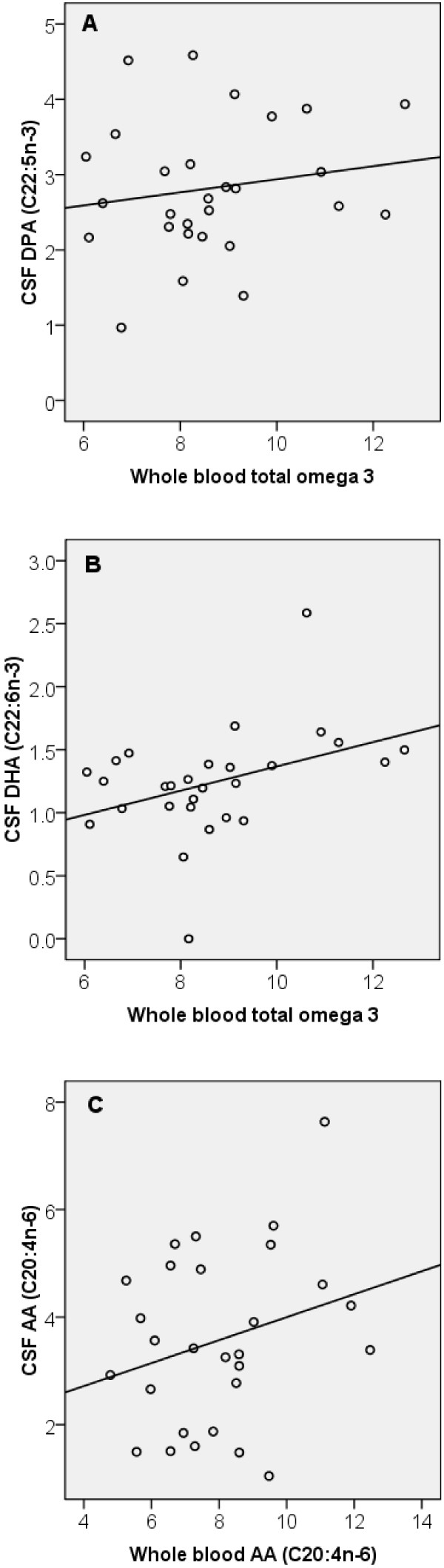
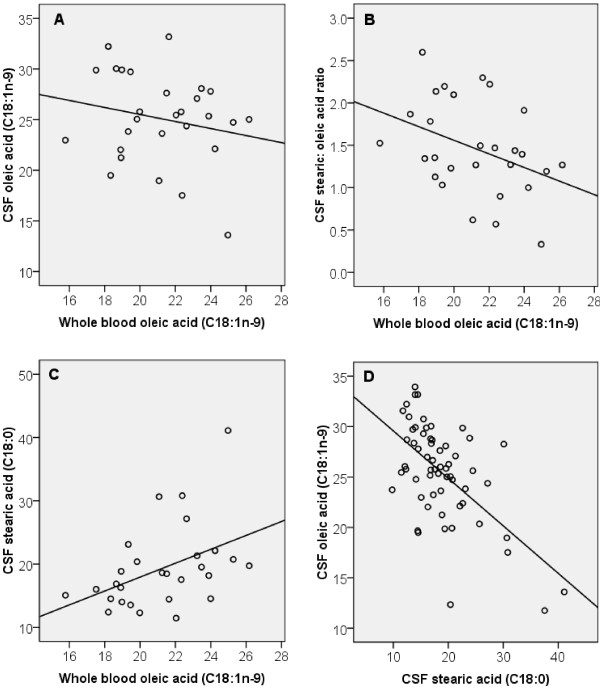
A significant positive relationship was seen between whole blood total omega-3 fatty acids and the CSF omega-3 subfractions, docosapentaenoic acid (DPA) (P = 0.019) and docosahexaenoic acid (DHA) (P = 0.015). A direct association was also observed between the whole blood and CSF omega-6 PUFA, arachidonic acid (AA) (P = 0.045). Interestingly an inverse association between central and peripheral oleic acid was also found (P = 0.045).
These findings indicate a relationship between central and peripheral fatty acids of varying degrees of unsaturation and chain length and support the view that some systemic fatty acids are likely to cross the human blood brain barrier (BBB) and thereby influence central fatty acid concentrations.
近年来,脂肪酸在周围和中枢神经系统(CNS)中的生理和病理重要性变得越来越明显。然而,令人惊讶的是,与中枢和周围脂质储存的脂肪酸组成相比,研究非常有限。
本研究比较了人类全血和脑脊液(CSF)中多不饱和(PUFA)以及特定饱和(SFA)和单不饱和(MUFA)脂肪酸的分布。气相色谱法-火焰离子化检测用于确定 28 对匹配的 CSF 和全血样本的脂肪酸谱。多元线性回归模型,控制年龄,用于确定显著的关系。
全血总 ω-3 脂肪酸与 CSF ω-3 亚组分二十二碳五烯酸(DPA)(P=0.019)和二十二碳六烯酸(DHA)(P=0.015)之间存在显著正相关。全血和 CSF ω-6 PUFA 花生四烯酸(AA)(P=0.045)之间也存在直接关联。有趣的是,还发现了中央和外周油酸之间的反比关系(P=0.045)。
这些发现表明,不同不饱和程度和链长的中枢和周围脂肪酸之间存在一定的关系,并支持某些系统性脂肪酸可能穿过血脑屏障(BBB)并影响中枢脂肪酸浓度的观点。