School of Psychology, Bangor University, Bangor, Gwynedd LL57 2AS, UK.
Trials. 2013 May 27;14:152. doi: 10.1186/1745-6215-14-152.
Preliminary evidence suggests that goal-oriented cognitive rehabilitation (CR) may be a clinically effective intervention for people with early-stage Alzheimer's disease, vascular or mixed dementia and their carers. This study aims to establish whether CR is a clinically effective and cost-effective intervention for people with early-stage dementia and their carers.
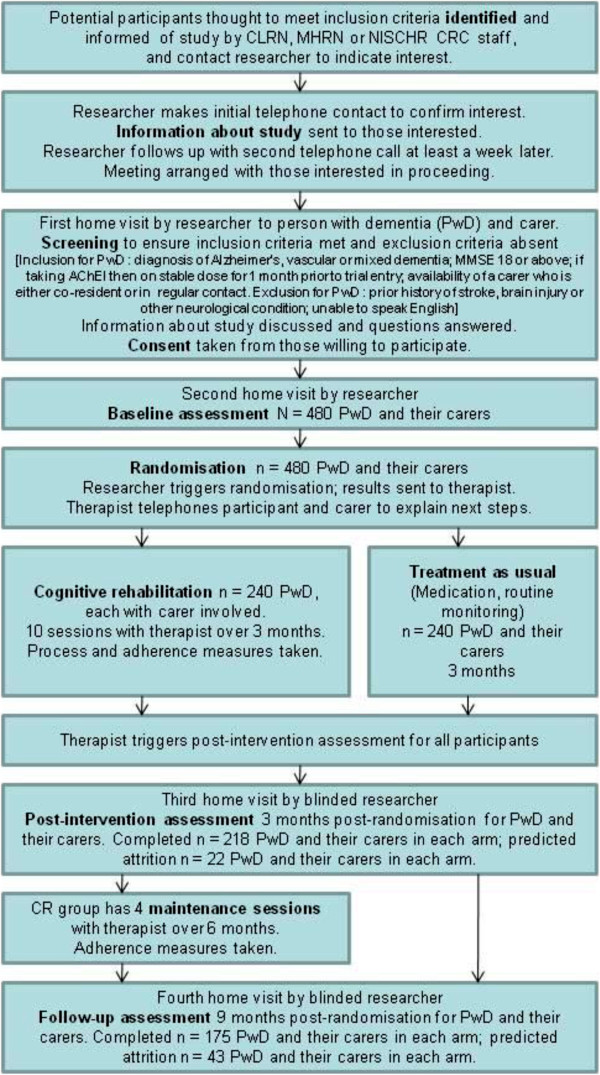
METHODS/DESIGN: In this multi-centre, single-blind randomised controlled trial, 480 people with early-stage dementia, each with a carer, will be randomised to receive either treatment as usual or cognitive rehabilitation (10 therapy sessions over 3 months, followed by 4 maintenance sessions over 6 months). We will compare the effectiveness of cognitive rehabilitation with that of treatment as usual with regard to improving self-reported and carer-rated goal performance in areas identified as causing concern by people with early-stage dementia; improving quality of life, self-efficacy, mood and cognition of people with early-stage dementia; and reducing stress levels and ameliorating quality of life for carers of participants with early-stage dementia. The incremental cost-effectiveness of goal-oriented cognitive rehabilitation compared to treatment as usual will also be examined.
If the study confirms the benefits and cost-effectiveness of cognitive rehabilitation, it will be important to examine how the goal-oriented cognitive rehabilitation approach can most effectively be integrated into routine health-care provision. Our aim is to provide training and develop materials to support the implementation of this approach following trial completion.
初步证据表明,以目标为导向的认知康复(CR)可能是一种针对早期阿尔茨海默病、血管性或混合性痴呆患者及其照顾者的临床有效干预措施。本研究旨在确定 CR 是否是一种针对早期痴呆患者及其照顾者的临床有效且具有成本效益的干预措施。
方法/设计:在这项多中心、单盲随机对照试验中,将 480 名早期痴呆患者(每位患者均有一名照顾者)随机分为接受常规治疗或认知康复(3 个月内进行 10 次治疗,然后在 6 个月内进行 4 次维持治疗)。我们将比较认知康复与常规治疗的效果,以改善早期痴呆患者自我报告和照顾者评定的目标表现,改善早期痴呆患者的生活质量、自我效能、情绪和认知,降低早期痴呆患者照顾者的压力水平并改善其生活质量。还将检查以目标为导向的认知康复相对于常规治疗的增量成本效益。
如果研究证实认知康复的益处和成本效益,那么研究以目标为导向的认知康复方法如何最有效地融入常规医疗服务就显得尤为重要。我们的目标是在试验完成后提供培训并开发材料以支持该方法的实施。