Department of Crop Science, Chungnam National University, Daejeon 305-754, Korea.
J Ginseng Res. 2012 Jan;36(1):107-13. doi: 10.5142/jgr.2012.36.1.107.
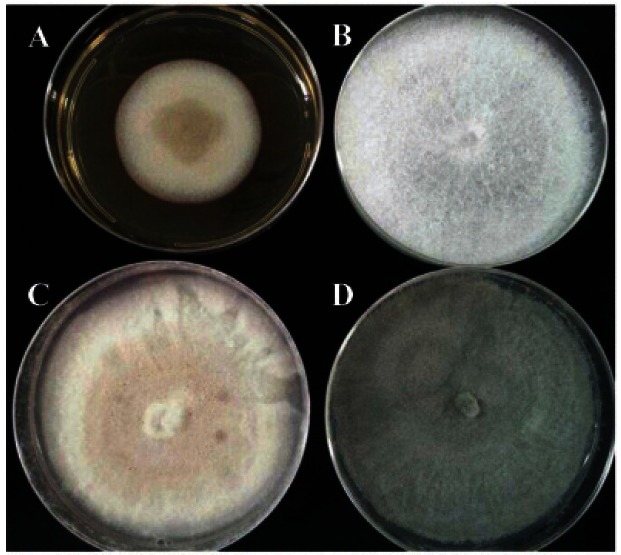
In order to investigate the diversity of endophytes, fungal endophytes in Panax ginseng Meyer cultivated in Korea were isolated and identified using internal transcribed spacer (ITS) sequences of ribosomal DNA. Three cultivars of 3-year-old ginseng roots (Chunpoong, Yunpoong, and Gumpoong) were used to isolate fungal endophytes. Surface sterilized ginseng roots were placed on potato dextrose agar plates supplemented with ampicilin and streptomycin to inhibit bacterial growth. Overall, 38 fungal endophytes were isolated from 12 ginseng roots. According to the sequence analysis of the ITS1-5.8S-ITS2, 38 fungal isolates were classified into 4 different fungal species, which were Phoma radicina, Fusarium oxysporum, Setophoma terrestris and Ascomycota sp. 2-RNK. The most dominant fungal endophyte was P. radicina in 3 cultivars. The percentage of dominant endophytes of P. radicina was 65.8%. The percentage of colonization frequency of P. radicina was 80%, 52.9%, and 75% in Chunpoong, Yunpoong, and Gumpoong, respectively. The second most dominant fungal endophyte was F. oxysporum. The diversity of the fungal endophytes was low and no ginseng cultivar specificity among endophytes was detected in this study. The identified endophytes can be potential fungi for the production of bioactive compounds and control against ginseng pathogens.
为了研究内生真菌的多样性,采用核糖体 DNA 内转录间隔区(ITS)序列对韩国种植的人参内生真菌进行了分离和鉴定。使用了 3 年生的春峰、云峰和贡峰三种人参根来分离内生真菌。对表面消毒的人参根进行了处理,将其放在添加氨苄青霉素和链霉素的土豆葡萄糖琼脂平板上,以抑制细菌生长。总的来说,从 12 个人参根中共分离出 38 株内生真菌。根据 ITS1-5.8S-ITS2 的序列分析,38 株真菌分离物分为 4 种不同的真菌物种,分别为 Phoma radicina、Fusarium oxysporum、Setophoma terrestris 和 Ascomycota sp. 2-RNK。最优势的内生真菌是 3 种栽培品种中的 Phoma radicina。Phoma radicina 的优势内生真菌比例为 65.8%。Phoma radicina 在春峰、云峰和贡峰中的定殖频率分别为 80%、52.9%和 75%。第二大优势内生真菌是 Fusarium oxysporum。本研究中内生真菌的多样性较低,且未检测到内生真菌对人参品种的特异性。鉴定出的内生真菌可以作为生物活性化合物产生和防治人参病原菌的潜在真菌。