Department of Neurosciences, University of California San Diego, CA, USA ; Department of Mathematics and Statistics, Boston University Boston, MA, USA.
Front Neurosci. 2013 May 14;7:75. doi: 10.3389/fnins.2013.00075. eCollection 2013.
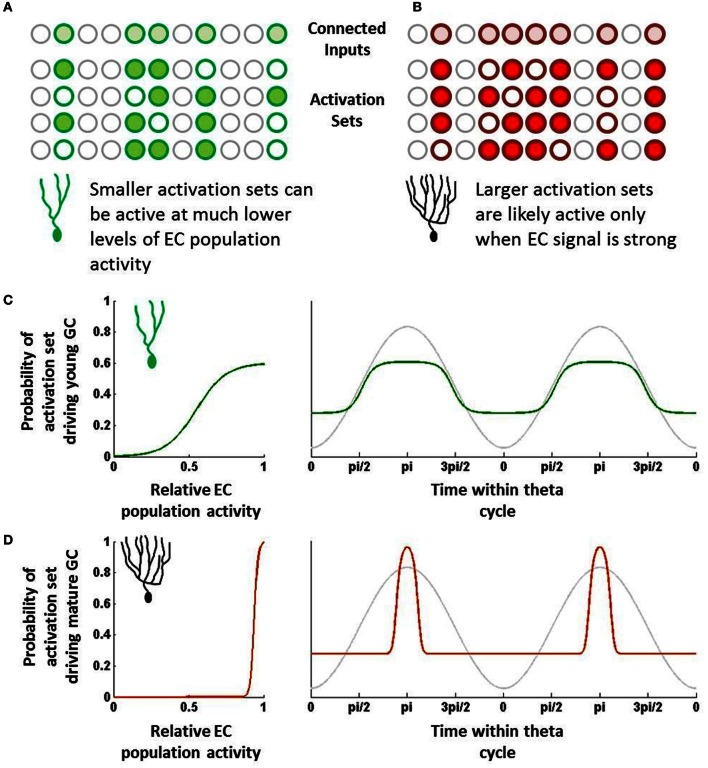
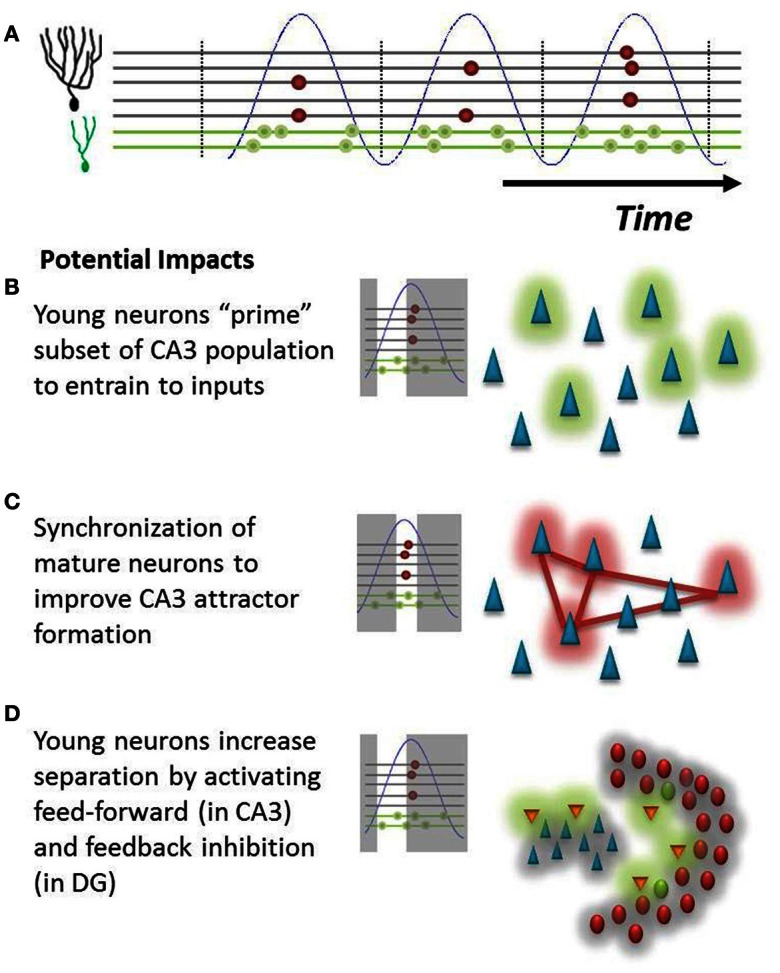
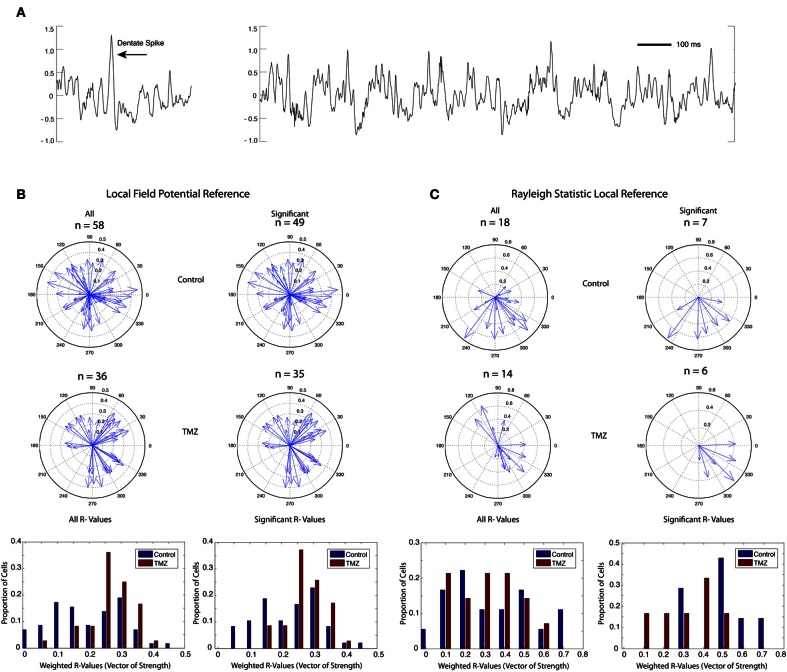
While it has been hypothesized that adult neurogenesis (NG) plays a role in the encoding of temporal information at long time-scales, the temporal relationship of immature cells to the highly rhythmic network activity of the hippocampus has been largely unexplored. Here, we present a theory for how the activity of immature adult-born granule cells relates to hippocampal oscillations. Our hypothesis is that theta rhythmic (5-10 Hz) excitatory and inhibitory inputs into the hippocampus could differentially affect young and mature granule cells due to differences in intrinsic physiology and synaptic inhibition between the two cell populations. Consequently, immature cell activity may occur at broader ranges of theta phase than the activity of their mature counterparts. We describe how this differential influence on young and mature granule cells could separate the activity of differently aged neurons in a temporal coding regime. Notably, this process could have considerable implications on how the downstream CA3 region interprets the information conveyed by young and mature granule cells. To begin to investigate the phasic behavior of granule cells, we analyzed in vivo recordings of the rat dentate gyrus (DG), observing that the temporal behavior of granule cells with respect to the theta rhythm is different between rats with normal and impaired levels of NG. Specifically, in control animals, granule cells exhibit both strong and weak coupling to the phase of the theta rhythm. In contrast, the distribution of phase relationships in NG-impaired rats is shifted such that they are significantly stronger. These preliminary data support our hypothesis that immature neurons could distinctly affect the temporal dynamics of hippocampal encoding.
虽然已经假设成人神经发生 (NG) 在长时间尺度上对时间信息的编码起作用,但不成熟细胞与海马体高度节律性网络活动之间的时间关系在很大程度上尚未得到探索。在这里,我们提出了一个关于不成熟的成年新生颗粒细胞的活动如何与海马体振荡相关的理论。我们的假设是,由于两个细胞群体之间的内在生理和突触抑制的差异,海马体中的θ节律性(5-10 Hz)兴奋性和抑制性输入可能会对年轻和成熟的颗粒细胞产生不同的影响。因此,不成熟细胞的活动可能发生在更广泛的θ相位范围内,而不是其成熟对应物的活动。我们描述了这种对年轻和成熟颗粒细胞的不同影响如何在时间编码机制中分离不同年龄神经元的活动。值得注意的是,这个过程可能对下游 CA3 区域如何解释年轻和成熟颗粒细胞传递的信息产生相当大的影响。为了开始研究颗粒细胞的相位行为,我们分析了大鼠齿状回 (DG) 的体内记录,观察到颗粒细胞相对于θ节律的时间行为在具有正常和受损 NG 水平的大鼠之间是不同的。具体而言,在对照动物中,颗粒细胞表现出与θ节律相位的强耦合和弱耦合。相比之下,NG 受损大鼠中相位关系的分布发生了偏移,使得它们的耦合明显更强。这些初步数据支持我们的假设,即不成熟的神经元可以明显影响海马体编码的时间动态。