Plant Physiology Laboratory, Center for Biotechnology and Department of Botany, Federal University of Rio Grande do Sul, Porto Alegre, Rio Grande do Sul, Brazil.
Front Plant Sci. 2013 May 14;4:133. doi: 10.3389/fpls.2013.00133. eCollection 2013.
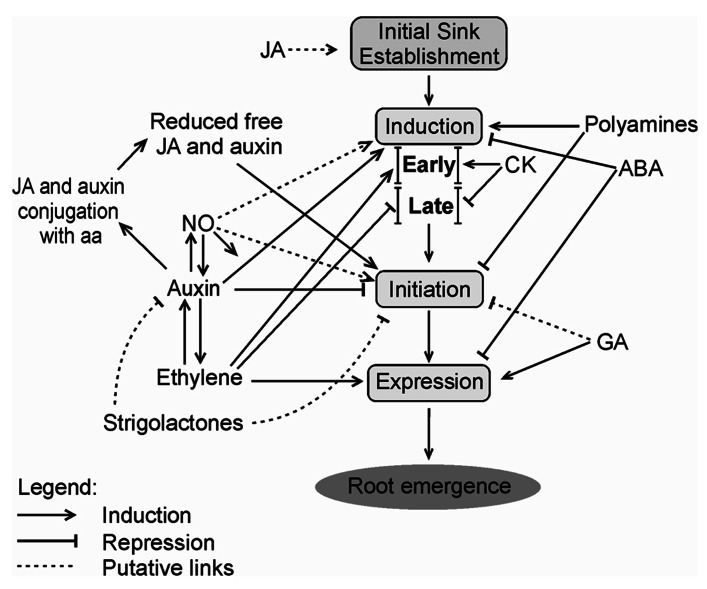
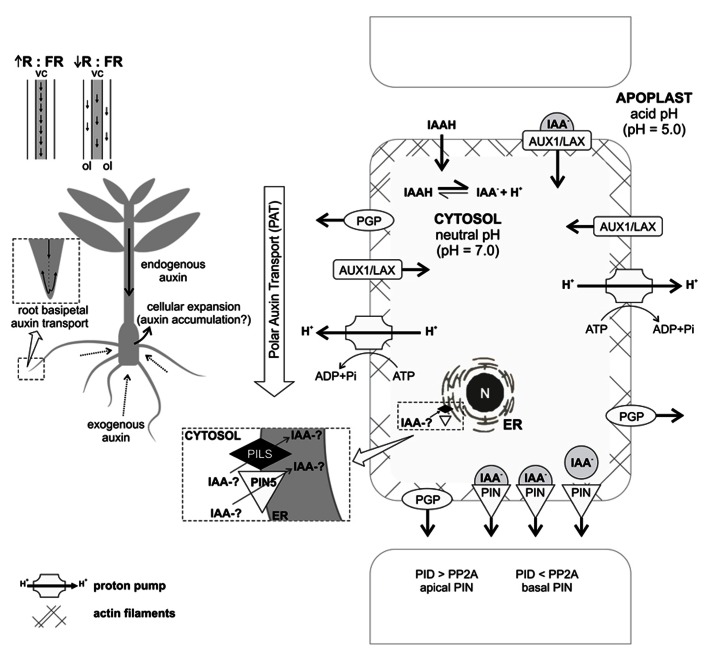
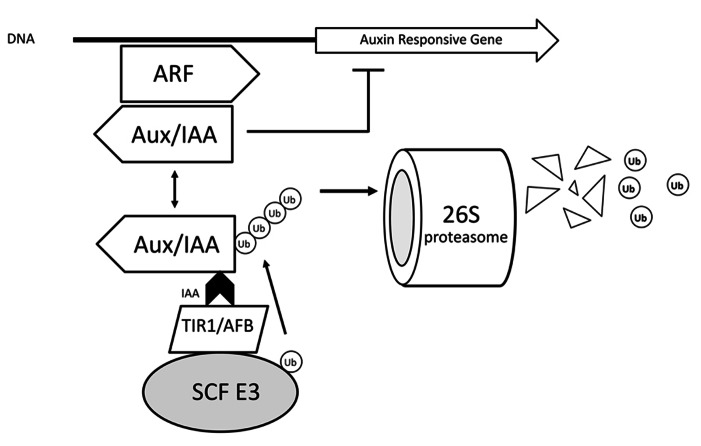
Adventitious rooting (AR) is a multifactorial response leading to new roots at the base of stem cuttings, and the establishment of a complete and autonomous plant. AR has two main phases: (a) induction, with a requirement for higher auxin concentration; (b) formation, inhibited by high auxin and in which anatomical changes take place. The first stages of this process in severed organs necessarily include wounding and water stress responses which may trigger hormonal changes that contribute to reprogram target cells that are competent to respond to rooting stimuli. At severance, the roles of jasmonate and abscisic acid are critical for wound response and perhaps sink strength establishment, although their negative roles on the cell cycle may inhibit root induction. Strigolactones may also inhibit AR. A reduced concentration of cytokinins in cuttings results from the separation of the root system, whose tips are a relevant source of these root induction inhibitors. The combined increased accumulation of basipetally transported auxins from the shoot apex at the cutting base is often sufficient for AR in easy-to-root species. The role of peroxidases and phenolic compounds in auxin catabolism may be critical at these early stages right after wounding. The events leading to AR strongly depend on mother plant nutritional status, both in terms of minerals and carbohydrates, as well as on sink establishment at cutting bases. Auxins play a central role in AR. Auxin transporters control auxin canalization to target cells. There, auxins act primarily through selective proteolysis and cell wall loosening, via their receptor proteins TIR1 (transport inhibitor response 1) and ABP1 (Auxin-Binding Protein 1). A complex microRNA circuitry is involved in the control of auxin response factors essential for gene expression in AR. After root establishment, new hormonal controls take place, with auxins being required at lower concentrations for root meristem maintenance and cytokinins needed for root tissue differentiation.
不定根发生(AR)是一种多因素反应,导致茎切段基部产生新根,并建立完整的自主植物。AR 有两个主要阶段:(a)诱导,需要较高的生长素浓度;(b)形成,受高生长素抑制,在此期间发生解剖学变化。在切断的器官中,这个过程的早期阶段必然包括创伤和水分胁迫反应,这些反应可能引发激素变化,有助于重编程具有响应生根刺激能力的靶细胞。在切断时,茉莉酸和脱落酸的作用对于创伤反应和可能的汇强度建立至关重要,尽管它们对细胞周期的负作用可能抑制根诱导。独脚金内酯也可能抑制 AR。由于根系分离,扦插中细胞分裂素的浓度降低,而根尖是这些根诱导抑制剂的一个重要来源。从切割基部的茎尖向下运输的生长素的浓度增加,通常足以在易于生根的物种中进行 AR。过氧化物酶和酚类化合物在生长素分解代谢中的作用在创伤后早期阶段可能至关重要。导致 AR 的事件强烈依赖于母株的营养状况,包括矿物质和碳水化合物,以及切割基部的汇建立。生长素在 AR 中起核心作用。生长素转运蛋白控制生长素向靶细胞的运输。在那里,生长素主要通过其受体蛋白 TIR1(运输抑制剂反应 1)和 ABP1(生长素结合蛋白 1)的选择性蛋白水解和细胞壁松弛来发挥作用。一个复杂的 microRNA 电路参与了对 AR 中基因表达至关重要的生长素响应因子的控制。在根建立后,新的激素控制发生,较低浓度的生长素用于根分生组织维持,细胞分裂素用于根组织分化。