Department of Biochemistry and Cellular and Molecular Biology, University of Tennessee, Knoxville, Tennessee, United States of America.
PLoS One. 2013 May 23;8(5):e64646. doi: 10.1371/journal.pone.0064646. Print 2013.
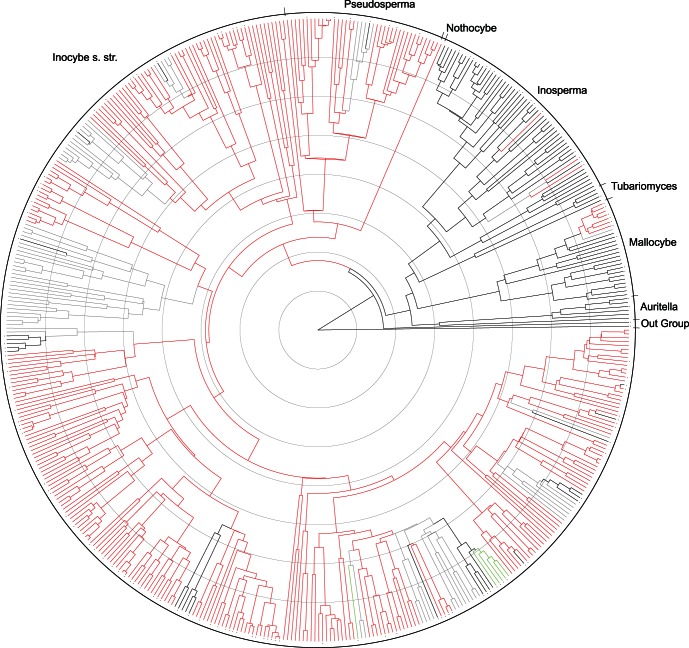
Mushroom-forming fungi produce a wide array of toxic alkaloids. However, evolutionary analyses aimed at exploring the evolution of muscarine, a toxin that stimulates the parasympathetic nervous system, and psilocybin, a hallucinogen, have never been performed. The known taxonomic distribution of muscarine within the Inocybaceae is limited, based only on assays of species from temperate regions of the northern hemisphere. Here, we present a review of muscarine and psilocybin assays performed on species of Inocybaceae during the last fifty years. To supplement these results, we used liquid chromatography-tandem mass spectrometry (LC-MS/MS) to determine whether muscarine was present in 30 new samples of Inocybaceae, the majority of which have not been previously assayed or that originated from either the tropics or temperate regions of the southern hemisphere. Our main objective is to test the hypothesis that the presence of muscarine is a shared ancestral feature of the Inocybaceae. In addition, we also test whether species of Inocyabceae that produce psilocybin are monophyletic. Our findings suggest otherwise. Muscarine has evolved independently on several occasions, together with several losses. We also detect at least two independent transitions of muscarine-free lineages to psilocybin-producing states. Although not ancestral for the family as a whole, muscarine is a shared derived trait for an inclusive clade containing three of the seven major lineages of Inocybaceae (the Inocybe, Nothocybe, and Pseudosperma clades), the common ancestor of which may have evolved ca. 60 million years ago. Thus, muscarine represents a conserved trait followed by several recent losses. Transitions to psilocybin from muscarine-producing ancestors occurred more recently between 10-20 million years ago after muscarine loss in two separate lineages. Statistical analyses firmly reject a single origin of muscarine-producing taxa.
产菇真菌会产生多种有毒生物碱。然而,探索毒蕈碱(一种刺激副交感神经系统的毒素)和裸盖菇素(一种致幻剂)进化的进化分析从未进行过。目前已知蕈碱在鸡油菌科中的分类分布仅限于对北半球温带地区物种的检测。在这里,我们回顾了过去五十年中在鸡油菌科物种上进行的毒蕈碱和裸盖菇素检测。为了补充这些结果,我们使用液相色谱-串联质谱法(LC-MS/MS)来确定是否存在 30 种新的鸡油菌科样本中的蕈碱,其中大多数样本以前未经过检测,或者来自南半球的热带或温带地区。我们的主要目的是检验这样一个假设,即蕈碱的存在是鸡油菌科的一个共同祖先特征。此外,我们还检验是否产生裸盖菇素的鸡油菌科物种是否是单系的。我们的发现表明并非如此。蕈碱已经独立进化了几次,同时也发生了几次丢失。我们还检测到至少有两个独立的蕈碱缺失谱系向产生裸盖菇素的状态的转变。虽然蕈碱不是整个家族的祖先,但它是一个包含鸡油菌科七个主要谱系中的三个谱系(鸡油菌、薄环柄菇和拟裸盖菇)的包容性进化枝的共享衍生特征,其共同祖先可能约在 6000 万年前进化而来。因此,蕈碱代表了一个保守特征,随后是几个最近的丢失。从蕈碱产生的祖先向裸盖菇素的转变发生在两个独立谱系蕈碱丢失后约 10-2000 万年前。统计分析坚决否定了蕈碱产生类群的单一起源。