School of Population Health, University of Queensland, Herston, Queensland, Australia.
PLoS One. 2013 May 22;8(5):e64965. doi: 10.1371/journal.pone.0064965. Print 2013.
To examine the cost-effectiveness of providing laparoscopic adjustable gastric banding (LAGB) surgery to all morbidly obese adults in the 2003 Australian population.
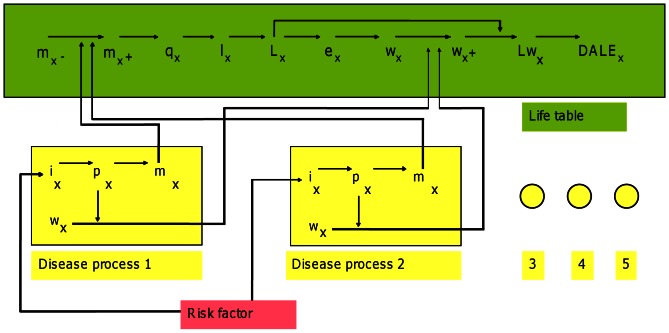
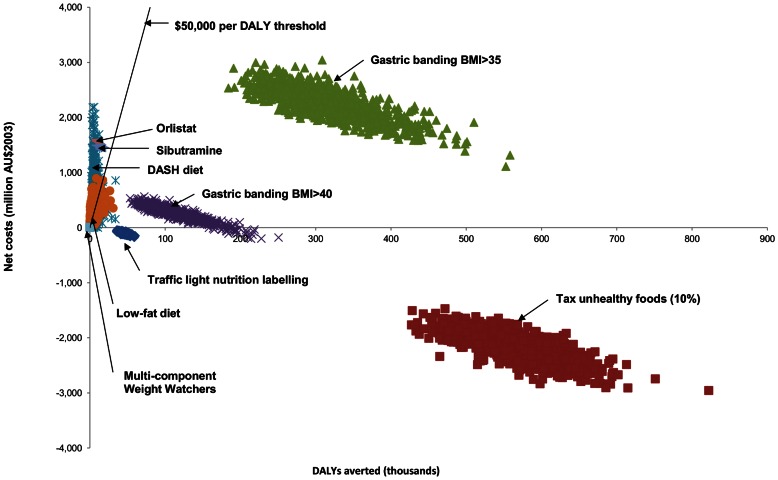
Analyzed costs and benefits associated with two intervention scenarios, one providing LAGB surgery to individuals with BMI >40 and another to individuals with BMI >35, with each compared relative to a 'do nothing' scenario. A multi-state, multiple cohort Markov model was used to determine the cost-effectiveness of LAGB surgery over the lifetime of each cohort. All costs and health outcomes were assessed from an Australian health sector perspective and were discounted using a 3% annual rate. Uncertainty and sensitivity analyzes were conducted to test the robustness of model outcomes. Incremental cost-effectiveness ratios (ICERs) were measured in 2003 Australian dollars per disability adjusted life year (DALY) averted. The ICER for the scenario providing LAGB surgery to all individuals with a BMI >40 was dominant [95% CI: dominant -$588] meaning that the intervention led to both improved health and cost savings. The ICER when providing surgery to those with a BMI >35 was $2,154/DALY averted [95% CI: dominant -$6,033]. Results were highly sensitive to changes in the likelihood of long-term complications.
LAGB surgery is highly cost-effective when compared to the $50,000/DALY threshold for cost-effectiveness used in Australia. LAGB surgery also ranks highly in terms of cost-effectiveness when compared to other population-level interventions for weight loss in Australia. The results of this study are in line with other economic evaluations on LAGB surgery. This study recommends that the Australian federal government provide a full subsidy for LAGB surgery to morbidly obese Australians with a BMI >40.
本研究旨在探讨在 2003 年澳大利亚人群中为所有病态肥胖成年人提供腹腔镜可调节胃束带术(LAGB)的成本效益。
分析了两种干预方案相关的成本和效益,一种方案为 BMI>40 的个体提供 LAGB 手术,另一种方案为 BMI>35 的个体提供 LAGB 手术,并将每种方案与“不作为”方案进行比较。使用多状态、多队列马尔可夫模型来确定 LAGB 手术在每个队列的整个生命周期内的成本效益。所有成本和健康结果均从澳大利亚卫生部门的角度进行评估,并采用 3%的年贴现率进行贴现。进行了不确定性和敏感性分析,以测试模型结果的稳健性。增量成本效益比(ICER)以 2003 年澳元每残疾调整生命年(DALY)的避免量进行衡量。为 BMI>40 的所有个体提供 LAGB 手术的方案具有优势[95%置信区间:优势 -588 澳元],这意味着干预措施同时提高了健康水平并节省了成本。为 BMI>35 的个体提供手术的方案的 ICER 为 2154 澳元每 DALY 的避免量[95%置信区间:优势 -6033 澳元]。结果对长期并发症发生可能性的变化非常敏感。
与澳大利亚用于成本效益的 50000 澳元/DALY 阈值相比,LAGB 手术具有很高的成本效益。与澳大利亚其他减肥人群干预措施相比,LAGB 手术在成本效益方面也排名很高。本研究结果与 LAGB 手术的其他经济评估结果一致。本研究建议澳大利亚联邦政府为 BMI>40 的病态肥胖澳大利亚人提供 LAGB 手术的全额补贴。