Faculty of Medical and Health Sciences, Auckland Cancer Society Research Centre, The University of Auckland Auckland, New Zealand.
Front Oncol. 2013 May 16;3:123. doi: 10.3389/fonc.2013.00123. eCollection 2013.
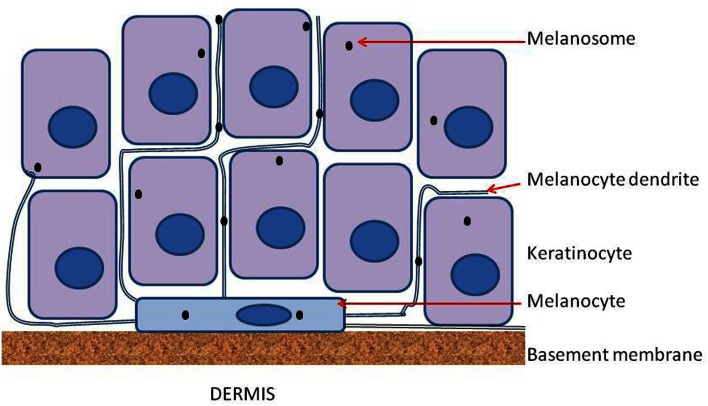
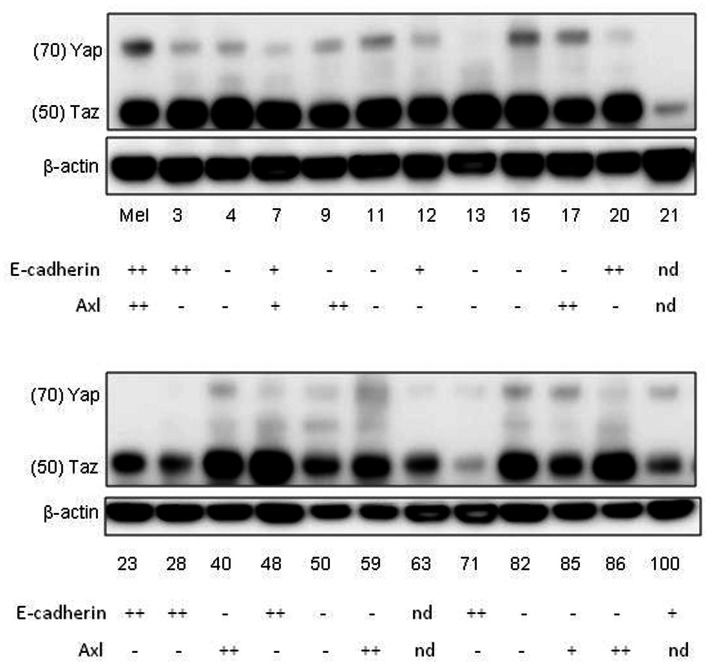
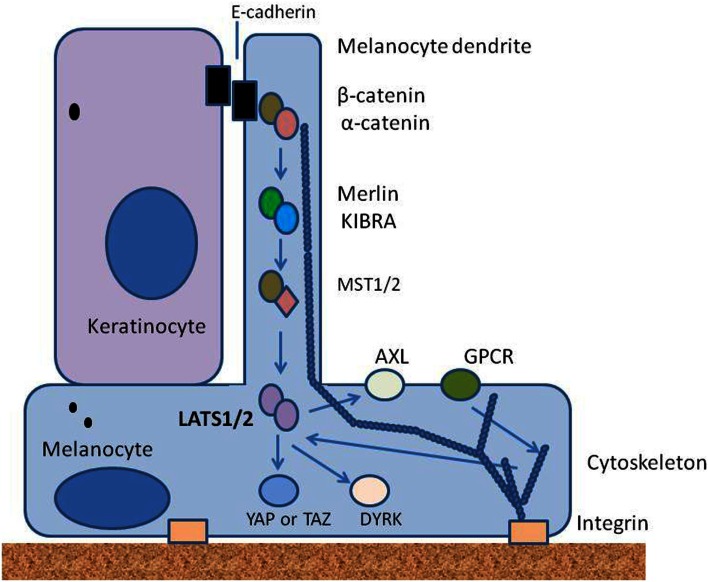
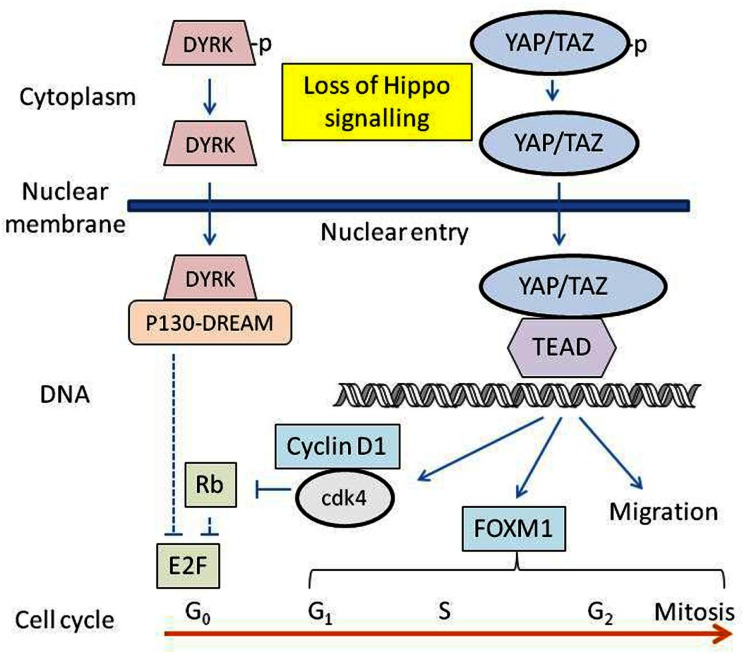
The Hippo signaling pathway comprises a series of cytoplasmic tumor suppressor proteins including Merlin and the Lats1/2 and MST1/2 kinases, and is thought to play a critical role in determining the sizes of organs and tissues. The Hippo pathway is regulated upstream by extracellular mechanosensory signaling arising from cell shape and polarity, as well as by a variety of extracellular signaling molecules. When active, the pathway maintains the transcriptional activators Yes-associated protein (YAP) and TAZ in phosphorylated forms in the cytoplasm, preventing cell proliferation. When the Hippo pathway is inactivated, YAP and TAZ are translocated to the nucleus and induce the expression of a variety of proteins concerned with entry into the cell division cycle, such as cyclin D1 and Fox M1, as well as the inhibition of apoptosis. The failure of the Hippo pathway has been implicated in the development of many different types of cancer but there is limited information available as to its involvement in melanoma. We hypothesize here firstly that the Hippo pathway is involved in maintaining density of cutaneous melanocytes on the basement membrane at the junction of the epidermis and the dermis, and secondly, that its function is disturbed in melanoma. We have analyzed a series of 23 low passage human melanoma lines as well as cultured normal melanoma, and find that melanocytes, as well as all melanoma cell lines examined express TAZ. Melanocytes and most melanoma lines also express YAP. E-cadherin, an upstream regulator of the Hippo pathway, and Axl, a receptor tyrosine kinase regulated by the Hippo pathway, are expressed in melanocytes and in several melanoma cell lines. These observations, together with published evidence for the presence of Merlin, Lats1/2, and MST1/2 in melanocytes and melanoma cells, support the hypothesis that the Hippo pathway is an important component of melanocyte and melanoma behavior.
Hippo 信号通路包含一系列细胞质肿瘤抑制蛋白,包括 Merlin 以及 Lats1/2 和 MST1/2 激酶,被认为在决定器官和组织大小方面发挥着关键作用。Hippo 通路受到来自细胞形状和极性的细胞外机械感觉信号以及各种细胞外信号分子的上游调控。当通路活跃时,它将转录激活因子 Yes 相关蛋白 (YAP) 和 TAZ 保持在细胞质中的磷酸化形式,从而阻止细胞增殖。当 Hippo 通路失活时,YAP 和 TAZ 易位到细胞核,并诱导与进入细胞分裂周期相关的各种蛋白的表达,如细胞周期蛋白 D1 和 FoxM1,以及抑制细胞凋亡。Hippo 通路的失活与多种不同类型的癌症的发展有关,但关于其在黑色素瘤中的参与情况的信息有限。我们在这里首先假设 Hippo 通路参与维持表皮和真皮交界处基底膜上皮肤黑素细胞的密度,其次,其功能在黑色素瘤中受到干扰。我们分析了一系列 23 个人类低传代黑色素瘤系以及培养的正常黑色素瘤,发现黑素细胞以及所有检查的黑色素瘤细胞系均表达 TAZ。黑素细胞和大多数黑色素瘤系也表达 YAP。E-钙黏蛋白,Hippo 通路的上游调节剂,以及 Axl,一种受 Hippo 通路调节的受体酪氨酸激酶,在黑素细胞和几种黑色素瘤细胞系中表达。这些观察结果,加上 Merlin、Lats1/2 和 MST1/2 存在于黑素细胞和黑色素瘤细胞中的已发表证据,支持 Hippo 通路是黑素细胞和黑色素瘤行为的重要组成部分的假说。