The Swire Institute of Marine Science and School of Biological Sciences, The University of Hong Kong, Hong Kong, SAR.
PLoS One. 2013 May 28;8(5):e64147. doi: 10.1371/journal.pone.0064147. Print 2013.
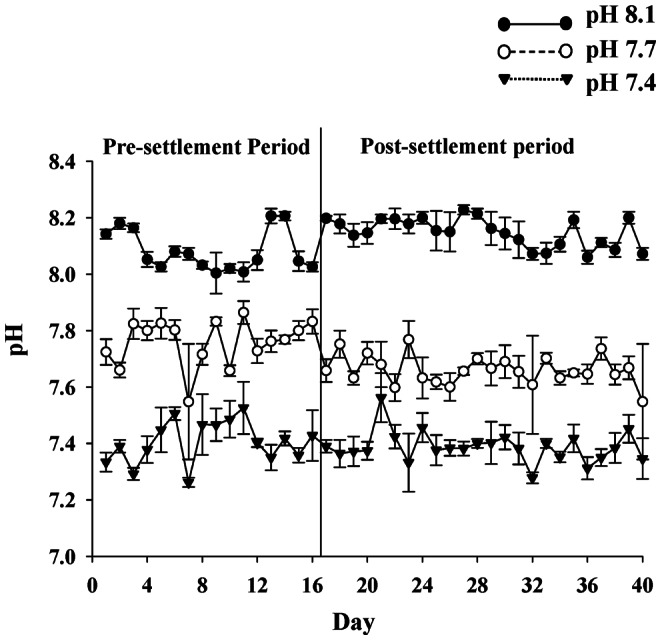
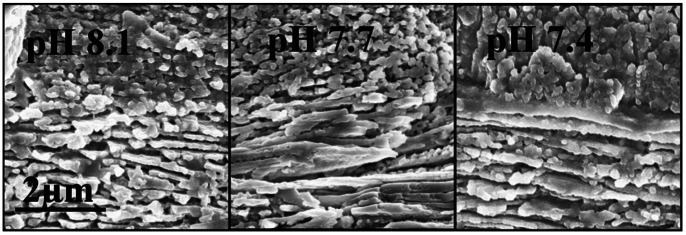
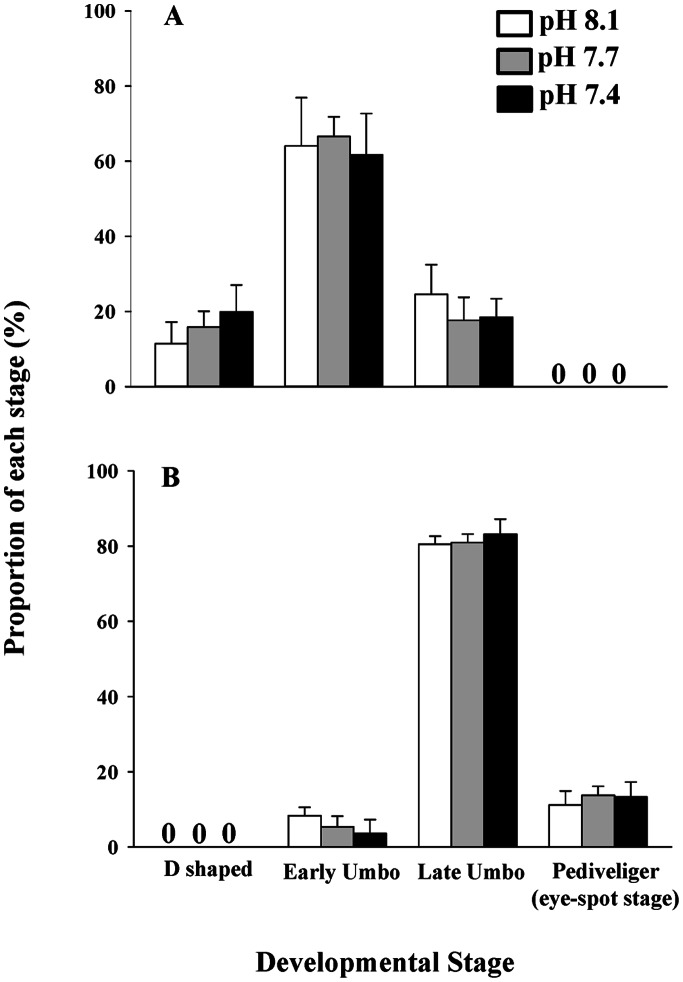
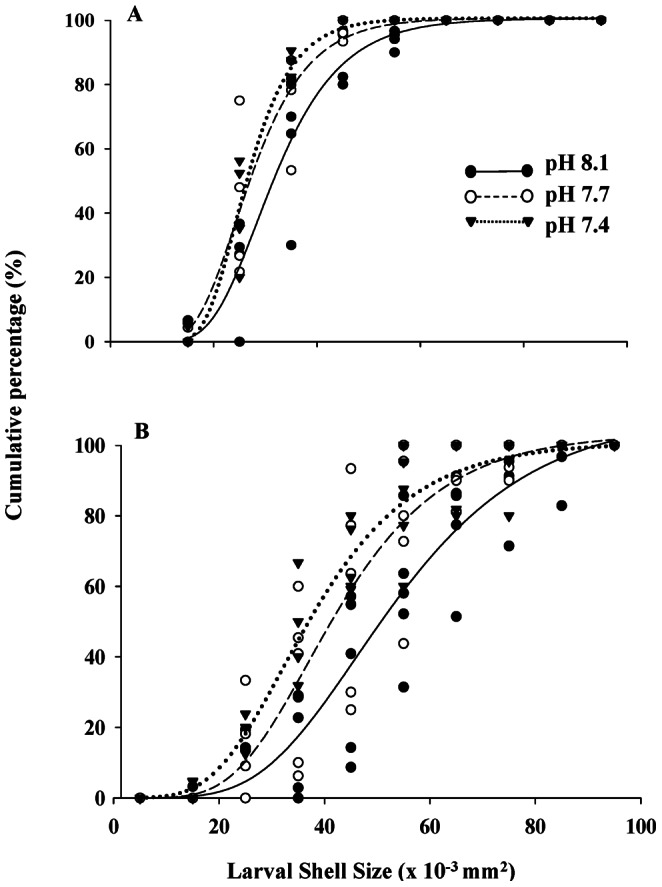
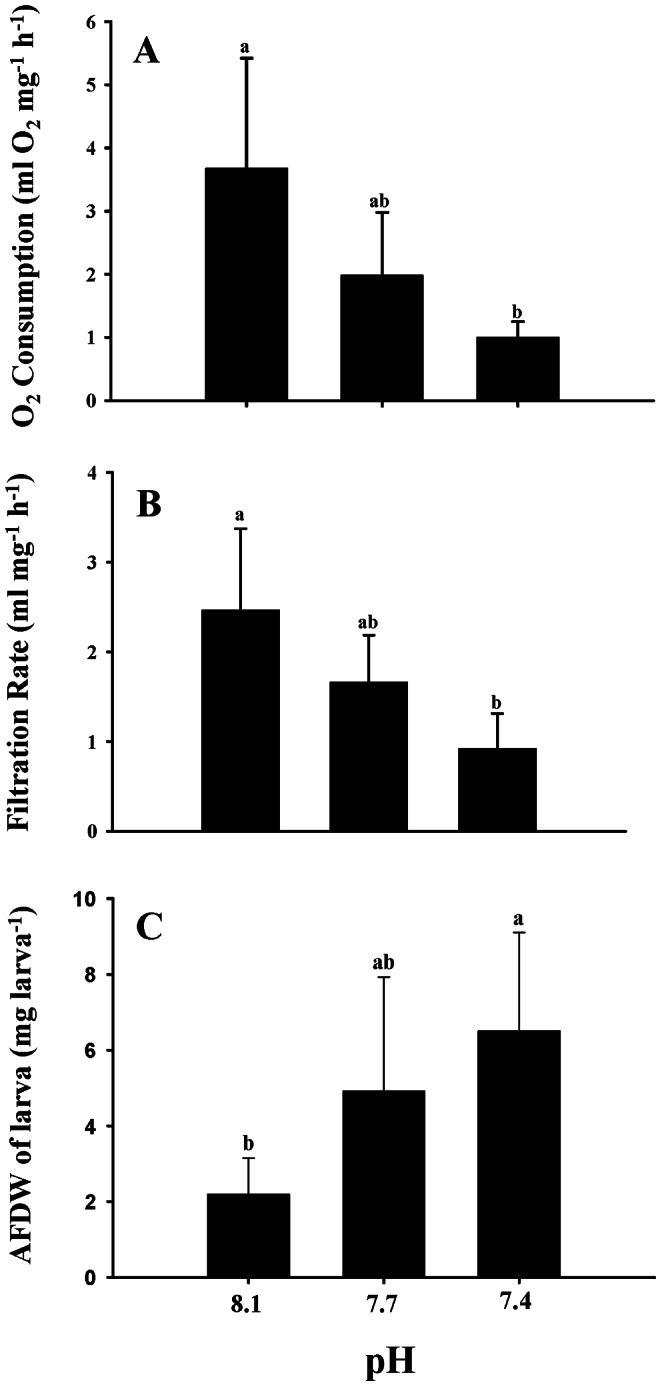
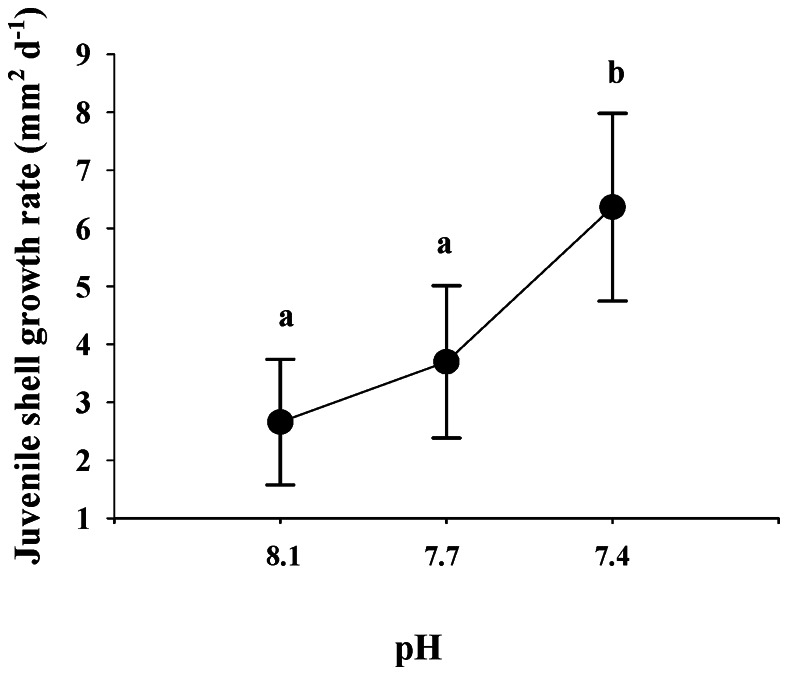
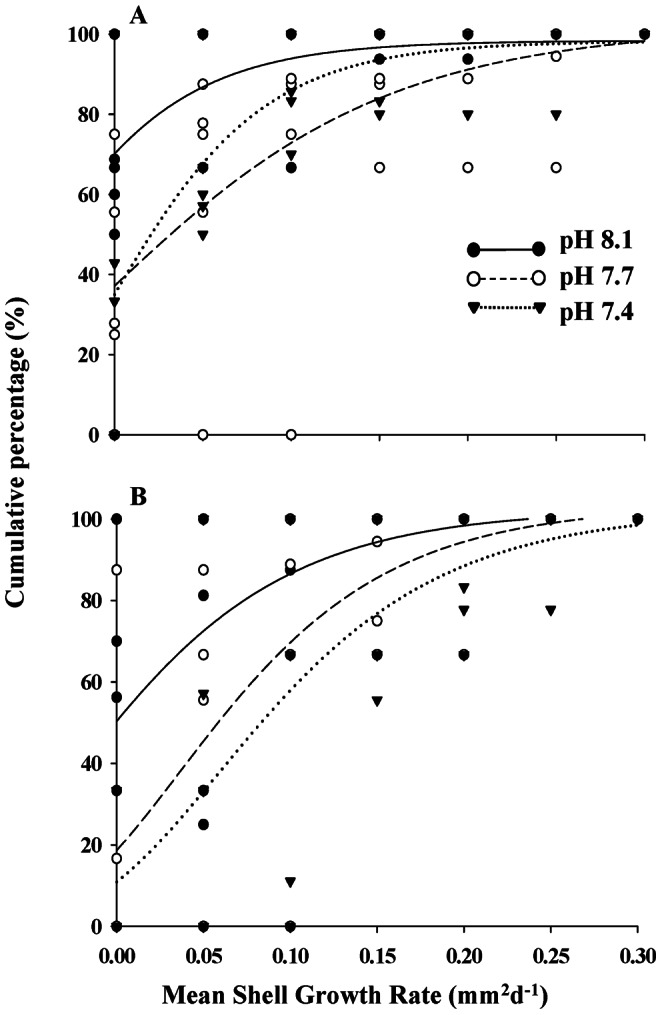
The average pH of surface oceans has decreased by 0.1 unit since industrialization and is expected to decrease by another 0.3-0.7 units before the year 2300 due to the absorption of anthropogenic CO2. This human-caused pH change is posing serious threats and challenges to the Pacific oyster (Crassostrea gigas), especially to their larval stages. Our knowledge of the effect of reduced pH on C. gigas larvae presently relies presumptively on four short-term (<4 days) survival and growth studies. Using multiple physiological measurements and life stages, the effects of long-term (40 days) exposure to pH 8.1, 7.7 and 7.4 on larval shell growth, metamorphosis, respiration and filtration rates at the time of metamorphosis, along with the juvenile shell growth and structure of the C. gigas, were examined in this study. The mean survival and growth rates were not affected by pH. The metabolic, feeding and metamorphosis rates of pediveliger larvae were similar, between pH 8.1 and 7.7. The pediveligers at pH 7.4 showed reduced weight-specific metabolic and filtration rates, yet were able to sustain a more rapid post-settlement growth rate. However, no evidence suggested that low pH treatments resulted in alterations to the shell ultrastructures (SEM images) or elemental compositions (i.e., Mg/Ca and Sr/Ca ratios). Thus, larval and post-larval forms of the C. gigas in the Yellow Sea are probably resistant to elevated CO2 and decreased near-future pH scenarios. The pre-adapted ability to resist a wide range of decreased pH may provide C. gigas with the necessary tolerance to withstand rapid pH changes over the coming century.
自工业化以来,表层海水的平均 pH 值已经下降了 0.1 个单位,预计到 2300 年,由于人为 CO2 的吸收,pH 值还将再下降 0.3-0.7 个单位。这种人为的 pH 值变化对太平洋牡蛎(Crassostrea gigas)构成了严重的威胁和挑战,尤其是对其幼虫阶段。目前,我们对降低 pH 值对 C. gigas 幼虫的影响的认识主要依赖于四项短期(<4 天)生存和生长研究。本研究使用多种生理测量和生命阶段,研究了长期(40 天)暴露于 pH8.1、7.7 和 7.4 对幼虫壳生长、变态、变态时呼吸和过滤率以及幼体壳生长和结构的影响。在 pH8.1 和 7.7 之间,幼虫的平均存活率和生长率不受 pH 值的影响。在 pH7.4 时,幼体的代谢、摄食和变态率与 pH8.1 相似。但在 pH7.4 时,稚贝的比代谢率和过滤率降低,但能维持更快的变态后生长率。然而,没有证据表明低 pH 值处理会导致贝壳超微结构(SEM 图像)或元素组成(即 Mg/Ca 和 Sr/Ca 比值)发生变化。因此,黄海的 C. gigas 幼虫和幼体可能对高 CO2 和未来近海水体 pH 值下降具有抗性。对广泛降低 pH 值的适应能力可能为 C. gigas 提供了耐受未来一个世纪快速 pH 值变化的必要耐受性。