Arthritis Research UK Primary Care Centre, Keele University, UK.
Pain. 2013 Sep;154(9):1783-1791. doi: 10.1016/j.pain.2013.05.035. Epub 2013 May 29.
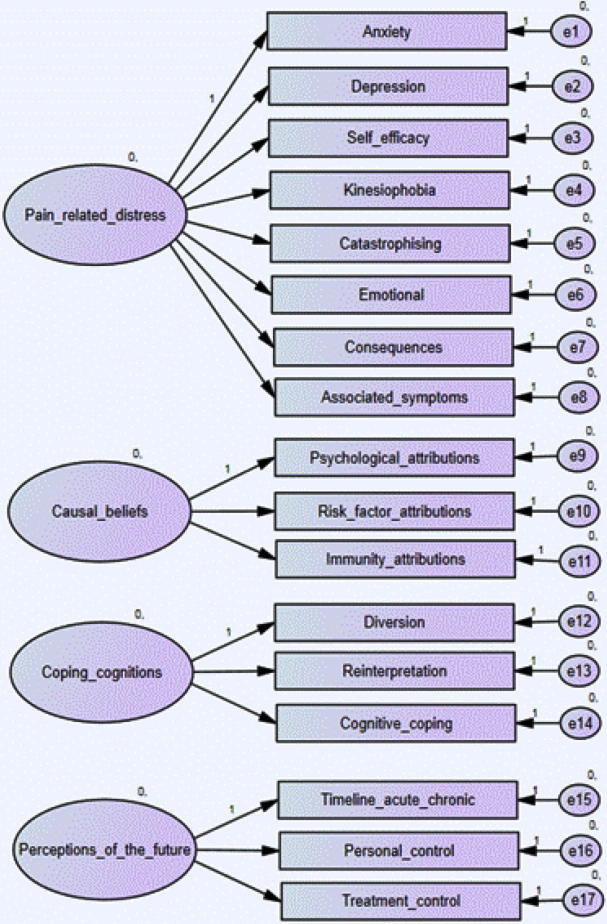
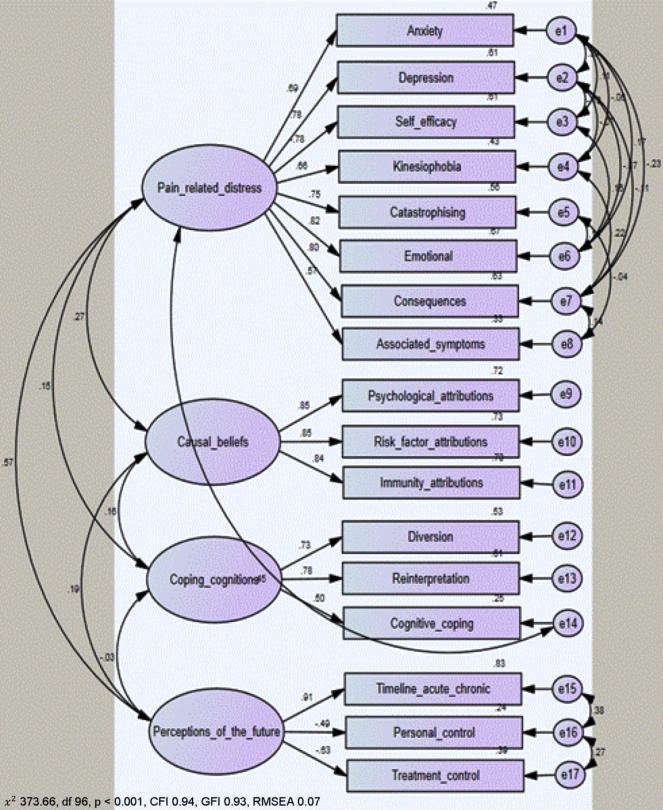
The biopsychosocial model is increasingly accepted in low back pain (LBP) research and clinical practice. In order to assess the role of psychological factors in the development and persistence of pain, a wide array of measures has been developed. Yet there is likely to be considerable conceptual overlap between such measures, and consequently, a lack of clarity about the importance of psychological factors. The aims of this study were to investigate the extent of any such overlap. An observational cohort study of 1591 LBP patients consulting in primary care completed data on a range of psychological instruments. Exploratory and confirmatory factor analyses (EFA and CFA, respectively) were carried out at the subscale level (n=20) to investigate factor structure. The influences of the derived factors on clinical outcomes (pain intensity and self-reported disability) were then tested using linear regression. EFA yielded 4 factors, termed "Pain-related distress," "Cognitive coping," "Causal beliefs," and "Perceptions of the future," which accounted for 65.5% of the variance. CFA confirmed the validity of these factors models. The pain-related distress factor was found to have the strongest association to LBP patients' outcomes, accounting for 34.6% of the variance in pain intensity, and 51.1% of the variance in disability. Results confirmed that considerable overlap exists in psychological measures commonly used in LBP research. Most measures tap into patients' emotional distress. These findings help us to understand how psychological constructs relate together; implications for future research and clinical practice are discussed.
生物心理社会模式在腰痛(LBP)研究和临床实践中越来越被接受。为了评估心理因素在疼痛的发展和持续中的作用,已经开发了广泛的测量方法。然而,这些测量方法之间可能存在相当大的概念重叠,因此,对于心理因素的重要性缺乏明确性。本研究的目的是调查这种重叠的程度。对在初级保健中就诊的 1591 名腰痛患者进行了观察性队列研究,完成了一系列心理工具的相关数据。在子量表水平(n=20)进行了探索性和验证性因素分析(EFA 和 CFA),以研究因素结构。然后使用线性回归测试了衍生因素对临床结果(疼痛强度和自我报告的残疾)的影响。EFA 产生了 4 个因素,分别称为“与疼痛相关的痛苦”、“认知应对”、“因果信念”和“对未来的看法”,它们解释了 65.5%的方差。CFA 证实了这些因素模型的有效性。与疼痛相关的痛苦因素与 LBP 患者的结果相关性最强,解释了疼痛强度方差的 34.6%,残疾方差的 51.1%。研究结果证实,在腰痛研究中常用的心理测量方法之间存在相当大的重叠。大多数测量方法都涉及到患者的情绪困扰。这些发现有助于我们了解心理结构之间的关系;讨论了对未来研究和临床实践的影响。