Lin David Pei-Cheng, Chang Han-Hsin, Yang Li-Chien, Huang Tzu-Ping, Liu Hsiang-Jui, Chang Lin-Song, Lin Chien-Hsun, Chen Bo-Yie
School of Medical Laboratory and Biotechnology, Chung Shan Medical University, Taichung, Taiwan, ROC.
Mol Vis. 2013 May 29;19:1158-68. Print 2013.
Weekly disposable soft contact lenses have been widely used recently, but their shield effects against ultraviolet (UV) irradiation remain to be evaluated. This study investigated the bioprotective effects of several weekly soft contact lenses against UVB irradiation on the corneal surface in a mouse model.
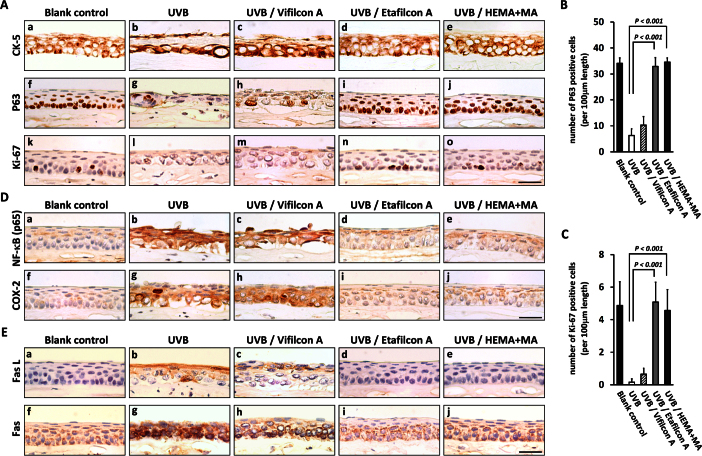
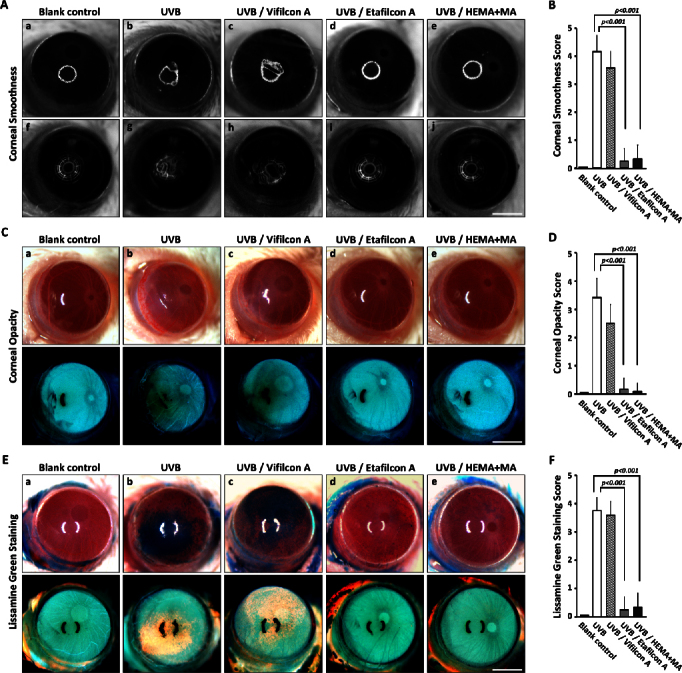
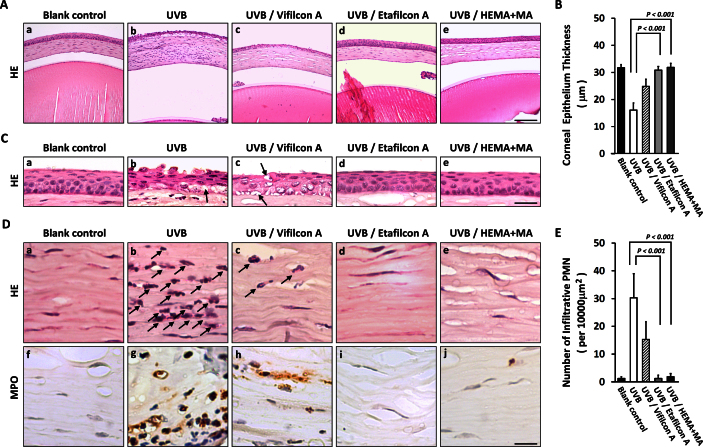
Fifty ICR mice were randomly divided into five groups: (1) blank control, (2) exposed to UVB without contact lens protection, (3) exposed to UVB and protected with Vifilcon A contact lenses, (4) exposed to UVB and protected with Etafilcon A contact lenses, and (5) exposed to UVB and protected with HEMA+MA contact lenses. The exposure to UVB irradiation was performed at 0.72 J/cm²)/day after anesthesia for a 7-day period, followed by cornea surface assessment for smoothness, opacity, and grading of lissamine green staining. Tissue sections were prepared for hematoxylin and eosin staining and immunohistochemical detection by using antibodies against myeloperoxidase, cytokeratin-5, P63, Ki-67, nuclear factor-kappa B (p65), cyclooxygenase-2, Fas L, and Fas.
The results showed impaired corneal surface with myeloperoxidase+ polymorphonuclear leukocyte infiltration into the stroma after UVB exposure, in contrast to the intact status of the blank controls. The corneas with Etafilcon A and HEMA+MA contact lenses maintained more cells positive for cytokeratin-5, P63, and Ki-67 compared to those with Vifilcon A or without contact lens protection. Furthermore, less proinflammatory factors, including nuclear factor-kappa (p65), cyclooxygenase-2, Fas L, and Fas, were induced in the corneas protected by Etafilcon A and HEMA+MA.
This study demonstrated various protective effects of weekly disposable contact lenses against UVB irradiation. The mouse model used in the present study may be used extensively for in vivo assessment of UV shield efficacy.
每周更换的一次性软性隐形眼镜近来已被广泛使用,但其对紫外线(UV)照射的防护效果仍有待评估。本研究在小鼠模型中调查了几种每周更换的软性隐形眼镜对角膜表面UVB照射的生物保护作用。
将50只ICR小鼠随机分为五组:(1)空白对照组;(2)暴露于UVB且无隐形眼镜保护;(3)暴露于UVB并用维氟康A隐形眼镜保护;(4)暴露于UVB并用依他氟康A隐形眼镜保护;(5)暴露于UVB并用甲基丙烯酸羟乙酯+甲基丙烯酸隐形眼镜保护。麻醉后,以0.72 J/cm²/天的剂量进行为期7天的UVB照射,随后评估角膜表面的光滑度、浑浊度以及丽丝胺绿染色分级。制备组织切片用于苏木精和伊红染色以及使用抗髓过氧化物酶、细胞角蛋白-5、P63、Ki-67、核因子-κB(p65)、环氧化酶-2、Fas配体和Fas的抗体进行免疫组织化学检测。
结果显示,与空白对照组的完整状态相比,UVB照射后角膜表面受损,有髓过氧化物酶阳性的多形核白细胞浸润到基质中。与使用维氟康A隐形眼镜或无隐形眼镜保护的角膜相比,使用依他氟康A和甲基丙烯酸羟乙酯+甲基丙烯酸隐形眼镜的角膜中细胞角蛋白-5、P63和Ki-67阳性的细胞更多。此外,在依他氟康A和甲基丙烯酸羟乙酯+甲基丙烯酸保护的角膜中,诱导产生的促炎因子(包括核因子-κB(p65)、环氧化酶-2、Fas配体和Fas)更少。
本研究证明了每周更换的一次性隐形眼镜对UVB照射具有多种保护作用。本研究中使用的小鼠模型可广泛用于体内紫外线防护效果评估。