School of Public Health, Li Ka Shing Faculty of Medicine, The University of Hong Kong, Hong Kong Special Administrative Region, Hong Kong, China.
Nat Commun. 2013;4:1935. doi: 10.1038/ncomms2922.
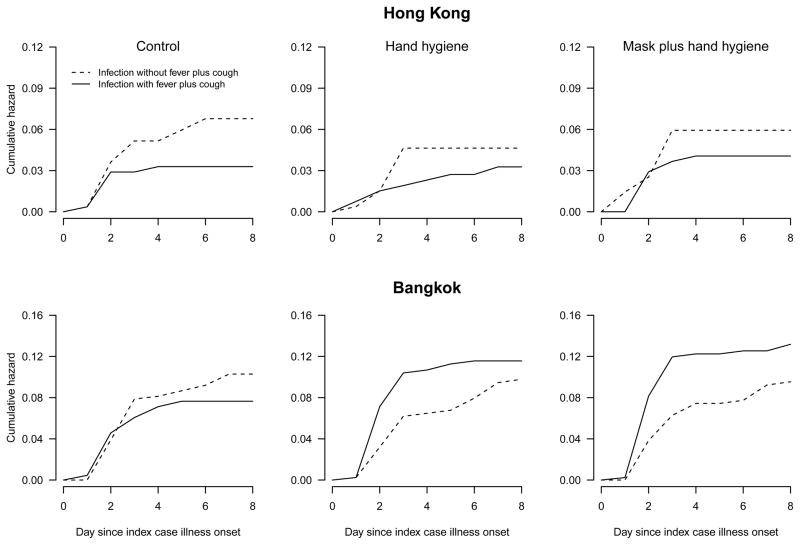
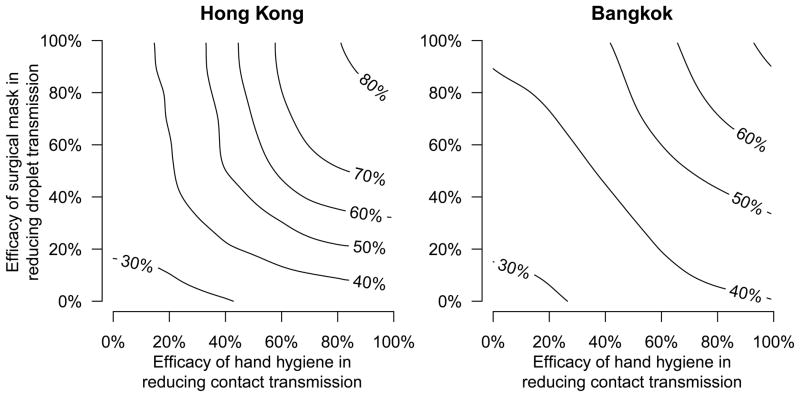
Influenza A viruses are believed to spread between humans through contact, large respiratory droplets and small particle droplet nuclei (aerosols), but the relative importance of each of these modes of transmission is unclear. Volunteer studies suggest that infections via aerosol transmission may have a higher risk of febrile illness. Here we apply a mathematical model to data from randomized controlled trials of hand hygiene and surgical face masks in Hong Kong and Bangkok households. In these particular environments, inferences on the relative importance of modes of transmission are facilitated by information on the timing of secondary infections and apparent differences in clinical presentation of secondary infections resulting from aerosol transmission. We find that aerosol transmission accounts for approximately half of all transmission events. This implies that measures to reduce transmission by contact or large droplets may not be sufficient to control influenza A virus transmission in households.
据信,甲型流感病毒通过接触、大呼吸道飞沫和小颗粒飞沫核(气溶胶)在人与人之间传播,但这些传播方式的相对重要性尚不清楚。志愿者研究表明,通过气溶胶传播的感染可能有更高的发热疾病风险。在这里,我们应用一个数学模型来分析香港和曼谷家庭中手部卫生和手术口罩的随机对照试验数据。在这些特定环境中,通过对继发感染的时间以及由于气溶胶传播导致的继发感染临床表现明显差异的信息,可以对传播方式的相对重要性进行推断。我们发现,气溶胶传播约占所有传播事件的一半。这意味着减少接触或大飞沫传播的措施可能不足以控制家庭中的甲型流感病毒传播。