Makerere University-Johns Hopkins University Clinical Core Laboratory at Infectious Diseases Institute, Kampala Uganda.
PLoS One. 2013 May 30;8(5):e64661. doi: 10.1371/journal.pone.0064661. Print 2013.
Clinical laboratories are crucial in addressing the high rates of communicable and non-communicable diseases seen in sub-Saharan Africa (SSA). However, the most basic information, such as the number and quality of clinical laboratories in SSA, is not available. The objective of this study was to create a practical method for obtaining this information in SSA towns and cities using an initial survey in Kampala, Uganda.
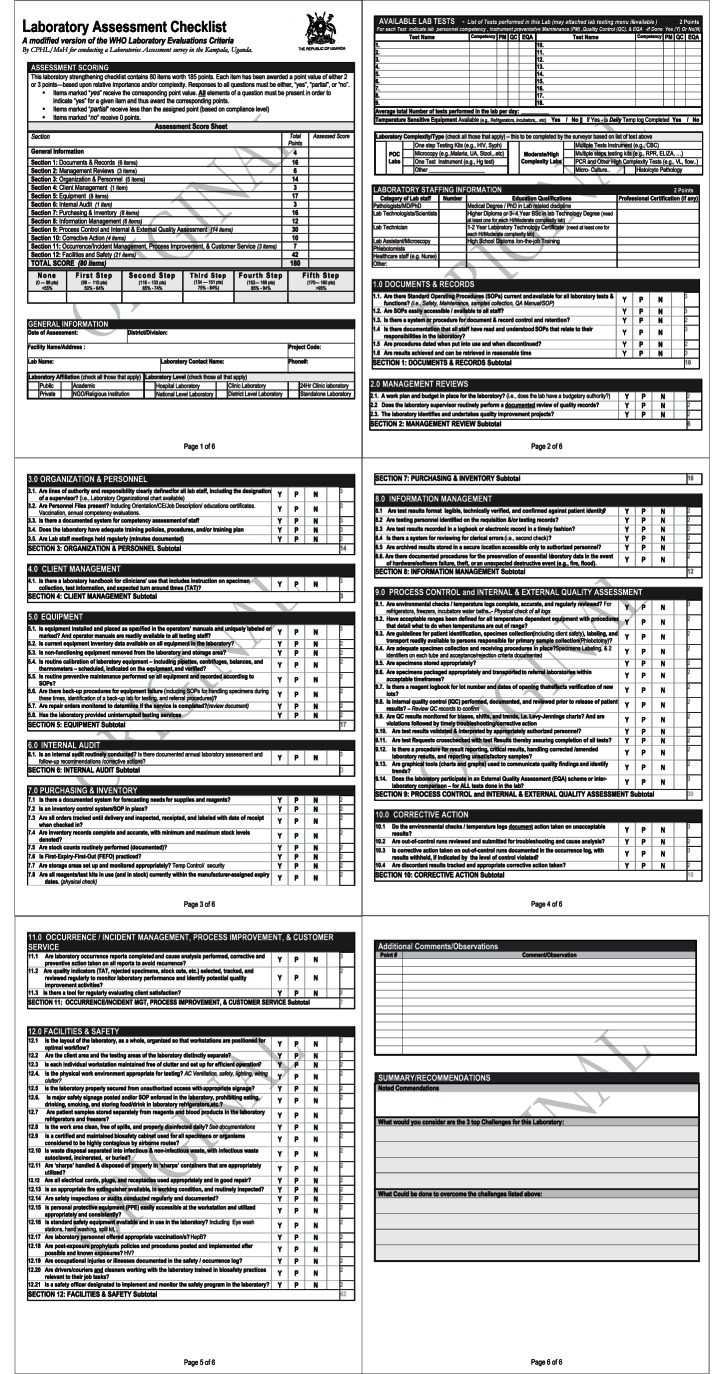
Kampala city was divided into 5 partially-overlapping regions. Each region was assigned to 2-3 surveyors who identified and surveyed laboratories in their respective regions; in person and on foot. A modified version of the World Health Organization - African Region (WHO/AFRO) Laboratory Strengthening Checklist was used to obtain baseline measures of quality for all clinical laboratories within Kampala city. The surveyors also measured other attributes of each laboratory, such as their affiliation (government, private etc), designation (national hospital, district hospital, standalone etc), staff numbers, and type of staff.
The survey team identified and surveyed 954 laboratories in Kampala city. 96% of laboratories were private. Only 45 (5%) of the laboratories met or surpassed the lowest quality standards defined by the WHO/AFRO-derived laboratory strengthening tool (1-star). These 45 higher-quality laboratories were, on average, larger and had a higher number of laboratory-specific staff (technologists, phlebotomists etc) than the other 909 laboratories. 688 (72%) of the 954 laboratories were not registered with the Ministry of Health (MoH).
This comprehensive evaluation of the number, scope, and quality of clinical laboratories in Kampala is the first published survey of its kind in sub-Saharan Africa. The survey findings demonstrated that laboratories in Kampala that had qualified personnel and those that had higher testing volumes, tended to be of higher-quality.
临床实验室在解决撒哈拉以南非洲(SSA)高发的传染病和非传染性疾病方面至关重要。然而,最基本的信息,如 SSA 临床实验室的数量和质量,尚不可用。本研究的目的是创建一种实用的方法,通过在乌干达坎帕拉的初步调查,在 SSA 城镇获取这些信息。
坎帕拉市被划分为 5 个部分重叠的区域。每个区域都分配给 2-3 名调查员,他们在各自的区域内通过个人和步行的方式识别和调查实验室。使用世界卫生组织-非洲区域(WHO/AFRO)实验室强化清单的修改版,获得坎帕拉市所有临床实验室的质量基线测量值。调查员还测量了每个实验室的其他属性,如隶属关系(政府、私营等)、指定(国家医院、地区医院、独立等)、员工人数和员工类型。
调查小组在坎帕拉市共识别并调查了 954 家实验室。96%的实验室为私营。仅有 45 家(5%)实验室达到或超过世卫组织/非洲区域实验室强化工具(1 星级)定义的最低质量标准。这些 45 家较高质量的实验室平均规模较大,且具有更高比例的实验室特定工作人员(技术员、采血员等),而其他 909 家实验室则没有。954 家实验室中有 688 家(72%)未在卫生部(MoH)注册。
这是对坎帕拉临床实验室数量、范围和质量的全面评估,是撒哈拉以南非洲首例此类调查。调查结果表明,具有合格人员和更高检测量的坎帕拉实验室往往质量更高。