Faculdade de Medicina de Lisboa, Hospital de Santa Maria, Clínica Dermatologica Universitaria, Avenida Professor Egas Moniz, 1699 Lisboa Codex, Portugal.
Oxid Med Cell Longev. 2013;2013:285825. doi: 10.1155/2013/285825. Epub 2013 Apr 23.
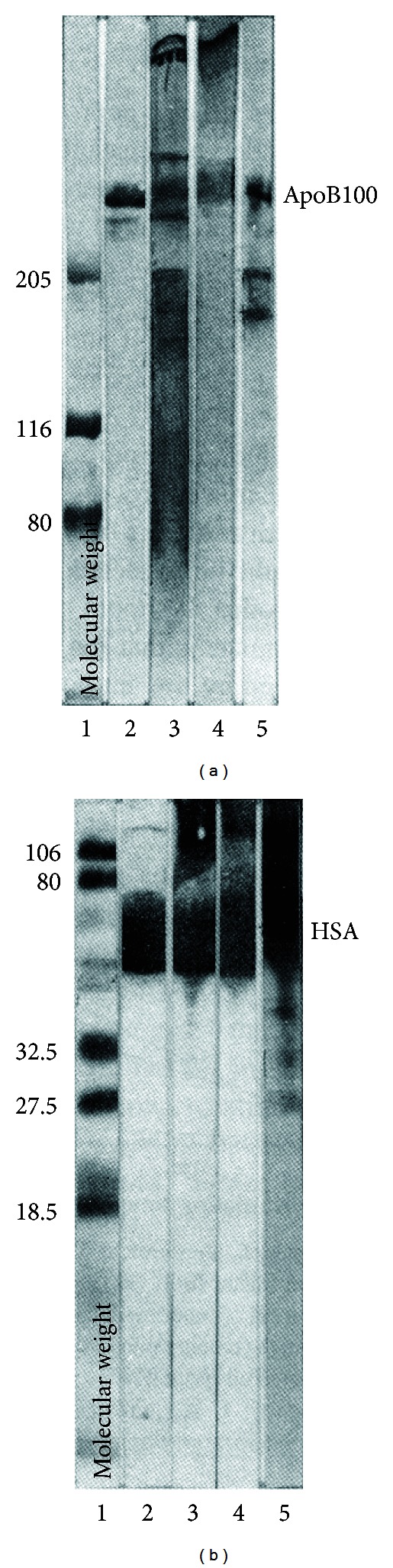
There are numerous studies concerning the effect of UVB light on skin cells but fewer on other skin components such as the interstitial fluid. This review highlights high-density lipoprotein (HDL) and low-density lipoprotein (LDL) as important targets of UVB in interstitial fluid. Tryptophan residues are the sole apolipoprotein residues absorbing solar UVB. The UVB-induced one-electron oxidation of Trp produces (•)Trp and (•)O2 (-) radicals which trigger lipid peroxidation. Immunoblots from buffered solutions or suction blister fluid reveal that propagation of photooxidative damage to other residues such as Tyr or disulfide bonds produces intra- and intermolecular bonds in apolipoproteins A-I, A-II, and B100. Partial repair of phenoxyl tyrosyl radicals (TyrO(•)) by α -tocopherol is observed with LDL and HDL on millisecond or second time scales, whereas limited repair of α -tocopherol by carotenoids occurs in only HDL. More effective repair of Tyr and α -tocopherol is observed with the flavonoid, quercetin, bound to serum albumin, but quercetin is less potent than new synthetic polyphenols in inhibiting LDL lipid peroxidation or restoring α -tocopherol. The systemic consequences of HDL and LDL oxidation and the activation and/or inhibition of signalling pathways by oxidized LDL and their ability to enhance transcription factor DNA binding activity are also reviewed.
有许多关于中波紫外线(UVB)对皮肤细胞影响的研究,但对其他皮肤成分(如间质液)的研究较少。这篇综述强调了高密度脂蛋白(HDL)和低密度脂蛋白(LDL)作为间质液中 UVB 的重要靶标。色氨酸残基是唯一吸收太阳 UVB 的载脂蛋白残基。UVB 诱导的色氨酸单电子氧化产生(•)Trp 和(•)O2(-)自由基,引发脂质过氧化。从缓冲溶液或抽吸水疱液中的免疫印迹揭示了其他残基(如 Tyr 或二硫键)的光氧化损伤的传播会在载脂蛋白 A-I、A-II 和 B100 中产生分子内和分子间键。在毫秒或秒的时间尺度上,用 LDL 和 HDL 观察到对苯氧自由基(TyrO(•))的α -生育酚的部分修复,但类胡萝卜素对α -生育酚的有限修复仅在 HDL 中发生。与游离的α -生育酚相比,与血清白蛋白结合的类黄酮槲皮素对 Tyr 和α -生育酚的修复更有效,但槲皮素在抑制 LDL 脂质过氧化或恢复α -生育酚方面的效力不如新合成的多酚。还综述了 HDL 和 LDL 氧化的系统后果,以及氧化 LDL 激活和/或抑制信号通路的能力及其增强转录因子 DNA 结合活性的能力。