Herman Cila
Department of Mechanical Engineering, The Johns Hopkins University, Baltimore, MD, USA.
Expert Rev Dermatol. 2013 Apr 1;8(2):177-184. doi: 10.1586/edm.13.15.
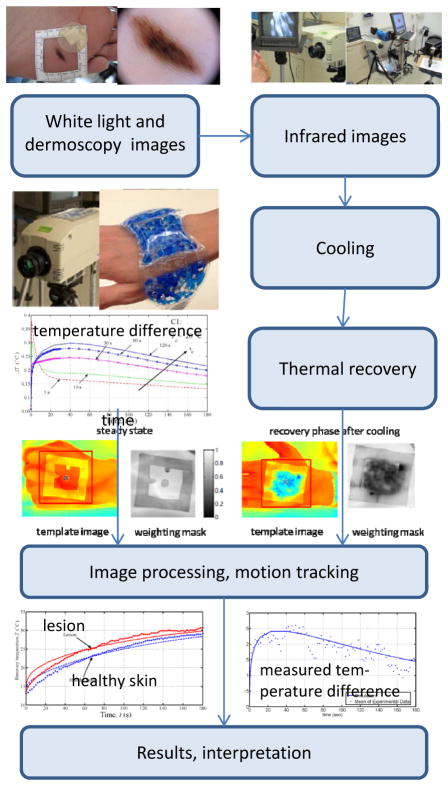
Melanoma incidence and the lifetime risk are increasing at an alarming rate in the United States and worldwide. In order to improve survival rates, the goal is to detect melanoma at an early stage of the disease. Accurate, sensitive and reliable quantitative diagnostic tools can reduce the number of unnecessary biopsies, the associated morbidity as well as the costs of care in addition to improving survival rates. The recently introduced quantitative dynamic infrared imaging system QUAINT measures differences in the infrared emission between healthy tissue and the lesion during the thermal recovery process after the removal of a cooling stress. Results from a clinical study suggest that the temperature of cancerous lesions is higher during the first 45-60 seconds of thermal recovery than the temperature of benign pigmented lesions. This small temperature difference can be measured by modern infrared cameras and serve as an indicator for melanoma in modern quantitative melanoma detectors.
在美国和全球范围内,黑色素瘤的发病率和终生风险正以惊人的速度上升。为了提高生存率,目标是在疾病的早期阶段检测出黑色素瘤。准确、灵敏且可靠的定量诊断工具除了能提高生存率外,还可减少不必要的活检数量、相关的发病率以及护理成本。最近推出的定量动态红外成像系统QUAINT可测量在去除冷却应激后的热恢复过程中,健康组织与病变部位之间红外发射的差异。一项临床研究结果表明,在热恢复的最初45至60秒内,癌性病变的温度高于良性色素沉着病变的温度。这种微小的温度差异可以通过现代红外相机测量,并作为现代定量黑色素瘤探测器中黑色素瘤的一个指标。