School of Psychological Sciences, The University of Manchester, Manchester, M13 9PL, UK,
J Assoc Res Otolaryngol. 2013 Oct;14(5):757-66. doi: 10.1007/s10162-013-0402-3. Epub 2013 Jun 13.
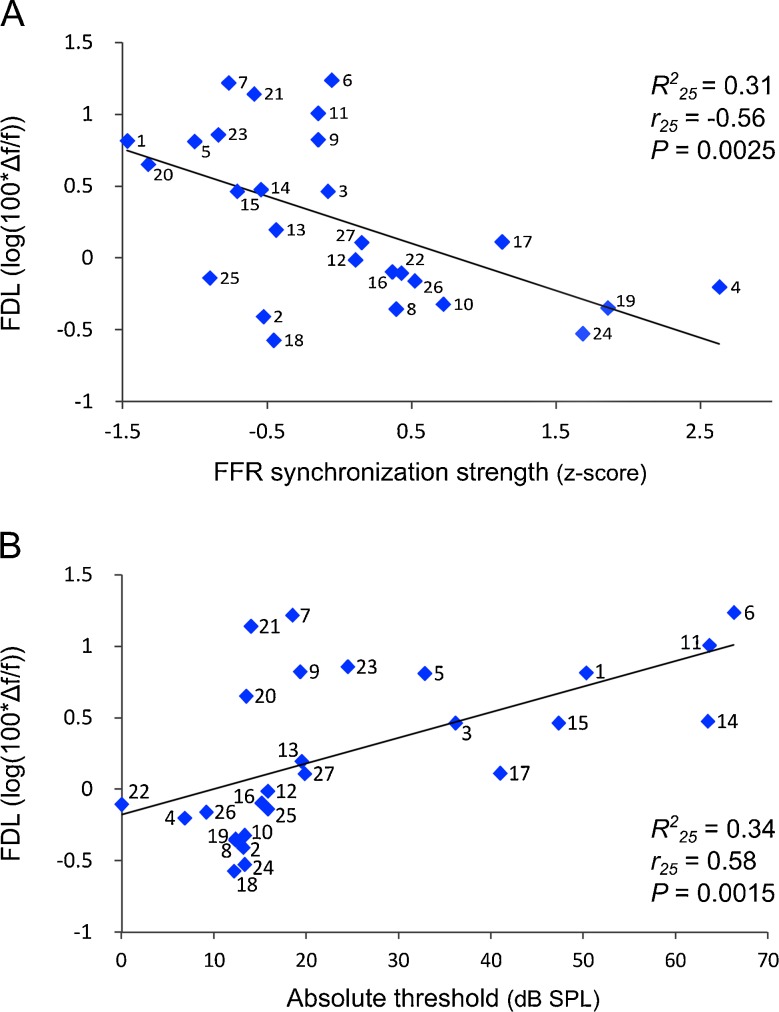
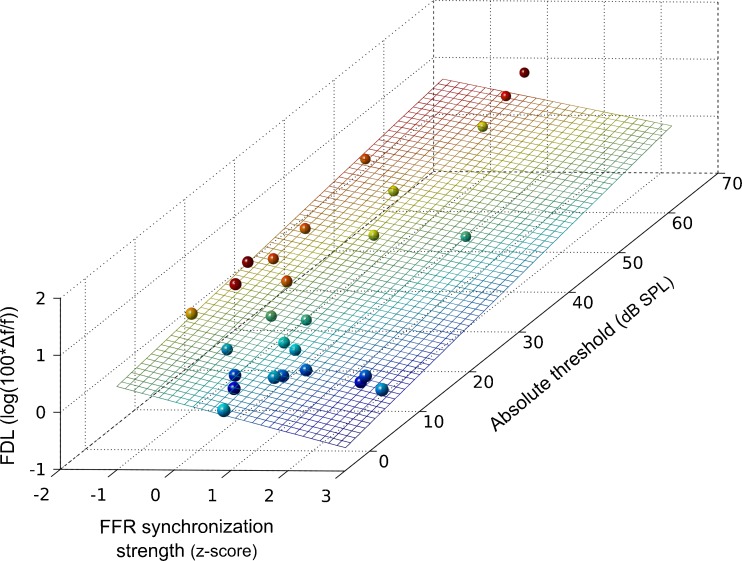
The neural mechanisms of pitch coding have been debated for more than a century. The two main mechanisms are coding based on the profiles of neural firing rates across auditory nerve fibers with different characteristic frequencies (place-rate coding), and coding based on the phase-locked temporal pattern of neural firing (temporal coding). Phase locking precision can be partly assessed by recording the frequency-following response (FFR), a scalp-recorded electrophysiological response that reflects synchronous activity in subcortical neurons. Although features of the FFR have been widely used as indices of pitch coding acuity, only a handful of studies have directly investigated the relation between the FFR and behavioral pitch judgments. Furthermore, the contribution of degraded neural synchrony (as indexed by the FFR) to the pitch perception impairments of older listeners and those with hearing loss is not well known. Here, the relation between the FFR and pure-tone frequency discrimination was investigated in listeners with a wide range of ages and absolute thresholds, to assess the respective contributions of subcortical neural synchrony and other age-related and hearing loss-related mechanisms to frequency discrimination performance. FFR measures of neural synchrony and absolute thresholds independently contributed to frequency discrimination performance. Age alone, i.e., once the effect of subcortical neural synchrony measures or absolute thresholds had been partialed out, did not contribute to frequency discrimination. Overall, the results suggest that frequency discrimination of pure tones may depend both on phase locking precision and on separate mechanisms affected in hearing loss.
音调编码的神经机制已经争论了一个多世纪。两种主要的机制是基于具有不同特征频率的听神经纤维的神经放电率分布进行编码(位置率编码),以及基于神经放电的锁相时变模式进行编码(时间编码)。相位锁定精度可以通过记录频率跟随反应(FFR)来部分评估,FFR 是一种头皮记录的电生理反应,反映了皮质下神经元的同步活动。尽管 FFR 的特征已被广泛用作音调编码锐度的指标,但只有少数研究直接调查了 FFR 与行为音调判断之间的关系。此外,神经同步(如 FFR 所表示)对老年听众和听力损失者的音调感知障碍的贡献尚不清楚。在这里,研究了具有广泛年龄和绝对听阈的听众中 FFR 与纯音频率辨别之间的关系,以评估皮质下神经同步和其他与年龄相关和听力损失相关的机制对频率辨别性能的各自贡献。神经同步的 FFR 测量值和绝对阈值独立地影响频率辨别性能。仅年龄(即,一旦部分考虑了皮质下神经同步测量值或绝对阈值的影响)对频率辨别没有贡献。总的来说,结果表明,纯音的频率辨别可能既取决于锁相精度,也取决于听力损失中受影响的单独机制。