CNRS, Department of Genetics, Genomics and Microbiology, University of Strasbourg, UMR 7156, 28, rue Goethe, Strasbourg, 67083, France.
BMC Genomics. 2013 Jun 14;14:399. doi: 10.1186/1471-2164-14-399.
In the model organism Saccharomyces cerevisiae, the transposable elements (TEs) consist of LTR (Long Terminal Repeat) retrotransposons called Ty elements belonging to five families, Ty1 to Ty5. They take the form of either full-length coding elements or non-coding solo-LTRs corresponding to remnants of former transposition events. Although the biological features of Ty elements have been studied in detail in S. cerevisiae and the Ty content of the reference strain (S288c) was accurately annotated, the Ty-related intra-specific diversity has not been closely investigated so far.
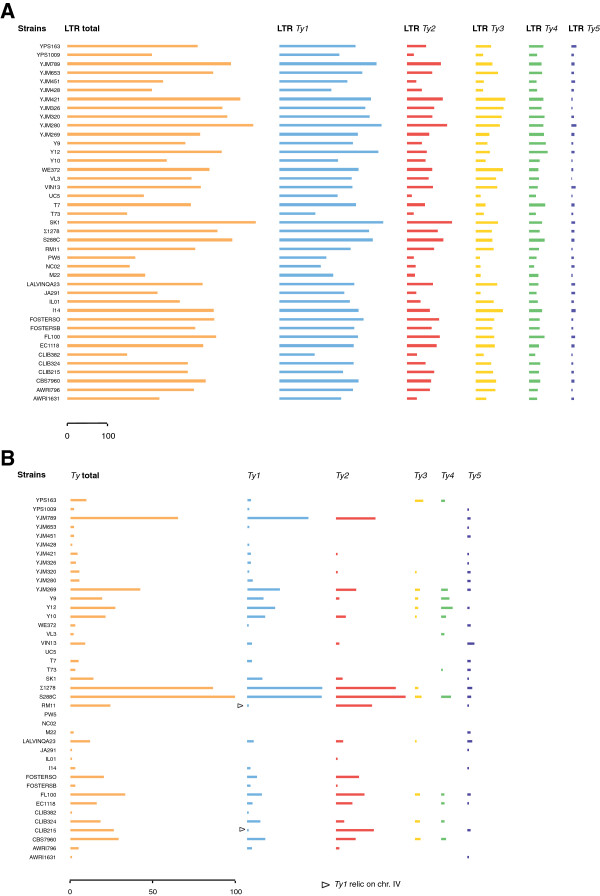
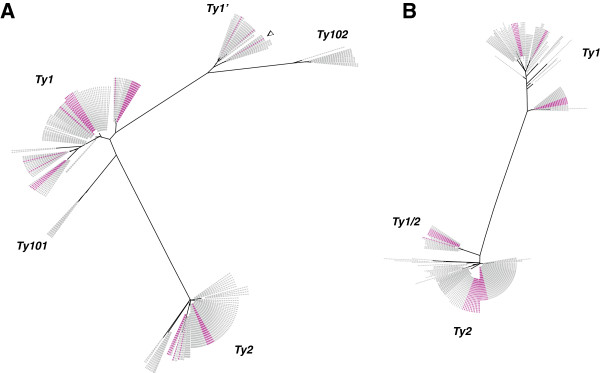
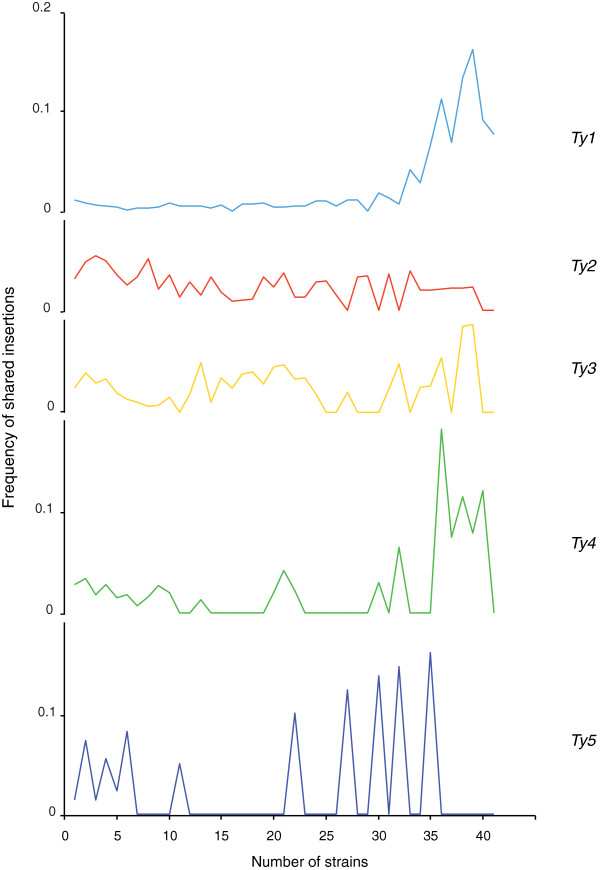
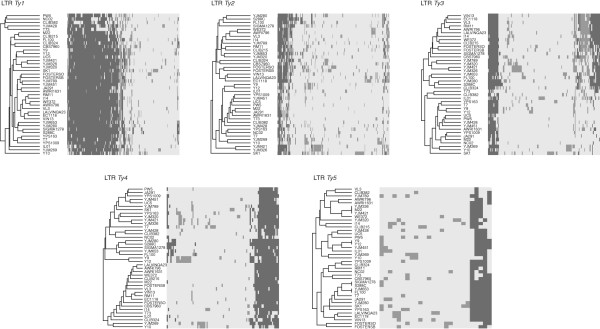
In this study, we investigated the Ty contents of 41 available genomes of isolated S. cerevisiae strains of diverse geographical and ecological origins. The strains were compared in terms of the number of Ty copies, the content of the potential transpositionally active elements and the genomic insertion maps. The strain repertoires were also investigated in the closely related Ty1 and Ty2 families and subfamilies.
This is the first genome-wide analysis of the diversity associated to the Ty elements, carried out for a large set of S. cerevisiae strains. The results of the present analyses suggest that the current Ty-related polymorphism has resulted from multiple causes such as differences between strains, between Ty families and over time, in the recent transpositional activity of Ty elements. Some new Ty1 variants were also identified, and we have established that Ty1 variants have different patterns of distribution among strains, which further contributes to the strain diversity.
在模式生物酿酒酵母中,转座元件(TEs)由 LTR(长末端重复)反转录转座子组成,称为 Ty 元素,属于五个家族,Ty1 到 Ty5。它们的形式要么是全长编码元件,要么是非编码的 solo-LTR,对应于以前转座事件的残余物。尽管 Ty 元素的生物学特征在酿酒酵母中已经得到了详细的研究,并且参考菌株(S288c)的 Ty 含量已经被准确注释,但迄今为止,Ty 相关的种内多样性尚未被密切研究。
在这项研究中,我们调查了 41 个来自不同地理和生态起源的孤立酿酒酵母菌株的 Ty 含量。这些菌株在 Ty 拷贝数、潜在转座活性元件的含量和基因组插入图谱方面进行了比较。还对密切相关的 Ty1 和 Ty2 家族和亚家族的菌株进行了研究。
这是对大量酿酒酵母菌株的 Ty 元素相关多样性进行的首次全基因组分析。目前分析的结果表明,目前的 Ty 相关多态性是由多种原因造成的,例如菌株之间、Ty 家族之间以及 Ty 元素最近转座活性的时间差异。还鉴定了一些新的 Ty1 变体,我们已经确定 Ty1 变体在菌株中的分布模式不同,这进一步增加了菌株的多样性。