The Program in Cellular and Molecular Medicine, Children's Hospital Boston, Harvard Medical School, Boston, MA 02115, USA.
Immunity. 2013 Jun 27;38(6):1164-75. doi: 10.1016/j.immuni.2013.02.023. Epub 2013 Jun 13.
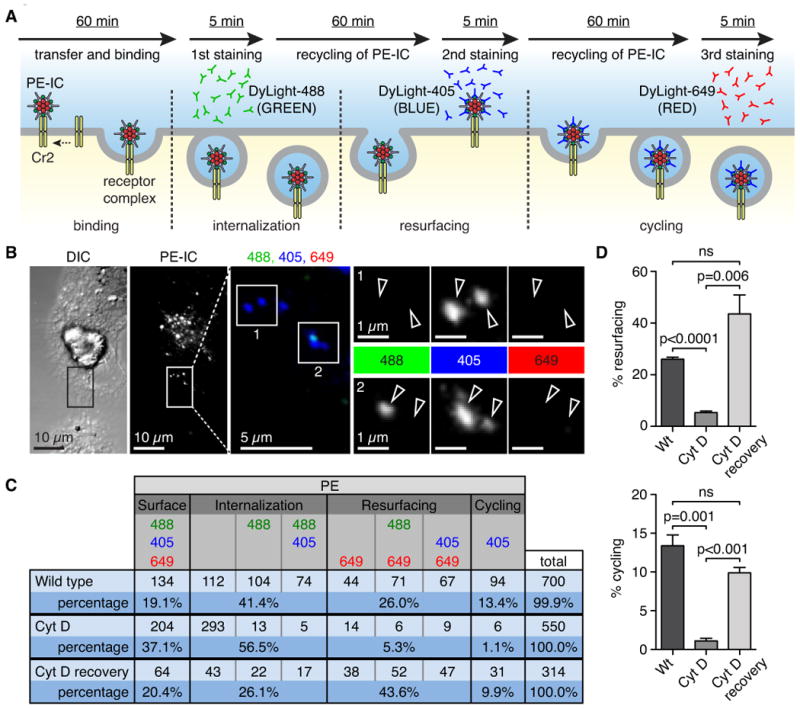
Stromal-derived follicular dendritic cells (FDCs) are a major reservoir for antigen that are essential for formation of germinal centers, the site where memory and effector B cells differentiate. A long-standing question is how FDCs retain antigen in its native form for extended periods and how they display it to specific B cells. Here we found that FDCs acquired complement-coated immune complexes (ICs) from noncognate B cells via complement receptors 1 and 2 (CD35 and CD21, respectively) and rapidly internalized them by an actin-dependent pathway. ICs were retained intact within a nondegradative cycling compartment and were displayed periodically on the cell surface where they were accessible to antigen-specific B cells. This would explain how antigens are protected from damage and retained over long periods of time, while remaining accessible for B cells.
基质衍生的滤泡树突状细胞(FDC)是抗原的主要储存库,对于生发中心的形成至关重要,生发中心是记忆和效应 B 细胞分化的场所。一个长期存在的问题是,FDC 如何以其天然形式长时间保留抗原,以及它们如何将其展示给特定的 B 细胞。在这里,我们发现 FDC 通过补体受体 1 和 2(分别为 CD35 和 CD21)从非同源 B 细胞中获得补体包被的免疫复合物(IC),并通过肌动蛋白依赖性途径迅速将其内化。IC 完整地保留在非降解性循环隔室中,并周期性地在细胞表面表达,在那里它们可被抗原特异性 B 细胞访问。这将解释抗原如何在长时间内受到保护而不被破坏,并保持可及性,以供 B 细胞使用。