Department of Nutrition and Food Hygiene, School of Public Health, Key Laboratory of Public Health Safety, Ministry of Education, Fudan University, 138 Yi Xue Yuan Road, Shanghai 200032, China.
BMC Public Health. 2013 Jun 18;13:590. doi: 10.1186/1471-2458-13-590.
Environmental exposure to cadmium causes renal dysfunction and bone damage. Cadmium contamination in food is regarded as the main environmental source of non-occupational exposure. The aim of this study was to assess the contribution of dietary cadmium exposure in environmental cadmium exposure and its health risk among adults in Shanghai, China.
A cross-sectional survey about food consumption was conducted in 2008 among 207 citizens aged over 40 years in Shanghai, China. The food frequency questionnaire was combined with food, tobacco and water cadmium exposure to estimate the daily environmental cadmium exposure in both point and probabilistic estimations. Urine and blood samples of the participants were analyzed for internal exposure to total cadmium. Correlation analysis was conducted between the internal cadmium exposure and environmental cadmium exposure.
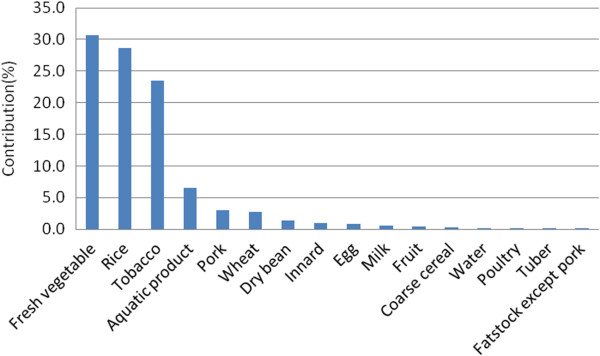
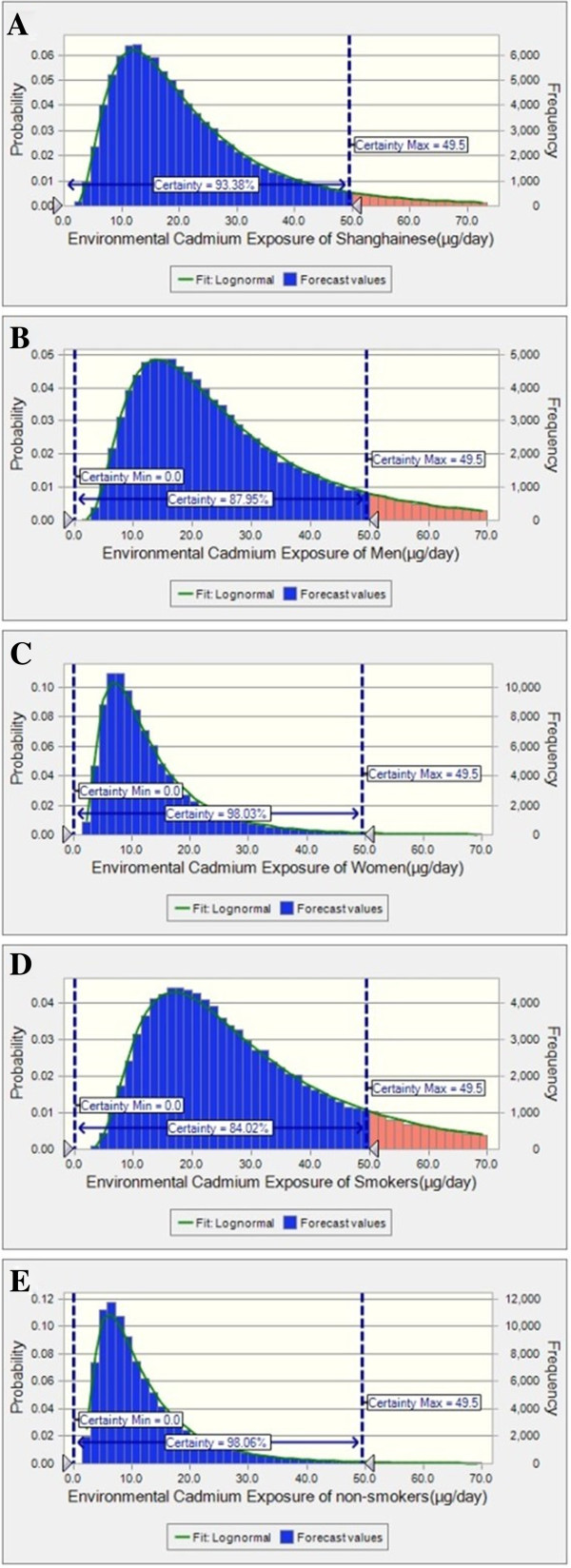
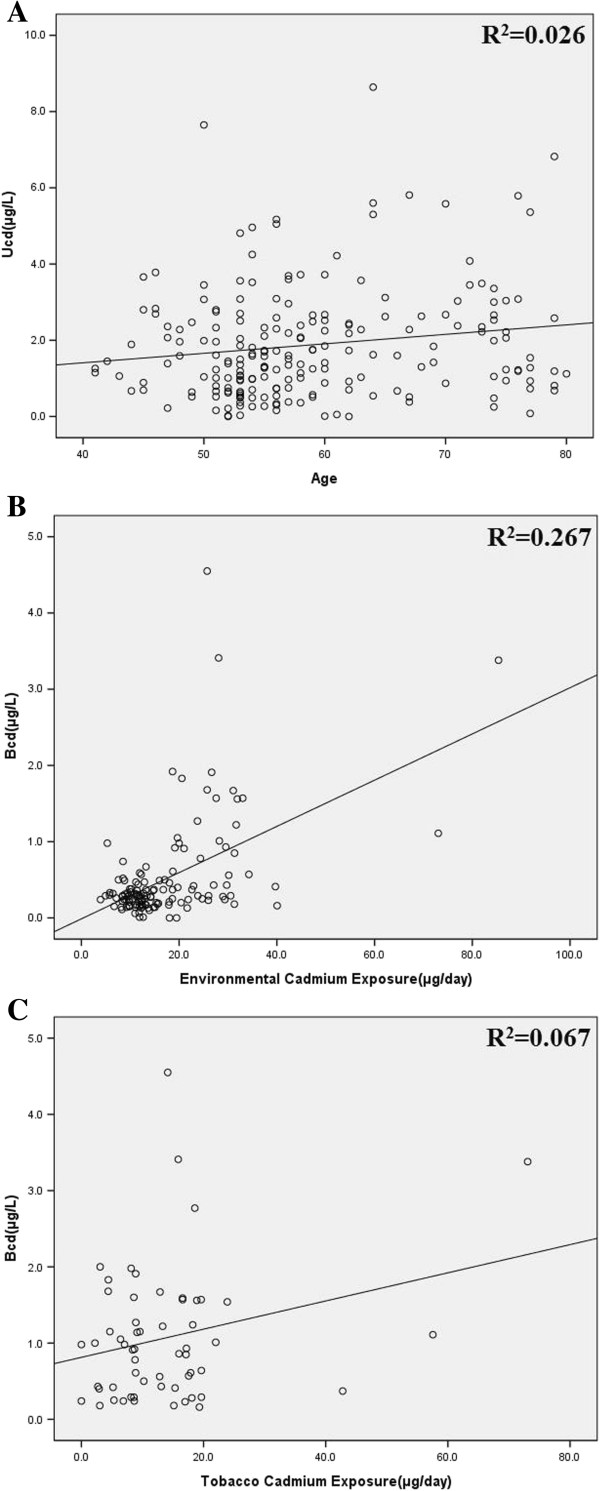
According to the point estimation, average daily environmental cadmium exposure of the participants was 16.7 μg/day and approached 33.8% of the provisional tolerable daily intake (PTDI). Dietary and tobacco cadmium exposure approached 25.8% and 7.9% of the PTDI, respectively. Males had higher levels of dietary cadmium exposure than females (p?=?0.002). The probabilistic model showed that 93.4% of the population did not have any health risks from dietary cadmium exposure. By sensitivity analysis, tobacco consumption, tobacco cadmium level, cadmium in vegetables and cadmium in rice accounted for 27.5%, 24.9%, 20.2% and 14.6% of the total cadmium exposure, respectively. The mean values of urinary and blood cadmium among the study population were 0.5 μg/L and 1.9 μg/L, respectively. Positive correlations were observed between environmental cadmium exposure and blood cadmium (R?=?0.52, P<0.01), tobacco cadmium intake and blood cadmium excluding non-smokers (R?=?0.26, P?=?0.049<0.05), and urine cadmium and age (R?=?0.15, P?=?0.037).
It has been suggested that there is no increased health risk among adult residents in Shanghai, China because of recent total cadmium exposure. Vegetables and rice were the main sources of dietary cadmium intake. Tobacco cadmium exposure, which accounted for approximately 25% of the total dietary cadmium exposure, was another important source of non-occupational cadmium exposure.
环境镉暴露可导致肾功能障碍和骨损伤。食物中的镉污染被认为是职业以外暴露的主要环境来源。本研究旨在评估膳食镉暴露在中国上海成年人环境镉暴露中的作用及其健康风险。
2008 年在中国上海对 207 名 40 岁以上的市民进行了一项关于食物消费的横断面调查。食物频率问卷结合食物、烟草和水镉暴露情况,对点估计和概率估计中的每日环境镉暴露进行了估计。对参与者的尿液和血液样本进行了总镉的体内暴露分析。对体内镉暴露与环境镉暴露之间的相关性进行了分析。
根据点估计,参与者的平均每日环境镉暴露量为 16.7μg/天,接近暂定可耐受每日摄入量(PTDI)的 33.8%。膳食和烟草镉暴露分别接近 PTDI 的 25.8%和 7.9%。男性的膳食镉暴露水平高于女性(p?=?0.002)。概率模型显示,93.4%的人群不存在任何因膳食镉暴露而产生的健康风险。通过敏感性分析,烟草消费、烟草镉水平、蔬菜中的镉和大米中的镉分别占总镉暴露的 27.5%、24.9%、20.2%和 14.6%。研究人群的尿镉和血镉平均值分别为 0.5μg/L 和 1.9μg/L。环境镉暴露与血镉(R?=?0.52,P<0.01)、烟草镉摄入与非吸烟者的血镉(R?=?0.26,P?=?0.049<0.05)以及尿镉与年龄(R?=?0.15,P?=?0.037)呈正相关。
本研究提示,由于最近的总镉暴露,中国上海成年居民不存在健康风险增加的情况。蔬菜和大米是膳食镉摄入的主要来源。烟草镉暴露占膳食镉总暴露量的 25%左右,是职业以外镉暴露的另一个重要来源。