El Hosry Leina, Sok Nicolas, Richa Rosalie, Al Mashtoub Layal, Cayot Philippe, Bou-Maroun Elias
Department of Nursing and Health Sciences, Notre Dame University-Louaize, Zouk Mosbeh, Lebanon.
PAM UMR 02 102, Institut Agro, Univ. Bourgogne Franche-Comté, 1 Esplanade Erasme, 21000 Dijon, France.
Foods. 2023 Feb 20;12(4):895. doi: 10.3390/foods12040895.
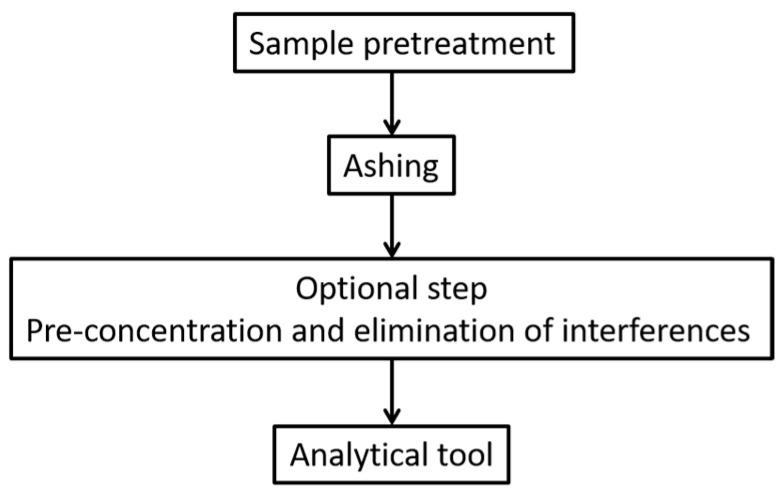
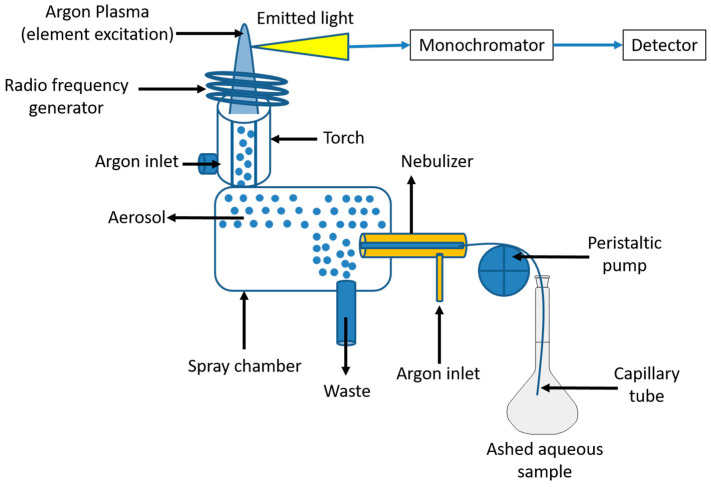
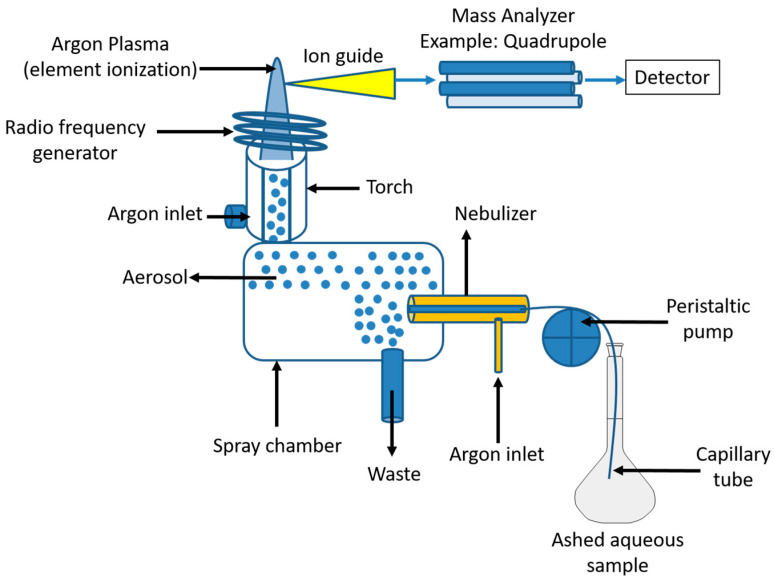
Every human being needs around 20 essential elements to maintain proper physiological processes. However, trace elements are classified as beneficial, essential, or toxic for living organisms. Some trace elements are considered essential elements for the human body in adequate quantities (dietary reference intakes, DRIs), while others have undetermined biological functions and are considered undesirable substances or contaminants. Pollution with trace elements is becoming a great concern since they can affect biological functions or accumulate in organs, causing adverse effects and illnesses such as cancer. These pollutants are being discarded in our soils, waters, and the food supply chain due to several anthropogenic factors. This review mainly aims to provide a clear overview of the commonly used methods and techniques in the trace element analysis of food from sample preparations, namely, ashing techniques, separation/extraction methods, and analytical techniques. Ashing is the first step in trace element analysis. Dry ashing or wet digestion using strong acids at high pressure in closed vessels are used to eliminate the organic matter. Separation and pre-concentration of elements is usually needed before proceeding with the analytical techniques to eliminate the interferences and ameliorate the detection limits.
每个人都需要约20种必需元素来维持正常的生理过程。然而,微量元素对生物体可分为有益、必需或有毒。一些微量元素在适量时(膳食参考摄入量,DRIs)被认为是人体必需元素,而其他一些元素的生物学功能尚未确定,被视为不良物质或污染物。由于微量元素会影响生物功能或在器官中积累,导致癌症等不良反应和疾病,因此微量元素污染正成为一个重大问题。由于多种人为因素,这些污染物正被排放到我们的土壤、水体和食品供应链中。本综述主要旨在清晰概述食品微量元素分析中常用的方法和技术,从样品制备开始,即灰化技术、分离/萃取方法和分析技术。灰化是微量元素分析的第一步。干法灰化或在密闭容器中高压使用强酸进行湿法消解用于去除有机物。在进行分析技术之前,通常需要对元素进行分离和预浓缩,以消除干扰并改善检测限。