College of Medicine, Swansea University, Swansea, Wales, United Kingdom.
PLoS One. 2013 Jun 11;8(6):e65640. doi: 10.1371/journal.pone.0065640. Print 2013.
The EQ-5D is a widely-used, standardised, quality of life measure producing health profiles, indices and states. The aims of this study were to assess the role of various factors in how people with Multiple Sclerosis rate their quality of life, based on responses to the EQ-5D received via the web portal of the UK MS Register.
The 4516 responses to the EQ-5D (between May 2011 and April 2012) were collated with basic demographic and descriptive MS data and the resulting dataset was analysed in SPSS (v.20).
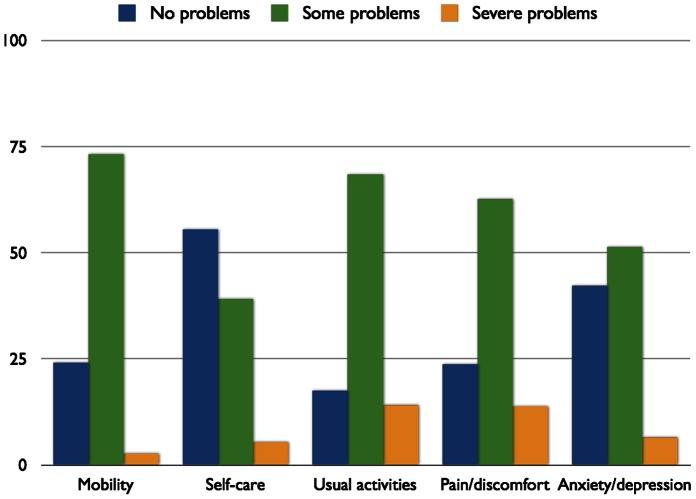
The mean health state for people with MS was 59.73 (SD 22.4, median 61), compared to the UK population mean of 82.48 (which is approximately 1SD above the cohort mean). The characteristics of respondents with high health states (at or above +1SD) were: better health profiles (most predictive dimension: Usual Activities), higher health indices, younger age, shorter durations of MS, female gender, relapsing-remitting MS, higher educational attainment and being in paid employment (all p-values<0.001). Conversely, the characteristics of respondents with low health states (at or below -1SD) were: poorer health profiles (most predictive dimension: Mobility), lower health indices, older age, longer durations of MS, male gender, progressive MS, lower educational attainment and having an employment status of sick/disabled (p = 0.0014 for age, all other p-values<0.001). Particular living arrangements were not associated with either the high or low health status groups.
This large-scale study has enabled in-depth analyses on how people with MS rate their quality of life, and it provides new knowledge on the various factors that contribute to their self-assessed health status. These findings demonstrate the impact of MS on quality of life, and they can be used to inform care provision and further research, to work towards enhancing the quality of life of people with MS.
EQ-5D 是一种广泛使用的、标准化的生活质量衡量标准,可生成健康状况概况、指数和状态。本研究的目的是基于英国多发性硬化症登记处网络门户收到的 EQ-5D 应答,评估各种因素在多发性硬化症患者如何评价其生活质量方面的作用。
2011 年 5 月至 2012 年 4 月期间,共收集了 4516 名多发性硬化症患者对 EQ-5D 的应答,同时收集了基本人口统计学和描述性多发性硬化症数据,并用 SPSS(v.20)对数据集进行了分析。
多发性硬化症患者的平均健康状况为 59.73(标准差 22.4,中位数 61),而英国普通人群的平均健康状况为 82.48(约为队列平均水平的 1SD 以上)。健康状况良好(高于或等于+1SD)的受访者的特征为:更好的健康状况概况(最具预测性维度:日常活动)、更高的健康指数、更年轻的年龄、较短的多发性硬化症病程、女性、缓解-复发型多发性硬化症、更高的教育程度和有薪就业(所有 p 值均<0.001)。相反,健康状况较差(低于或等于-1SD)的受访者的特征为:较差的健康状况概况(最具预测性维度:行动能力)、较低的健康指数、较年长的年龄、较长的多发性硬化症病程、男性、进行性多发性硬化症、较低的教育程度和有患病/残疾的就业状况(年龄 p=0.0014,所有其他 p 值均<0.001)。特定的生活安排与健康状况良好或较差的组均无关联。
这项大规模研究深入分析了多发性硬化症患者如何评价其生活质量,为影响其自我评估健康状况的各种因素提供了新的认识。这些发现表明多发性硬化症对生活质量的影响,并可用于为提供护理和进一步研究提供信息,以提高多发性硬化症患者的生活质量。