Larysz Patrycja, Larysz Dawid, Mandera Marek
Division of Pediatric Neurosurgery, Medical University of Silesia, Upper-Silesian Children's Health Centre, Katowice, Poland,
Childs Nerv Syst. 2014 Jan;30(1):99-104. doi: 10.1007/s00381-013-2200-y. Epub 2013 Jun 22.
The aim of the study was to compare the radiological indicators of effectiveness for hydrocephalus treatment in children operated on under the third year of age with the use of shunt insertion (SI) and endoscopic third ventriculostomy (ETV). The effectiveness was considered in terms of postoperative neurodevelopment in correlation to pre- and postoperative radiological findings.
The examined group consisted of 46 children operated on for hydrocephalus in the Division of Pediatric Neurosurgery in Katowice, Poland. There were 21 children treated with SI and 25 with ETV. The radiographic assessment was carried out on the basis of MRI and CT examinations with the use of a linear estimate known as frontal and occipital horn ratio (FOR). The FOR values were calculated for the entire group and in correlation to the treatment method and to the children neurodevelopment evaluated with The Denver Developmental Screening Test.
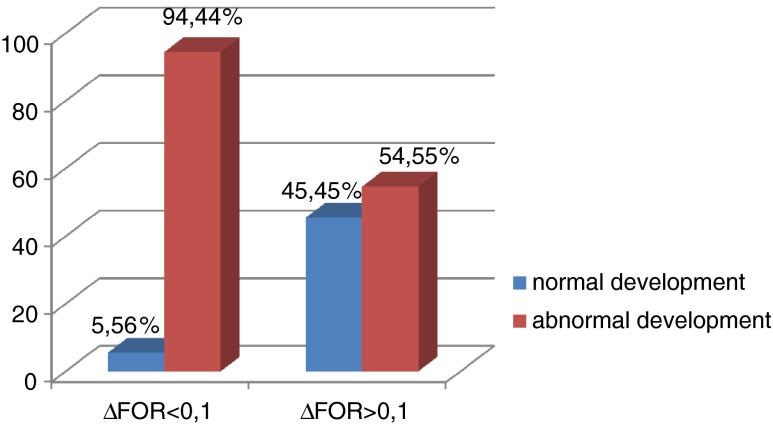
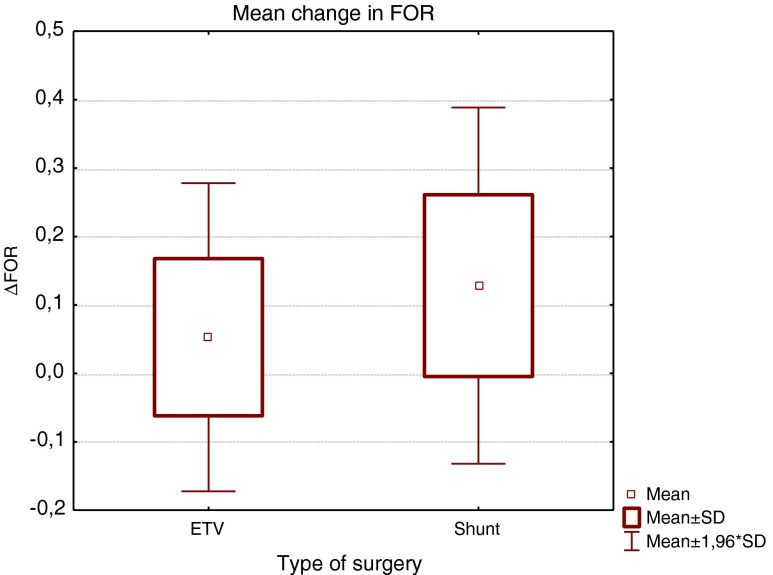
No differences were recognized between initial FOR value in terms of the postoperative children neurodevelopment. In the successful ETV-treated subgroup, the mean change in FOR was 0.05 and in the SI-treated subgroup, the mean change in FOR 0.13. The patients with BFOR >0.1, developed normally more often than those in whom BFOR was lower than 0.1.
The initial FOR value probably does not affect the postoperative developmental outcome. Long-term change in ventricles size after surgery can correlate with psychomotor development of hydrocephalic children. Presumably, there are no differences between two treatment options according to initial FOR values and to changes in FOR values.
本研究旨在比较3岁以下接受分流术(SI)和内镜下第三脑室造瘘术(ETV)治疗的脑积水患儿的放射学疗效指标。根据术前和术后的放射学检查结果,从术后神经发育的角度评估疗效。
研究组由波兰卡托维兹儿科神经外科接受脑积水手术治疗的46名儿童组成。其中21名儿童接受了SI治疗,25名接受了ETV治疗。基于MRI和CT检查,采用一种称为额枕角比(FOR)的线性估计方法进行影像学评估。计算了整个研究组的FOR值,并将其与治疗方法以及通过丹佛发育筛查测试评估的儿童神经发育情况相关联。
就术后儿童神经发育而言,初始FOR值之间未发现差异。在ETV治疗成功的亚组中,FOR的平均变化为0.05,而在SI治疗的亚组中,FOR的平均变化为0.13。BFOR>0.1的患者比BFOR低于0.1的患者更常出现正常发育。
初始FOR值可能不会影响术后发育结果。手术后脑室大小的长期变化可能与脑积水患儿的精神运动发育相关。根据初始FOR值和FOR值的变化,两种治疗方案可能没有差异。