Neurology, Neurological Institute, Taipei Veterans General Hospital and National Yang-Ming University, Taipei, Taiwan.
PLoS One. 2013 Jun 17;8(6):e65911. doi: 10.1371/journal.pone.0065911. Print 2013.
Few studies in the world have assessed the incidence of multiple sclerosis (MS) with soil heavy metal concentrations. We explored the association of soil heavy metal factors and the MS incidence in Taiwan.
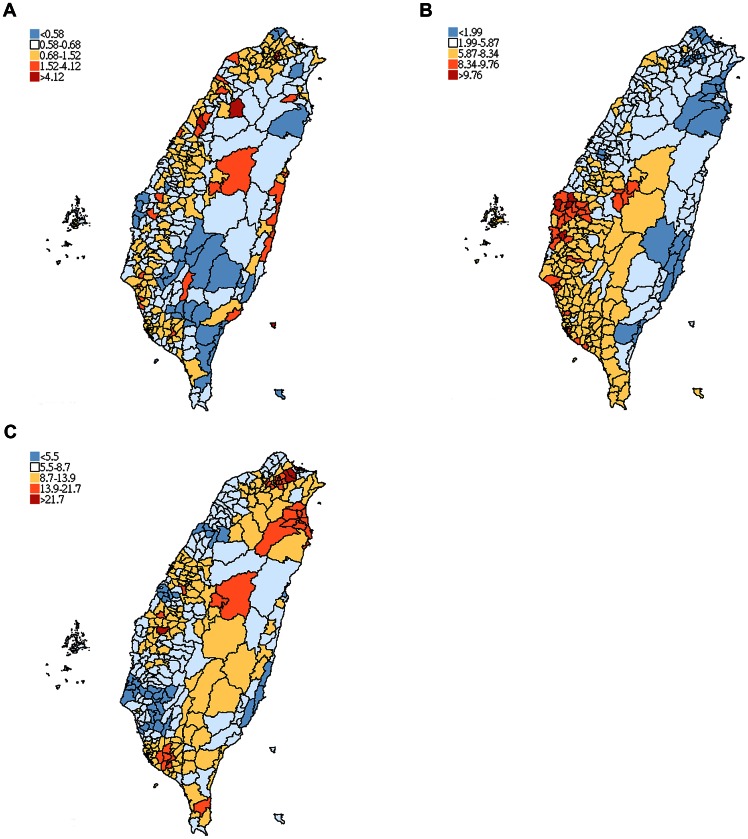
There were 1240 new MS cases from the National Health Insurance Research Database and were verified with serious disabling disease certificates, 1997-2008. Soil heavy metal factors records included arsenic, mercury, cadmium, chromium, copper, nickel, lead and zinc in Taiwan from 1986 to 2002. Spatial regression was used to reveal the association of soil heavy metals and age- and gender-standardized incidence ratios for townships by controlling sunlight exposure hours, smoking prevalence and spatial autocorrelation.
The lead (Pb) concentration in the soil positively correlated with the township incidence; on the other hand, the arsenic (As) concentration in soil negatively correlated with the township incidence and when found together controlled each other. The positive correlation of lead (Pb) predominated in males, whereas the negative correlation of arsenic (As) in soil predominated in females.
We conclude that exposure to lead (Pb) in soil positive associated with incidence of MS in Taiwan, especially in males. Exposure to arsenic (As) in soil negative associated with MS in Taiwan, especially in females.
世界上很少有研究评估土壤重金属浓度与多发性硬化症 (MS) 的发病率之间的关系。我们探讨了土壤重金属因素与台湾多发性硬化症发病率之间的关联。
从国家健康保险研究数据库中选择了 1997 年至 2008 年间的 1240 例新多发性硬化症病例,并通过严重残疾疾病证书进行了验证。土壤重金属因素记录包括台湾 1986 年至 2002 年的砷、汞、镉、铬、铜、镍、铅和锌。通过控制阳光暴露时间、吸烟流行率和空间自相关,空间回归用于揭示土壤重金属与城乡年龄和性别标准化发病率比之间的关联。
土壤中的铅 (Pb) 浓度与乡镇发病率呈正相关;另一方面,土壤中的砷 (As) 浓度与乡镇发病率呈负相关,当两者同时存在时,相互抵消。土壤中铅 (Pb) 的正相关在男性中占主导地位,而土壤中砷 (As) 的负相关在女性中占主导地位。
我们得出结论,土壤中铅 (Pb) 的暴露与台湾多发性硬化症的发病率呈正相关,尤其是在男性中。土壤中砷 (As) 的暴露与台湾多发性硬化症的发病率呈负相关,尤其是在女性中。