Epidemiology Branch, National Institute of Environmental Health Sciences (NIEHS), National Institutes of Health (NIH), Department of Heath and Human Services (DHHS), Research Triangle Park, North Carolina, USA.
Environ Health Perspect. 2013 Oct;121(10):1129-34. doi: 10.1289/ehp.1206211. Epub 2013 Jun 25.
Environmental exposures to phthalates, particularly high-molecular-weight (HMW) phthalates, are suspected to contribute to allergy.
We assessed whether phthalate metabolites are associated with allergic symptoms and sensitization in a large nationally representative sample.
We used data on urinary phthalate metabolites and allergic symptoms (hay fever, rhinitis, allergy, wheeze, asthma) and sensitization from participants ≥ 6 years of age in the National Health and Nutrition Examination Survey (NHANES) 2005-2006. Allergen sensitization was defined as a positive response to at least one of 19 specific IgE antigens (≥ 0.35 kU/L). Odds ratios (ORs) per one log10 unit change in phthalate concentration were estimated using logistic regression adjusting for age, race, body mass index, gender, creatinine, and cotinine. Separate analyses were conducted for children (6-17 years of age) and adults.
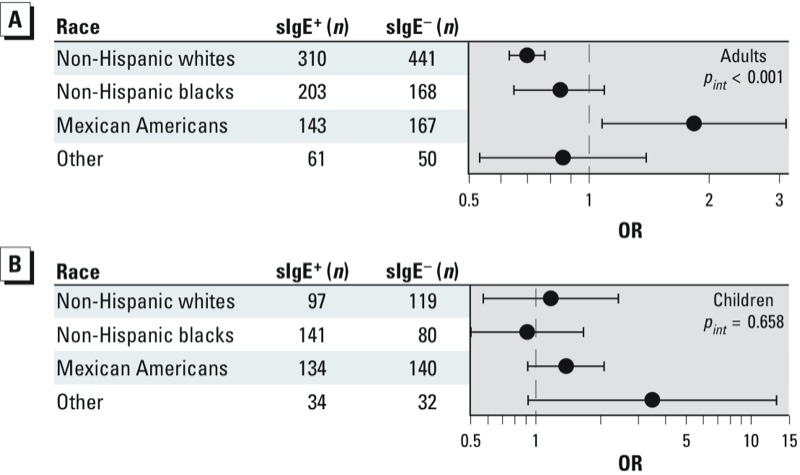
The HMW phthalate metabolite monobenzyl phthalate (MBzP) was the only metabolite positively associated with current allergic symptoms in adults (wheeze, asthma, hay fever, and rhinitis). Mono-(3-carboxypropyl) phthalate and the sum of diethylhexyl phthalate metabolites (both representing HMW phthalate exposures) were positively associated with allergic sensitization in adults. Conversely, in children, HMW phthalate metabolites were inversely associated with asthma and hay fever. Of the low-molecular-weight phthalate metabolites, monoethyl phthalate was inversely associated with allergic sensitization in adults (OR = 0.79; 95% CI: 0.70, 0.90).
In this cross-sectional analysis of a nationally representative sample, HMW phthalate metabolites, particularly MBzP, were positively associated with allergic symptoms and sensitization in adults, but there was no strong evidence for associations between phthalates and allergy in children 6-17 years of age.
环境中的邻苯二甲酸酯暴露,特别是高分子量(HMW)邻苯二甲酸酯,被怀疑会导致过敏。
我们评估了在一个大型的全国代表性样本中,邻苯二甲酸酯代谢物是否与过敏症状和致敏有关。
我们使用了来自国家健康和营养检查调查(NHANES)2005-2006 年≥6 岁参与者的尿液邻苯二甲酸酯代谢物和过敏症状(花粉热、鼻炎、过敏、喘息、哮喘)以及致敏数据。过敏原致敏定义为至少对 19 种特异性 IgE 抗原中的一种呈阳性反应(≥0.35 kU/L)。使用逻辑回归,根据年龄、种族、体重指数、性别、肌酐和可替宁,对邻苯二甲酸浓度每增加一个对数 10 单位的比值比(OR)进行估计。分别对儿童(6-17 岁)和成人进行了分析。
只有 HMW 邻苯二甲酸酯代谢物单苄基邻苯二甲酸酯(MBzP)与成人当前的过敏症状(喘息、哮喘、花粉热和鼻炎)呈正相关。单-(3-羧基丙基)邻苯二甲酸酯和邻苯二甲酸二乙基己基酯代谢物的总和(均代表 HMW 邻苯二甲酸酯暴露)与成人的过敏致敏呈正相关。相反,在儿童中,HMW 邻苯二甲酸酯代谢物与哮喘和花粉热呈负相关。在低分子量邻苯二甲酸酯代谢物中,单乙基邻苯二甲酸酯与成人的过敏致敏呈负相关(OR=0.79;95%CI:0.70,0.90)。
在这项全国代表性样本的横断面分析中,HMW 邻苯二甲酸酯代谢物,特别是 MBzP,与成人的过敏症状和致敏呈正相关,但在 6-17 岁儿童中,没有强有力的证据表明邻苯二甲酸酯与过敏有关。