Department of Microbiology, Faculty of Medicine, University of Porto, Porto, Portugal.
mBio. 2013 Aug 30;4(4):e00285-13. doi: 10.1128/mBio.00285-13.
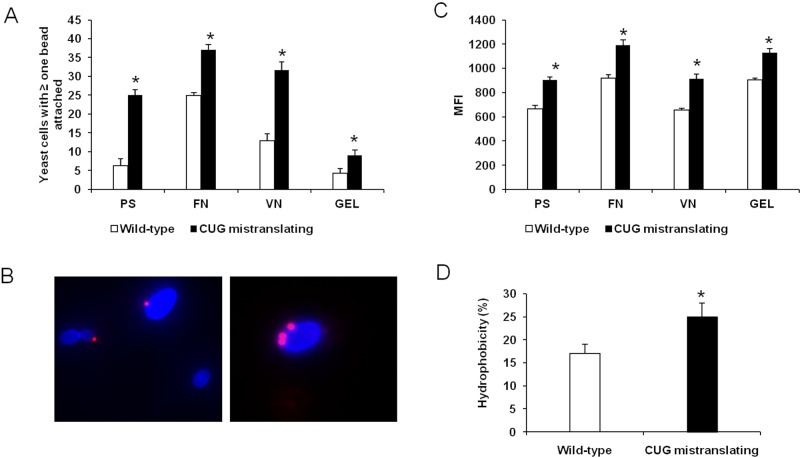
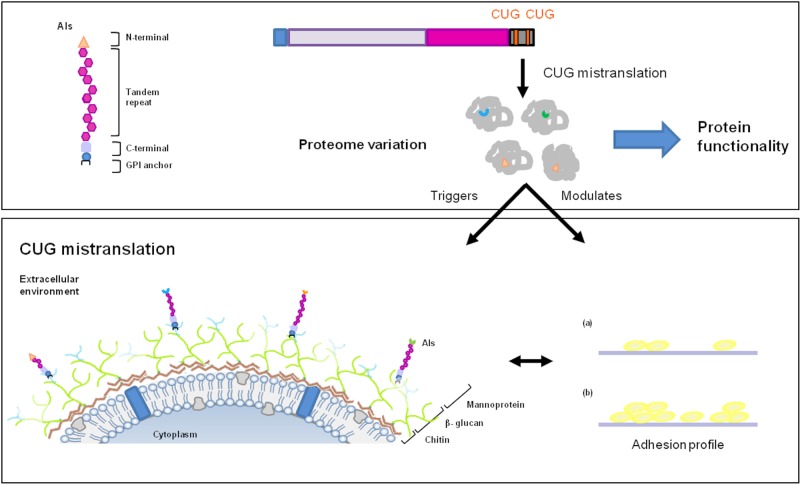
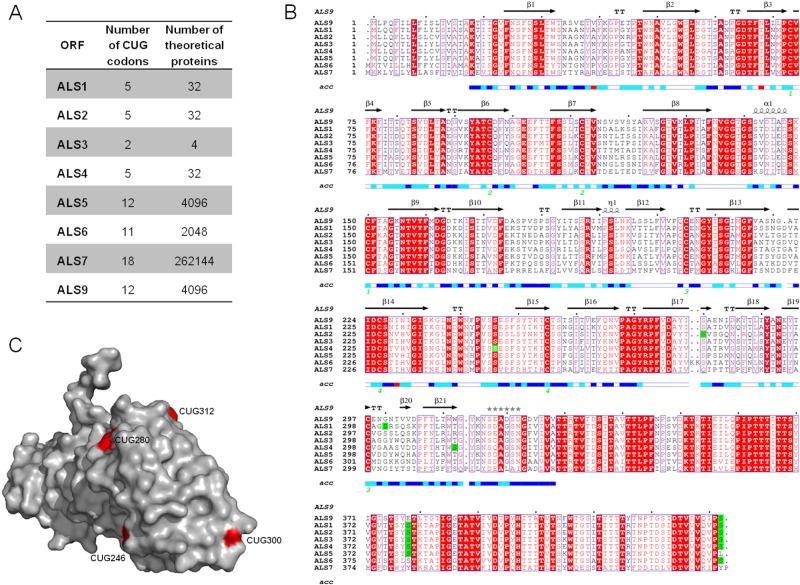
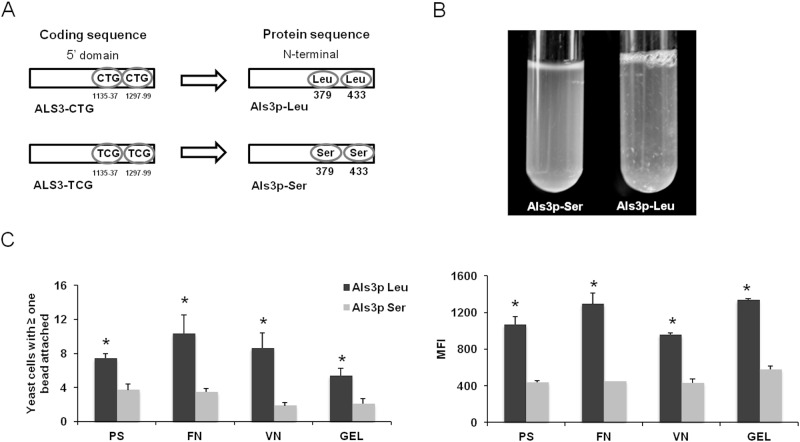
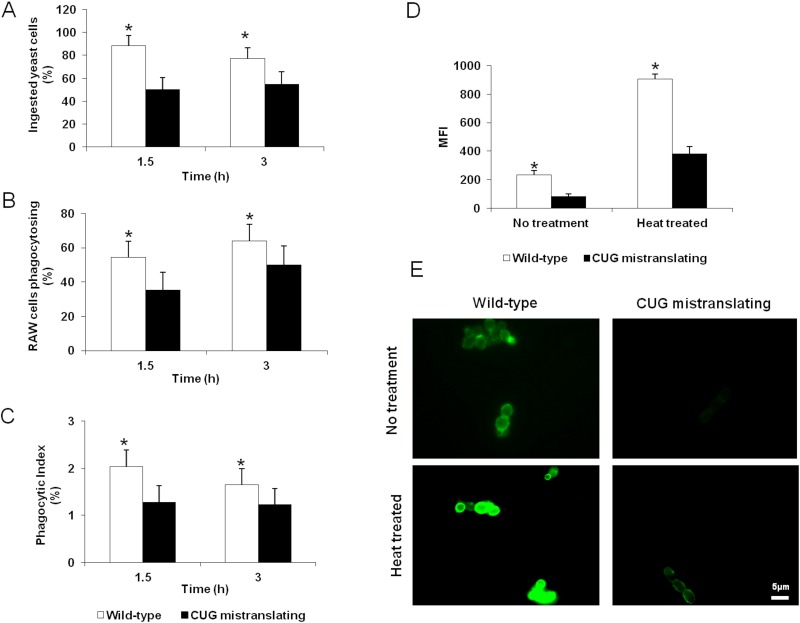
In the human fungal pathogen Candida albicans, the CUG codon is translated 97% of the time as serine and 3% of the time as leucine, which potentially originates an array of proteins resulting from the translation of a single gene. Genes encoding cell surface proteins are enriched in CUG codons; thus, CUG mistranslation may influence the interactions of the organism with the host. To investigate this, we compared a C. albicans strain that misincorporates 28% of leucine at CUGs with a wild-type parental strain. The first strain displayed increased adherence to inert and host molecules. In addition, it was less susceptible to phagocytosis by murine macrophages, probably due to reduced exposure of cell surface β-glucans. To prove that these phenotypes occurred due to serine/leucine exchange, the C. albicans adhesin and invasin ALS3 was expressed in Saccharomyces cerevisiae in its two natural isoforms (Als3p-Leu and Als3p-Ser). The cells with heterologous expression of Als3p-Leu showed increased adherence to host substrates and flocculation. We propose that CUG mistranslation has been maintained during the evolution of C. albicans due to its potential to generate cell surface variability, which significantly alters fungus-host interactions.
The translation of genetic information into proteins is a highly accurate cellular process. In the human fungal pathogen Candida albicans, a unique mistranslation event involving the CUG codon occurs. The CUG codon is mainly translated as serine but can also be translated as leucine. Leucine and serine are two biochemically distinct amino acids, hydrophobic and hydrophilic, respectively. The increased rate of leucine incorporation at CUG decoding triggers C. albicans virulence attributes, such as morphogenesis, phenotypic switching, and adhesion. Here, we show that CUG mistranslation masks the fungal cell wall molecule β-glucan that is normally recognized by the host immune system, delaying its response. Furthermore, we demonstrate that two different proteins of the adhesin Als3 generated by CUG mistranslation confer increased hydrophobicity and adhesion ability on yeast cells. Thus, CUG mistranslation functions as a mechanism to create protein diversity with differential activities, constituting an advantage for a mainly asexual microorganism. This could explain its preservation during evolution.
在人类真菌病原体白色念珠菌中,CUG 密码子 97%的时间被翻译为丝氨酸,3%的时间被翻译为亮氨酸,这可能源于单个基因翻译产生的一系列蛋白质。细胞表面蛋白的编码基因富含 CUG 密码子;因此,CUG 错译可能会影响生物体与宿主的相互作用。为了研究这一点,我们比较了一种在 CUG 处误掺入 28%亮氨酸的白色念珠菌菌株与野生型亲本菌株。第一株菌显示出对惰性和宿主分子的粘附性增加。此外,它对鼠巨噬细胞的吞噬作用的敏感性降低,可能是由于细胞表面β-葡聚糖暴露减少所致。为了证明这些表型是由于丝氨酸/亮氨酸交换引起的,将白色念珠菌黏附素和侵袭素 ALS3 以其两种天然同工型(Als3p-Leu 和 Als3p-Ser)在酿酒酵母中表达。表达异源 Als3p-Leu 的细胞对宿主底物的粘附性和絮凝性增加。我们提出,由于 CUG 错译可能产生细胞表面变异性,从而显著改变真菌-宿主相互作用,因此在白色念珠菌的进化过程中一直保持着 CUG 错译。
将遗传信息翻译成蛋白质是一个高度精确的细胞过程。在人类真菌病原体白色念珠菌中,涉及 CUG 密码子的独特错译事件发生。CUG 密码子主要翻译为丝氨酸,但也可以翻译为亮氨酸。亮氨酸和丝氨酸是两种生化上不同的氨基酸,分别是疏水性和亲水性的。CUG 解码时亮氨酸掺入率的增加引发了白色念珠菌毒力特性,如形态发生、表型转换和粘附。在这里,我们表明 CUG 错译掩盖了通常被宿主免疫系统识别的真菌细胞壁分子β-葡聚糖,从而延迟了其反应。此外,我们证明 CUG 错译产生的黏附素 Als3 的两种不同蛋白赋予酵母细胞增加的疏水性和粘附能力。因此,CUG 错译作为一种产生具有不同活性的蛋白质多样性的机制发挥作用,这对一种主要是无性的微生物来说是一个优势。这可以解释它在进化过程中的保存。