Bales Patrick M, Renke Emilija Miljkovic, May Sarah L, Shen Yang, Nelson Daniel C
Institute for Bioscience and Biotechnology Research, University of Maryland, Rockville, Maryland, United States of America.
PLoS One. 2013 Jun 21;8(6):e67950. doi: 10.1371/journal.pone.0067950. Print 2013.
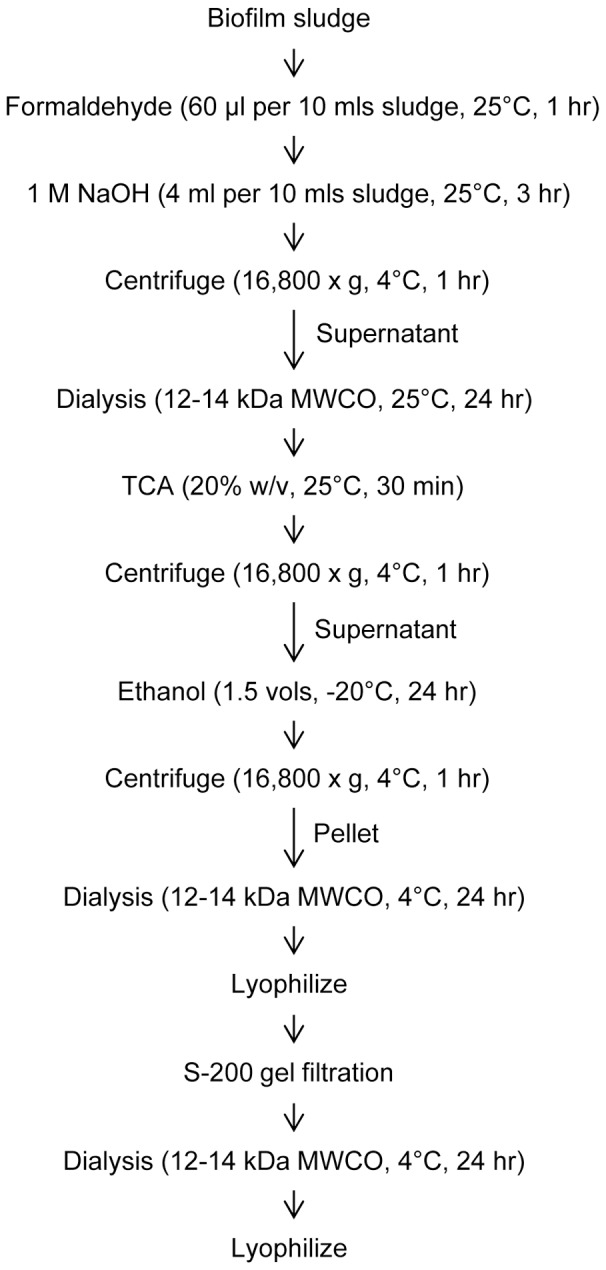
In bacterial biofilms, high molecular weight, secreted exopolysaccharides can serve as a scaffold to which additional carbohydrates, proteins, lipids, and nucleic acids adhere, forming the matrix of the developing biofilm. Here we report methods to extract and purify high molecular weight (>15 kDa) exopolysaccharides from biofilms of eight human pathogens, including species of Staphylcococcus, Klebsiella, Acinetobacter, Pseudomonas, and a toxigenic strain of Escherichia coli O157:H7. Glycosyl composition analysis indicated a high total mannose content across all strains with P. aeruginosa and A. baumannii exopolysaccharides comprised of 80-90% mannose, K. pneumoniae and S. epidermidis strains containing 40-50% mannose, and E. coli with ∼10% mannose. Galactose and glucose were also present in all eight strains, usually as the second and third most abundant carbohydrates. N-acetyl-glucosamine and galacturonic acid were found in 6 of 8 strains, while arabinose, fucose, rhamnose, and xylose were found in 5 of 8 strains. For linkage analysis, 33 distinct residue-linkage combinations were detected with the most abundant being mannose-linked moieties, in line with the composition analysis. The exopolysaccharides of two P. aeruginosa strains analyzed were consistent with the Psl carbohydrate, but not Pel or alginate. The S. epidermidis strain had a composition rich in mannose and glucose, which is consistent with the previously described slime associated antigen (SAA) and the extracellular slime substance (ESS), respectively, but no polysaccharide intracellular adhesion (PIA) was detected. The high molecular weight exopolysaccharides from E. coli, K. pneumoniae, and A. baumannii appear to be novel, based on composition and/or ratio analysis of carbohydrates.
在细菌生物膜中,高分子量的分泌型胞外多糖可作为一种支架,其他碳水化合物、蛋白质、脂质和核酸会附着其上,形成正在发育的生物膜的基质。在此,我们报告了从八种人类病原体的生物膜中提取和纯化高分子量(>15 kDa)胞外多糖的方法,这些病原体包括葡萄球菌属、克雷伯菌属、不动杆菌属、假单胞菌属以及产毒的大肠杆菌O157:H7菌株。糖基组成分析表明,所有菌株的总甘露糖含量都很高,铜绿假单胞菌和鲍曼不动杆菌的胞外多糖中甘露糖占80 - 90%,肺炎克雷伯菌和表皮葡萄球菌菌株含40 - 50%的甘露糖,大肠杆菌含约10%的甘露糖。所有八种菌株中也都存在半乳糖和葡萄糖,通常是第二和第三丰富的碳水化合物。在8种菌株中的6种中发现了N - 乙酰葡糖胺和半乳糖醛酸,而在8种菌株中的5种中发现了阿拉伯糖、岩藻糖、鼠李糖和木糖。对于连接分析,检测到33种不同的残基 - 连接组合,其中最丰富的是甘露糖连接部分,这与组成分析结果一致。分析的两种铜绿假单胞菌菌株的胞外多糖与Psl碳水化合物一致,但与Pel或藻酸盐不符。表皮葡萄球菌菌株的组成富含甘露糖和葡萄糖,分别与先前描述的黏液相关抗原(SAA)和细胞外黏液物质(ESS)一致,但未检测到多糖细胞内黏附素(PIA)。基于碳水化合物的组成和/或比例分析,大肠杆菌、肺炎克雷伯菌和鲍曼不动杆菌的高分子量胞外多糖似乎是新发现的。