Department of Chemistry, Stanford University, Stanford, California 94305-5012, USA.
J Am Chem Soc. 2013 Jul 31;135(30):11181-92. doi: 10.1021/ja403917z. Epub 2013 Jul 18.
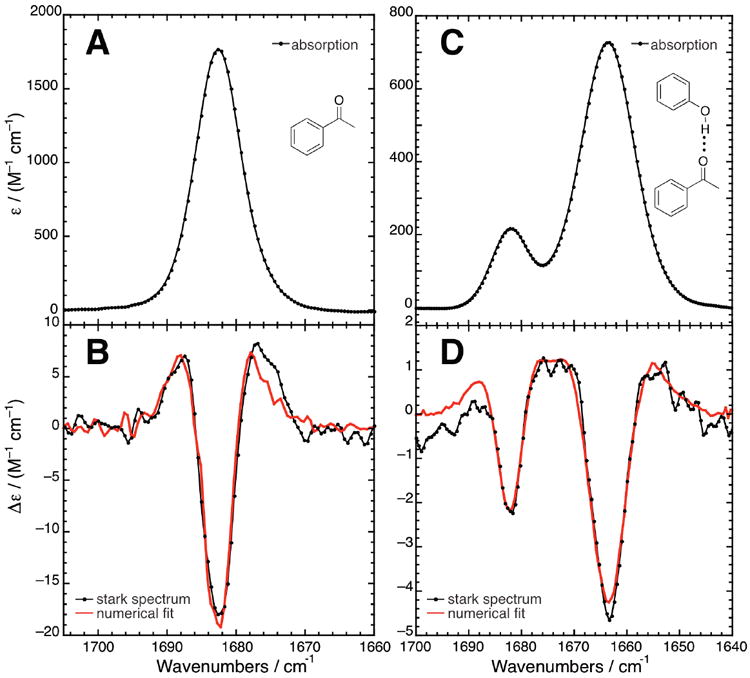
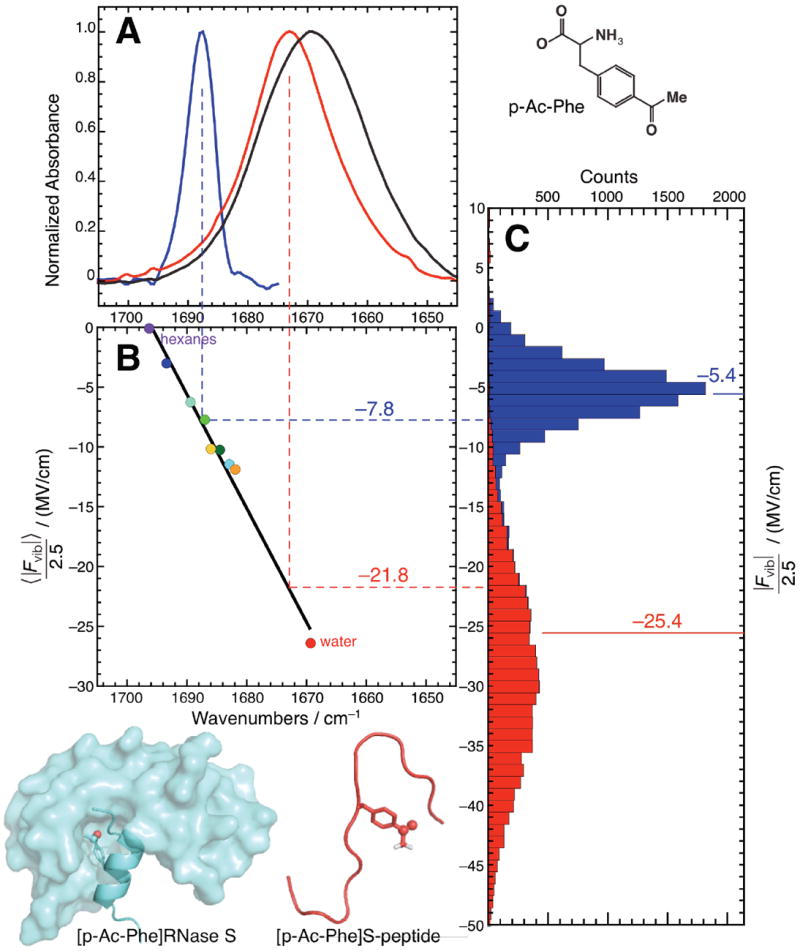
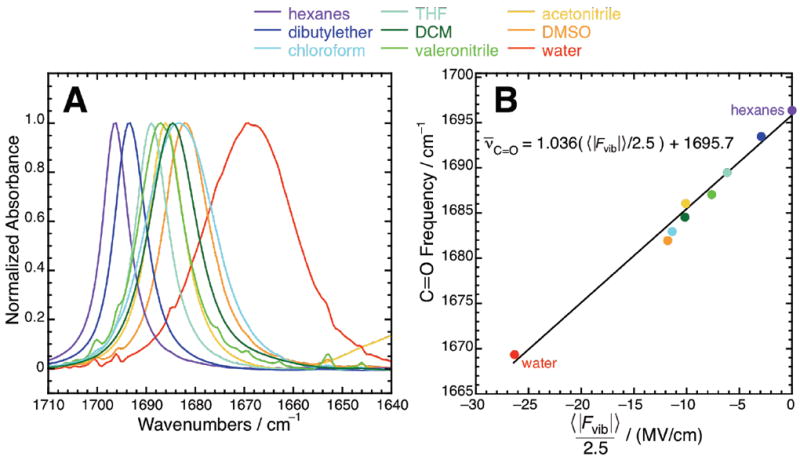
Vibrational probes can provide a direct readout of the local electrostatic field in complex molecular environments, such as protein binding sites and enzyme active sites. This information provides an experimental method to explore the underlying physical causes of important biomolecular processes such as binding and catalysis. However, specific chemical interactions such as hydrogen bonds can have complicated effects on vibrational probes and confound simple electrostatic interpretations of their frequency shifts. We employ vibrational Stark spectroscopy along with infrared spectroscopy of carbonyl probes in different solvent environments and in ribonuclease S to understand the sensitivity of carbonyl frequencies to electrostatic fields, including those due to hydrogen bonds. Additionally, we carried out molecular dynamics simulations to calculate ensemble-averaged electric fields in solvents and in ribonuclease S and found excellent correlation between calculated fields and vibrational frequencies. These data enabled the construction of a robust field-frequency calibration curve for the C═O vibration. The present results suggest that carbonyl probes are capable of quantitatively assessing the electrostatics of hydrogen bonding, making them promising for future study of protein function.
振动探针可以提供复杂分子环境(如蛋白质结合位点和酶活性位点)中局部电场的直接读数。这些信息提供了一种实验方法来探索重要生物分子过程(如结合和催化)的潜在物理原因。然而,氢键等特定的化学相互作用会对振动探针产生复杂的影响,并混淆对其频率位移的简单静电解释。我们采用振动斯塔克光谱学以及不同溶剂环境中和核糖核酸酶 S 中的羰基探针的红外光谱,了解羰基频率对静电场的敏感性,包括氢键引起的静电场。此外,我们进行了分子动力学模拟,以计算溶剂和核糖核酸酶 S 中的平均电场,并发现计算出的电场与振动频率之间存在极好的相关性。这些数据使我们能够为 C=O 振动构建一个稳健的场-频校准曲线。目前的结果表明,羰基探针能够定量评估氢键的静电特性,这使得它们有望成为未来蛋白质功能研究的有力工具。