Institute of Disease Control and Prevention, Academy of Military Medical Science, Beijing, People's Republic of China.
PLoS Negl Trop Dis. 2013 Jun 20;7(6):e2285. doi: 10.1371/journal.pntd.0002285. Print 2013.
The aim of the study is to examine the spatiotemporal pattern of Japanese Encephalitis (JE) in mainland China during 2002-2010. Specific objectives of the study were to quantify the temporal variation in incidence of JE cases, to determine if clustering of JE cases exists, to detect high risk spatiotemporal clusters of JE cases and to provide evidence-based preventive suggestions to relevant stakeholders.
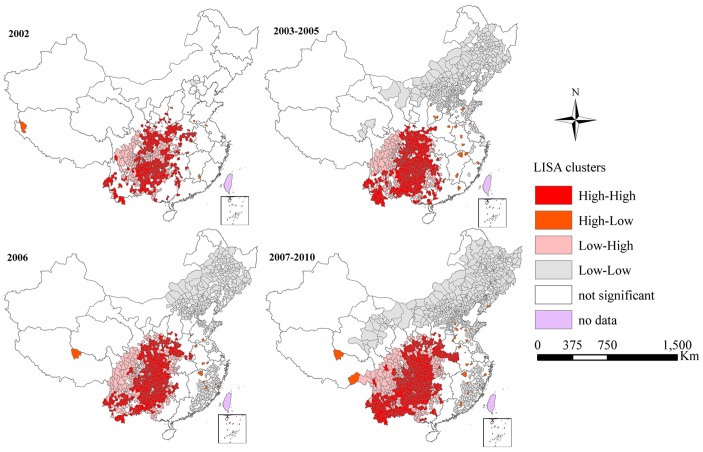
Monthly JE cases at the county level in mainland China during 2002-2010 were obtained from the China Information System for Diseases Control and Prevention (CISDCP). For the purpose of the analysis, JE case counts for nine years were aggregated into four temporal periods (2002; 2003-2005; 2006; and 2007-2010). Local Indicators of Spatial Association and spatial scan statistics were performed to detect and evaluate local high risk space-time clusters.
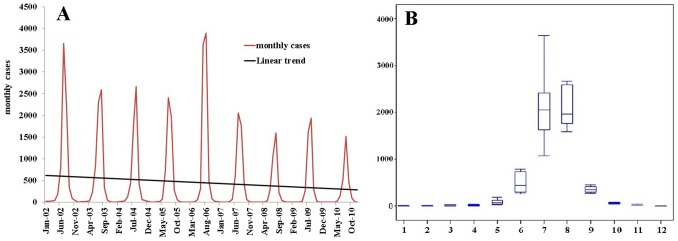
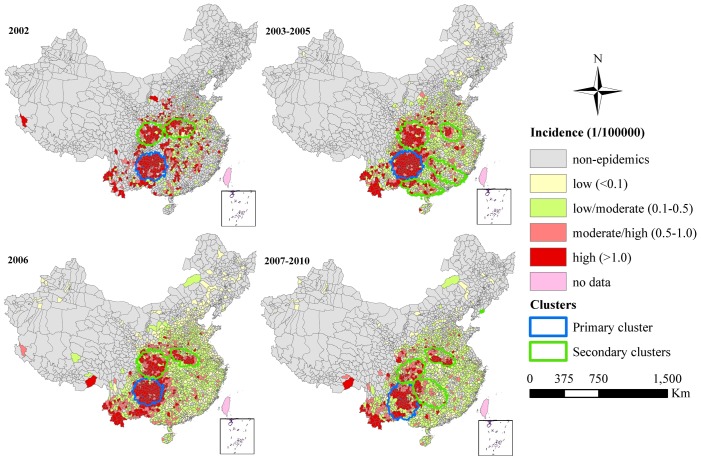
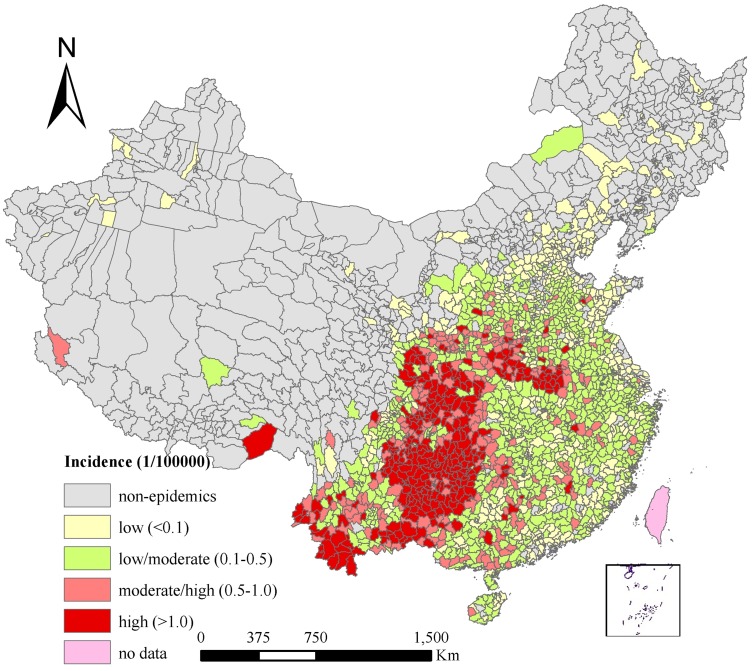
JE incidence showed a decreasing trend from 2002 to 2005 but peaked in 2006, then fluctuated over the study period. Spatial cluster analysis detected high value clusters, mainly located in Southwestern China. Similarly, we identified a primary spatiotemporal cluster of JE in Southwestern China between July and August, with the geographical range of JE transmission increasing over the past years.
JE in China is geographically clustered and its spatial extent dynamically changed during the last nine years in mainland China. This indicates that risk factors for JE infection are likely to be spatially heterogeneous. The results may assist national and local health authorities in the development/refinement of a better preventive strategy and increase the effectiveness of public health interventions against JE transmission.
本研究旨在考察 2002-2010 年中国大陆地区日本脑炎(JE)的时空分布模式。具体目标是量化 JE 病例的时间变化,确定是否存在 JE 病例聚集,检测 JE 病例高风险时空聚集,并为相关利益相关者提供基于证据的预防建议。
从中国疾病预防控制信息系统(CISDCP)获取 2002-2010 年中国大陆县级 JE 病例的月数据。为了进行分析,将九年的 JE 病例计数汇总为四个时间期(2002 年;2003-2005 年;2006 年;2007-2010 年)。进行局部空间关联指标和空间扫描统计,以检测和评估局部高风险时空聚集。
JE 发病率从 2002 年到 2005 年呈下降趋势,但在 2006 年达到峰值,随后在研究期间波动。空间聚类分析检测到高值聚集区,主要位于中国西南部。同样,我们在西南部发现了一个原发性 JE 时空聚集区,其地理范围在过去几年中不断扩大。
中国的 JE 具有地理聚集性,在过去九年中,其空间范围在中国大陆不断变化。这表明 JE 感染的危险因素可能在空间上存在异质性。研究结果可能有助于国家和地方卫生当局制定/完善更好的预防策略,并提高针对 JE 传播的公共卫生干预措施的效果。