Del Rosario Mithi, Gillespie-Lynch Kristen, Johnson Scott, Sigman Marian, Hutman Ted
Department of Psychiatry and Bio-behavioral Sciences, University of California, Los Angeles, Los Angeles, CA, USA.
J Autism Dev Disord. 2014 Feb;44(2):381-93. doi: 10.1007/s10803-013-1876-x.
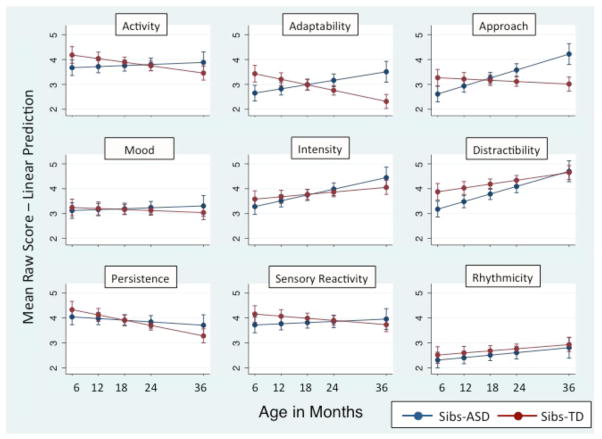
Temperament atypicalities have been documented in infancy and early development in children who develop autism spectrum disorders (ASD). The current study investigates whether there are differences in developmental trajectories of temperament between infants and toddlers with and without ASD. Parents of infant siblings of children with autism completed the Carey Temperament Scales about their child at 6, 12, 18, 24, and 36 months of age. Temperament trajectories of children with ASD reflected increases over time in activity level, and decreasing adaptability and approach behaviors relative to high-risk typically developing (TD) children. This study is the first to compare temperament trajectories between high-risk TD infants and infants subsequently diagnosed with ASD in the developmental window when overt symptoms of ASD first emerge.
在患有自闭症谱系障碍(ASD)的儿童的婴儿期和早期发育阶段,已有气质异常的记录。本研究调查了患有和未患有ASD的婴幼儿在气质发展轨迹上是否存在差异。自闭症患儿的婴儿兄弟姐妹的父母在孩子6、12、18、24和36个月大时完成了凯里气质量表。与高风险的典型发育(TD)儿童相比,患有ASD的儿童的气质轨迹反映出活动水平随时间增加,适应性和接近行为减少。本研究首次比较了在ASD明显症状首次出现的发育窗口期,高风险TD婴儿与随后被诊断为ASD的婴儿之间的气质轨迹。