Animal Genetics and Breeding Department, Institute of Animal Science, Chinese Academy of Agricultural Sciences, Beijing, China.
PLoS One. 2013 Jun 25;8(6):e66569. doi: 10.1371/journal.pone.0066569. Print 2013.
Growth and meat production traits are significant economic traits in sheep. The aim of the study is to identify candidate genes affecting growth and meat production traits at genome level with high throughput single nucleotide polymorphisms (SNP) genotyping technologies.
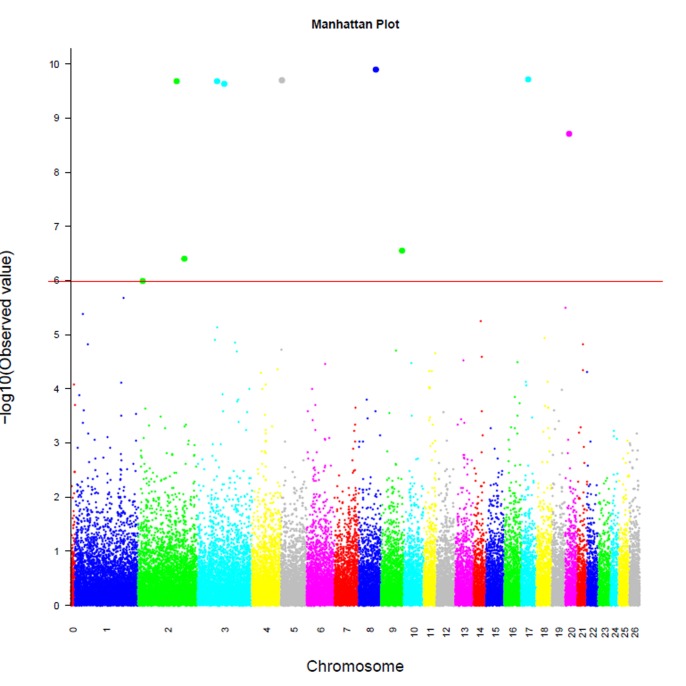
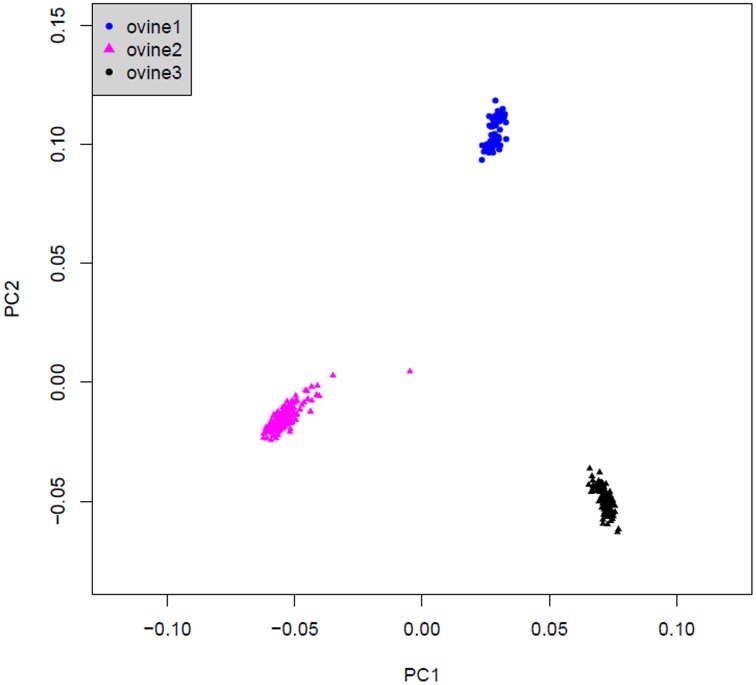
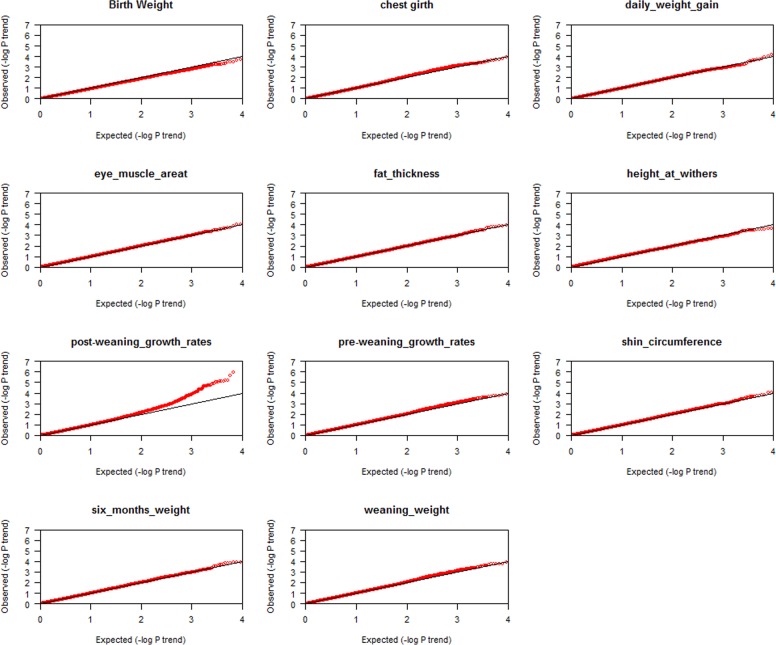
Using Illumina OvineSNP50 BeadChip, we performed a GWA study in 329 purebred sheep for 11 growth and meat production traits (birth weight, weaning weight, 6-month weight, eye muscle area, fat thickness, pre-weaning gain, post-weaning gain, daily weight gain, height at withers, chest girth, and shin circumference). After quality control, 319 sheep and 48,198 SNPs were analyzed by TASSEL program in a mixed linear model (MLM). 36 significant SNPs were identified for 7 traits, and 10 of them reached genome-wise significance level for post-weaning gain. Gene annotation was implemented with the latest sheep genome Ovis_aries_v3.1 (released October 2012). More than one-third SNPs (14 out of 36) were located within ovine genes, others were located close to ovine genes (878bp-398,165bp apart). The strongest new finding is 5 genes were thought to be the most crucial candidate genes associated with post-weaning gain: s58995.1 was located within the ovine genes MEF2B and RFXANK, OAR3_84073899.1, OAR3_115712045.1 and OAR9_91721507.1 were located within CAMKMT, TRHDE, and RIPK2 respectively. GRM1, POL, MBD5, UBR2, RPL7 and SMC2 were thought to be the important candidate genes affecting post-weaning gain too. Additionally, 25 genes at chromosome-wise significance level were also forecasted to be the promising genes that influencing sheep growth and meat production traits.
The results will contribute to the similar studies and facilitate the potential utilization of genes involved in growth and meat production traits in sheep in future.
生长和肉质生产性状是绵羊重要的经济性状。本研究的目的是利用高通量单核苷酸多态性(SNP)基因分型技术,在全基因组水平上鉴定影响生长和肉质生产性状的候选基因。
我们使用 Illumina OvineSNP50 BeadChip 对 329 只纯种绵羊的 11 个生长和肉质生产性状(初生重、断奶重、6 月龄重、眼肌面积、脂肪厚度、断奶前增重、断奶后增重、日增重、肩高、胸围和小腿围)进行了 GWAS 研究。经过质量控制,利用 TASSEL 程序在混合线性模型(MLM)中对 319 只绵羊和 48198 个 SNP 进行了分析。在 7 个性状中鉴定出 36 个显著 SNP,其中 10 个 SNP 对断奶后增重达到全基因组显著水平。利用最新的绵羊基因组 Ovis_aries_v3.1(2012 年 10 月发布)进行基因注释。超过三分之一的 SNP(36 个中的 14 个)位于绵羊基因内,其他 SNP 位于绵羊基因附近(距离为 878bp-398165bp)。最有力的新发现是 5 个基因被认为是与断奶后增重最密切相关的候选基因:s58995.1 位于绵羊基因 MEF2B 和 RFXANK 内,OAR3_84073899.1、OAR3_115712045.1 和 OAR9_91721507.1 分别位于 CAMKMT、TRHDE 和 RIPK2 内。GRM1、POL、MBD5、UBR2、RPL7 和 SMC2 也被认为是影响断奶后增重的重要候选基因。此外,在染色体水平上预测到 25 个基因也可能影响绵羊生长和肉质生产性状。
这些结果将有助于类似的研究,并为未来绵羊生长和肉质生产性状相关基因的潜在利用提供参考。