Lao-Oxford-Mahosot Hospital-Wellcome Trust Research Unit, Microbiology Laboratory, Mahosot Hospital, Vientiane, Lao PDR.
Malar J. 2013 Jul 8;12:229. doi: 10.1186/1475-2875-12-229.
Severe malaria remains a major cause of death and morbidity amongst adults in the Asiatic tropics.
A retrospective analysis of the clinical and laboratory data of 988 adult patients, hospitalized with Plasmodium falciparum malaria and prospectively recruited to malaria studies in western Thailand between 1986 and 2002, was performed to assess the factors associated with a fatal outcome. Different severity scores and classifications for defining severe malaria were compared and, using multiple logistic regression, simple models for predicting mortality developed.
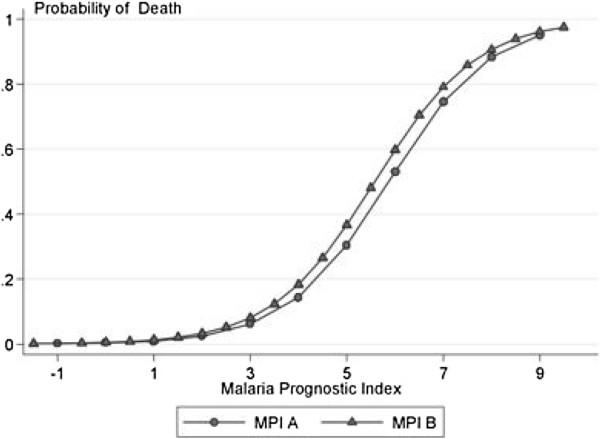
The proportion of patients fulfilling the WHO 2000 definition of severe malaria was 78.1%, and their mortality was 10%. Mortality in patients given parenteral artesunate or artemether (16/317, 5%) was lower than in those given parenteral quinine (59/442, 13%) (P < 0.001). Models using parameter sets based on WHO 1990, 2000 and Adapted AQ criteria plus blood smear parasite-stage assessment gave the best mortality prediction. A malaria prognostic index (MPI), derived from the dataset using five clinical or laboratory variables gave similar prognostic accuracy.
The mortality of severe malaria in adults has fallen and the switch from quinine to artesunate has probably been an important contributor. Prognostic indices based on WHO 2000 definitions, and other simpler indices based on fewer variables, provide clinically useful predictions of outcome in Asian adults with severe malaria.
在亚洲热带地区,重症疟疾仍然是成年人死亡和发病的主要原因。
对 1986 年至 2002 年期间在泰国西部因恶性疟原虫疟疾住院的 988 例成年患者的临床和实验室数据进行回顾性分析,前瞻性地招募进行疟疾研究,以评估与死亡结局相关的因素。比较了不同的严重程度评分和分类方法来定义重症疟疾,并使用多元逻辑回归,建立了简单的死亡率预测模型。
符合世界卫生组织 2000 年重症疟疾定义的患者比例为 78.1%,死亡率为 10%。接受青蒿琥酯或蒿甲醚(317 例中的 16 例,5%)治疗的患者死亡率低于接受奎宁(442 例中的 59 例,13%)(P<0.001)。使用基于世界卫生组织 1990 年、2000 年和适应性 AQ 标准的参数集以及血涂片寄生虫分期评估的模型得出了最佳死亡率预测结果。从数据集使用五个临床或实验室变量得出的疟疾预后指数(MPI)具有相似的预后准确性。
成人重症疟疾的死亡率已经下降,从奎宁向青蒿琥酯的转变可能是一个重要因素。基于世界卫生组织 2000 年定义的预后指数以及基于较少变量的其他更简单的指数,为亚洲成年重症疟疾患者提供了有用的预后预测。