Kucherenko Mariya M, Shcherbata Halyna R
Max Planck Research Group of Gene Expression and Signaling; Max Planck Institute for Biophysical Chemistry; Goettingen, Germany.
Fly (Austin). 2013 Jul-Sep;7(3):173-83. doi: 10.4161/fly.25241. Epub 2013 Jul 9.
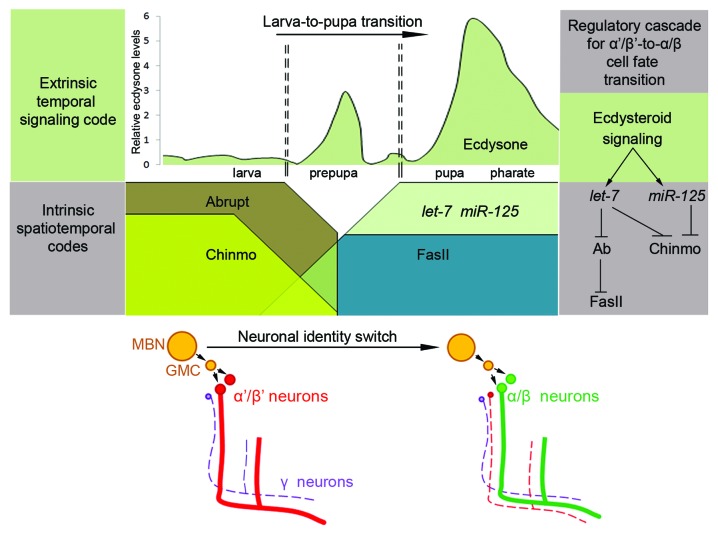
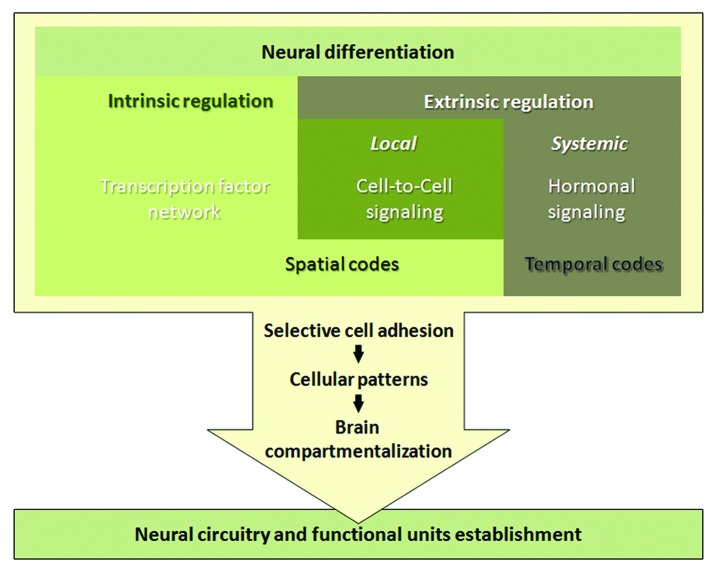
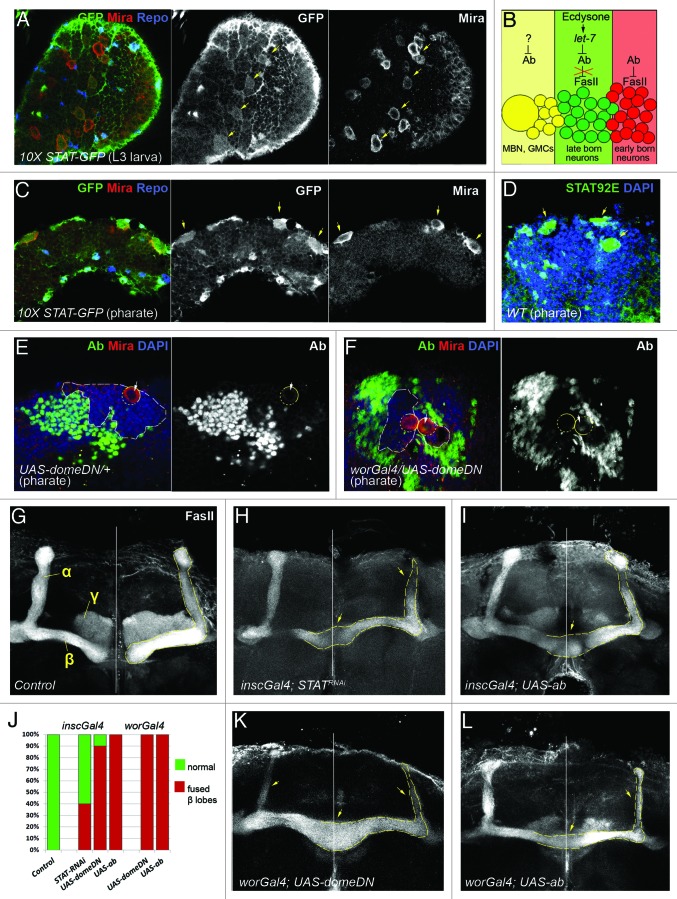
The generation of neuronal cell diversity is controlled by interdependent mechanisms, including cell intrinsic programs and environmental cues. During development, the astonishing variety of neurons is originated according to a precise timetable that is managed by a complex network of genes specifying individual types of neurons. Different neurons express specific sets of transcription factors, and they can be recognized by morphological characteristics and spatial localization, but, most importantly, they connect to each other and form functional units in a stereotyped fashion. This connectivity depends, mostly, on selective cell adhesion that is strictly regulated. While intrinsic factors specifying neuronal temporal identity have been extensively studied, an extrinsic temporal factor controlling neuronal temporal identity switch has not been shown. Our data demonstrate that pulses of steroid hormone act as a temporal cue to fine-tune neuronal cell differentiation. Here we also provide evidence that extrinsic JAK/STAT cytokine signaling acts as a spatial code in the process. Particularly, in Drosophila mushroom bodies, neuronal identity transition is controlled by steroid-dependent microRNAs that regulate spatially distributed cytokine-dependent signaling factors that in turn modulate cell adhesion. A new era of neuronal plasticity assessment via managing external temporal cues such as hormones and cytokines that specify individual types of neurons might open new possibilities for brain regenerative therapeutics.
神经元细胞多样性的产生受相互依存的机制控制,包括细胞内在程序和环境线索。在发育过程中,惊人多样的神经元是按照精确的时间表产生的,该时间表由一个复杂的基因网络管理,这些基因指定了个体类型的神经元。不同的神经元表达特定的转录因子集,并且可以通过形态特征和空间定位来识别,但最重要的是,它们以固定的方式相互连接并形成功能单元。这种连接性主要取决于受到严格调控的选择性细胞黏附。虽然已经广泛研究了指定神经元时间身份的内在因素,但尚未发现控制神经元时间身份转换的外在时间因素。我们的数据表明,类固醇激素脉冲作为一种时间线索来微调神经元细胞分化。在这里,我们还提供证据表明外在的JAK/STAT细胞因子信号传导在此过程中充当空间编码。特别是,在果蝇蘑菇体中,神经元身份转变由类固醇依赖性微小RNA控制,这些微小RNA调节空间分布的细胞因子依赖性信号因子,进而调节细胞黏附。通过控制诸如指定个体类型神经元的激素和细胞因子等外部时间线索来评估神经元可塑性的新时代,可能为脑再生治疗开辟新的可能性。