MRC Social, Genetic and Developmental Psychiatry Centre, Institute of Psychiatry, King's College London, De Crespigny Park, London, SE5 8AF, UK,
J Abnorm Child Psychol. 2014 Jan;42(1):127-36. doi: 10.1007/s10802-013-9771-7.
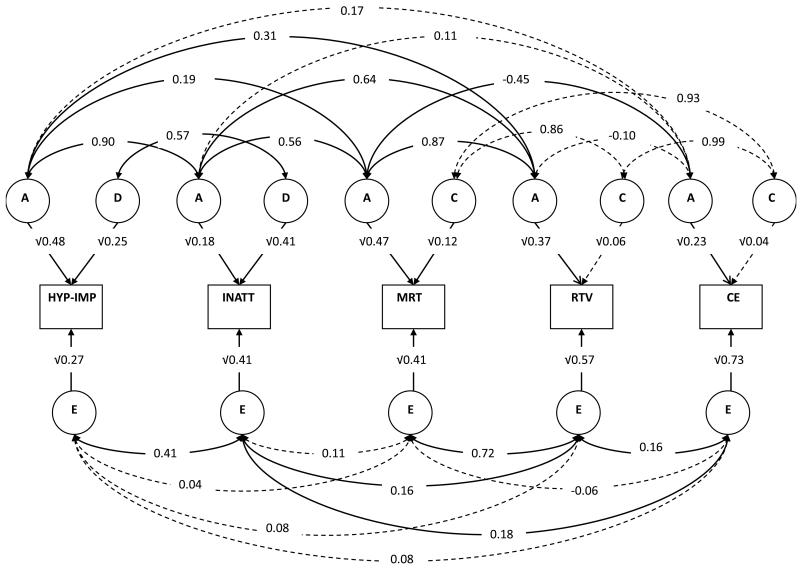
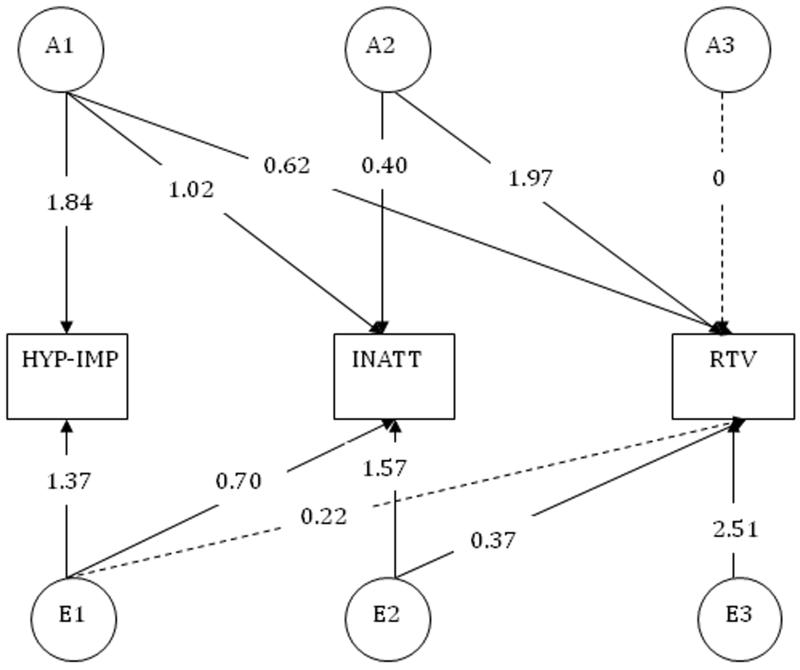
Both shared and unique genetic risk factors underlie the two symptom domains of attention deficit hyperactivity disorder (ADHD): inattention and hyperactivity-impulsivity. The developmental course and relationship to co-occurring disorders differs across the two symptom domains, highlighting the importance of their partially distinct etiologies. Familial cognitive impairment factors have been identified in ADHD, but whether they show specificity in relation to the two ADHD symptom domains remains poorly understood. We aimed to investigate whether different cognitive impairments are genetically linked to the ADHD symptom domains of inattention versus hyperactivity-impulsivity. We conducted multivariate genetic model fitting analyses on ADHD symptom scores and cognitive data, from go/no-go and fast tasks, collected on a population twin sample of 1,312 children aged 7-10. Reaction time variability (RTV) showed substantial genetic overlap with inattention, as observed in an additive genetic correlation of 0.64, compared to an additive genetic correlation of 0.31 with hyperactivity-impulsivity. Commission errors (CE) showed low additive genetic correlations with both hyperactivity-impulsivity and inattention (genetic correlations of 0.17 and 0.11, respectively). The additive genetic correlation between RTV and CE was also low and non-significant at -0.10, consistent with the etiological separation between the two indices of cognitive impairments. Overall, two key cognitive impairments phenotypically associated with ADHD symptoms, captured by RTV and CE, showed different genetic relationships to the two ADHD symptom domains. The findings extend a previous model of two familial cognitive impairment factors in combined subtype ADHD by separating pathways underlying inattention and hyperactivity-impulsivity symptoms.
共同和独特的遗传风险因素是注意缺陷多动障碍(ADHD)两个症状领域的基础:注意力不集中和多动冲动。这两个症状领域的发展过程和与共病障碍的关系不同,突出了它们部分不同病因的重要性。ADHD 中已经确定了家族性认知障碍因素,但它们与 ADHD 的两个症状领域之间是否存在特异性仍知之甚少。我们旨在研究不同的认知障碍是否与 ADHD 的注意力不集中与多动冲动两个症状领域在遗传上相关。我们对来自人群双胞胎样本的 1312 名 7-10 岁儿童的 ADHD 症状评分和认知数据(来自 Go/No-Go 和快速任务)进行了多变量遗传模型拟合分析。反应时变异性(RTV)与注意力不集中具有实质性的遗传重叠,表现在加性遗传相关性为 0.64,而与多动冲动的加性遗传相关性为 0.31。错误率(CE)与多动冲动和注意力不集中的加性遗传相关性均较低,分别为 0.17 和 0.11。RTV 和 CE 之间的加性遗传相关性也较低且不显著,为-0.10,与这两个认知障碍指标的病因分离一致。总体而言,与 ADHD 症状相关的两个关键认知障碍,即 RTV 和 CE,与 ADHD 的两个症状领域表现出不同的遗传关系。研究结果扩展了先前在 ADHD 混合亚型中存在两个家族性认知障碍因素的模型,将注意力不集中和多动冲动症状的潜在途径分开。