Division of Pathway Medicine and Centre for Infectious Diseases, School of Biomedical Sciences, College of Medicine and Veterinary Medicine, The University of Edinburgh, Chancellor's Building, 49 Little France Crescent, Edinburgh EH16 4SB, UK.
Parasit Vectors. 2013 Jul 10;6:204. doi: 10.1186/1756-3305-6-204.
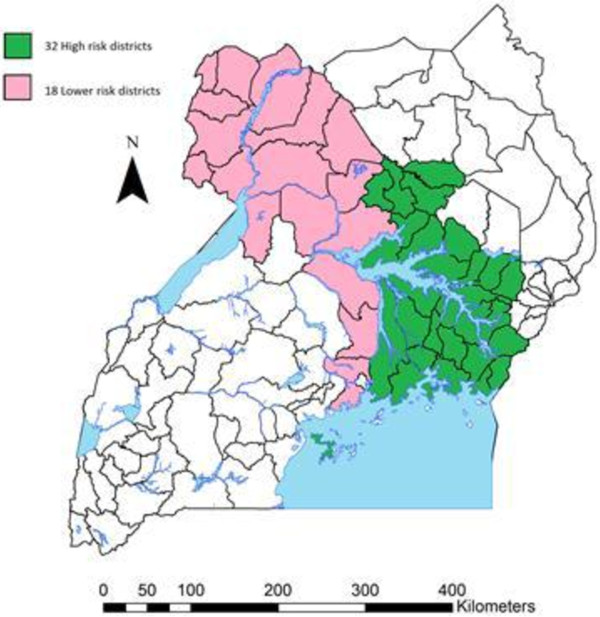
Caused by trypanosomes and transmitted by tsetse flies, Human African Trypanosomiasis and bovine trypanosomiasis remain endemic across much of rural Uganda where the major reservoir of acute human infection is cattle. Following elimination of trypanosomes by mass trypanocidal treatment, it is crucial that farmers regularly apply pyrethroid-based insecticides to cattle to sustain parasite reductions, which also protect against tick-borne diseases. The private veterinary market is divided between products only effective against ticks (amidines) and those effective against both ticks and tsetse (pyrethroids). This study explored insecticide sales, demand and use in four districts of Uganda where mass cattle treatments have been undertaken by the 'Stamp Out Sleeping Sickness' programme.
A mixed-methods study was undertaken in Dokolo, Kaberamaido, Serere and Soroti districts of Uganda between September 2011 and February 2012. This included: focus groups in 40 villages, a livestock keeper survey (n = 495), a veterinary drug shop questionnaire (n = 74), participatory methods in six villages and numerous semi-structured interviews.
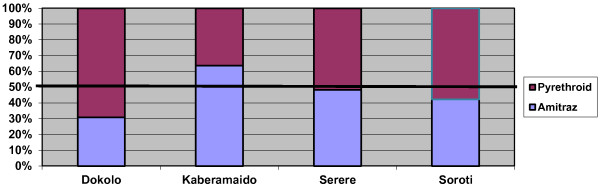
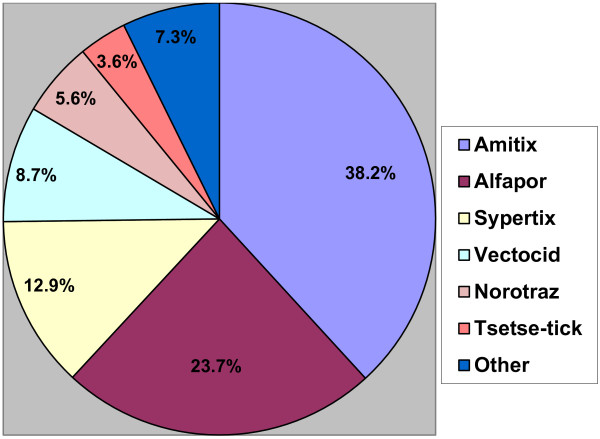
Although 70.5% of livestock keepers reportedly used insecticide each month during the rainy season, due to a variety of perceptions and practices nearly half used products only effective against ticks and not tsetse. Between 640 and 740 litres of insecticide were being sold monthly, covering an average of 53.7 cattle/km(2). Sales were roughly divided between seven pyrethroid-based products and five products only effective against ticks. In the high-risk HAT district of Kaberamaido, almost double the volume of non-tsetse effective insecticide was being sold. Factors influencing insecticide choice included: disease knowledge, brand recognition, product price, half-life and mode of product action, product availability, and dissemination of information. Stakeholders considered market restriction of non-tsetse effective products the most effective way to increase pyrethroid use.
Conflicts of interest between veterinary business and vector control were found to constrain sleeping sickness control. While a variety of strategies could increase pyrethroid use, regulation of the insecticide market could effectively double the number of treated cattle with little cost to government, donors or farmers. Such regulation is entirely consistent with the role of the state in a privatised veterinary system and should include a mitigation strategy against the potential development of tick resistance.
人类非洲锥虫病和牛锥虫病由锥虫引起,通过采采蝇传播,在乌干达农村的大部分地区仍然流行,急性人类感染的主要储存库是牛。在大规模杀灭锥虫治疗后,农民必须定期给牛使用拟除虫菊酯类杀虫剂,以维持寄生虫减少,这也可以预防蜱传疾病。私人兽医市场分为仅对蜱虫有效的产品(脒类)和对蜱虫和采采蝇都有效的产品(拟除虫菊酯类)。本研究探索了在乌干达的 Dokolo、Kaberamaido、Serere 和 Soroti 四个地区进行大规模牛治疗的“消灭昏睡病”计划中,杀虫剂的销售、需求和使用情况。
2011 年 9 月至 2012 年 2 月,在乌干达的 Dokolo、Kaberamaido、Serere 和 Soroti 四个地区进行了一项混合方法研究。其中包括:40 个村庄的焦点小组、495 名牲畜饲养员调查、74 名兽医药店问卷、6 个村庄的参与式方法和许多半结构化访谈。
尽管 70.5%的牲畜饲养员在雨季每月报告使用杀虫剂,但由于各种观念和做法,近一半人只使用对蜱虫有效的产品,而不使用对采采蝇有效的产品。每月销售约 640 至 740 升杀虫剂,平均覆盖 53.7 头牛/平方公里。销售情况大致分为七种拟除虫菊酯类产品和五种仅对蜱虫有效的产品。在高危昏睡病地区 Kaberamaido,销售的非针对采采蝇有效的杀虫剂几乎是后者的两倍。影响杀虫剂选择的因素包括:疾病知识、品牌认知度、产品价格、半衰期和产品作用方式、产品供应情况以及信息传播。利益相关者认为,限制非针对采采蝇有效的产品市场是增加拟除虫菊酯类产品使用的最有效方法。
兽医业务和病媒控制之间的利益冲突被发现限制了昏睡病的控制。虽然有多种策略可以增加拟除虫菊酯类产品的使用,但对杀虫剂市场的监管可以在不增加政府、捐助者或农民成本的情况下,将接受治疗的牛的数量增加一倍。这种监管完全符合国家在私有化兽医系统中的作用,并且应该包括一项减轻策略,以应对潜在的蜱虫耐药性的发展。