Department of Surgery, Loyola University Chicago Health Sciences Campus, Maywood, Illinois.
J Surg Res. 2013 Dec;185(2):e101-8. doi: 10.1016/j.jss.2013.06.011. Epub 2013 Jun 29.
Aspiration of gastroesophageal refluxate has been implicated in the pathogenesis of idiopathic pulmonary fibrosis (IPF) and the progression of bronchiolitis obliterans syndrome after lung transplantation. The goals of the present study were to identify lung transplant patients at the greatest risk of aspiration and to investigate the causative factors.
From September 2009 to November 2011, 252 bronchoalveolar lavage fluid (BALF) samples were collected from 100 lung transplant patients. The BALF pepsin concentrations and the results of transbronchial biopsy, esophageal function testing, barium swallow, and gastric emptying scan were compared among those with the most common end-stage lung diseases requiring lung transplantation: IPF, chronic obstructive pulmonary disease, cystic fibrosis, and α1-antitrypsin deficiency.
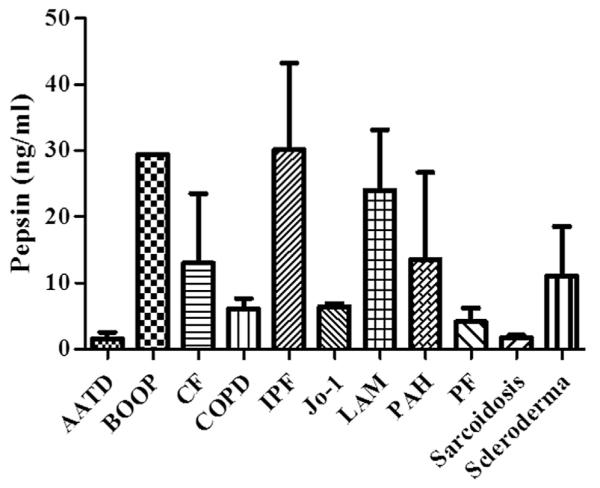
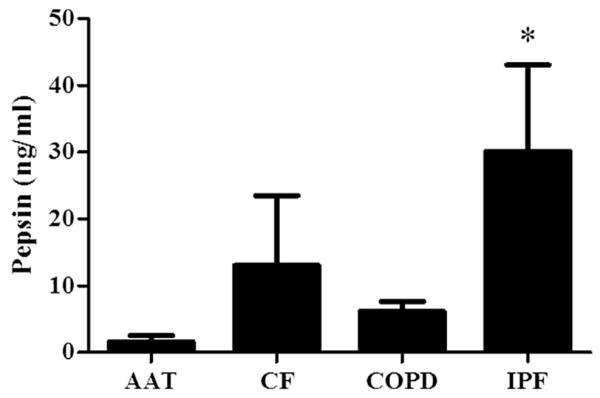
Patients with IPF had higher BALF pepsin concentrations and a greater frequency of acute rejection than those with α1-antitrypsin deficiency, cystic fibrosis, or chronic obstructive pulmonary disease (P = 0.037). Moreover, the BALF pepsin concentrations correlated negatively with a lower esophageal sphincter pressure and distal esophageal amplitude; negatively with distal esophageal amplitude and positively with total esophageal acid time, longest reflux episode, and DeMeester score in those with chronic obstructive pulmonary disease; and negatively with the upright acid clearance time in those with IPF.
Our results suggest that patients with IPF after lung transplantation are at increased risk of aspiration and a greater frequency of acute rejection episodes, and that the risk factors for aspiration might be different among those with the most common end-stage lung diseases who have undergone lung transplantation. These results support the role of evaluating the BALF for markers of aspiration in assessing lung transplant patients as candidates for antireflux surgery.
胃食管反流物的吸入与特发性肺纤维化(IPF)的发病机制以及肺移植后闭塞性细支气管炎综合征的进展有关。本研究的目的是确定发生吸入风险最大的肺移植患者,并探讨其致病因素。
2009 年 9 月至 2011 年 11 月,对 100 例肺移植患者的 252 份支气管肺泡灌洗液(BALF)样本进行了收集。比较了最常见的需要肺移植的终末期肺病(特发性肺纤维化、慢性阻塞性肺疾病、囊性纤维化和α1-抗胰蛋白酶缺乏症)患者的 BALF 胃蛋白酶浓度以及经支气管活检、食管功能检查、钡餐和胃排空扫描的结果。
与α1-抗胰蛋白酶缺乏症、囊性纤维化或慢性阻塞性肺疾病患者相比,特发性肺纤维化患者的 BALF 胃蛋白酶浓度更高,且急性排斥反应的发生率更高(P = 0.037)。此外,在慢性阻塞性肺疾病患者中,BALF 胃蛋白酶浓度与食管下括约肌压力和远端食管幅度呈负相关;与远端食管幅度呈负相关,与总食管酸时间、最长反流时间和 DeMeester 评分呈正相关;与特发性肺纤维化患者直立酸清除时间呈负相关。
我们的结果表明,肺移植后特发性肺纤维化患者发生吸入和急性排斥反应的风险增加,且发生吸入的危险因素在接受肺移植的最常见终末期肺病患者中可能不同。这些结果支持通过评估 BALF 中与吸入相关的标志物来评估肺移植患者作为抗反流手术候选者的作用。