Lang Andrew, Carass Aaron, Hauser Matthew, Sotirchos Elias S, Calabresi Peter A, Ying Howard S, Prince Jerry L
Department of Electrical and Computer Engineering, The Johns Hopkins University, Baltimore, MD 21218, USA.
Biomed Opt Express. 2013 Jun 14;4(7):1133-52. doi: 10.1364/BOE.4.001133. Print 2013 Jul 1.
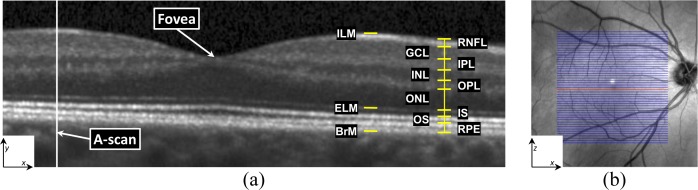
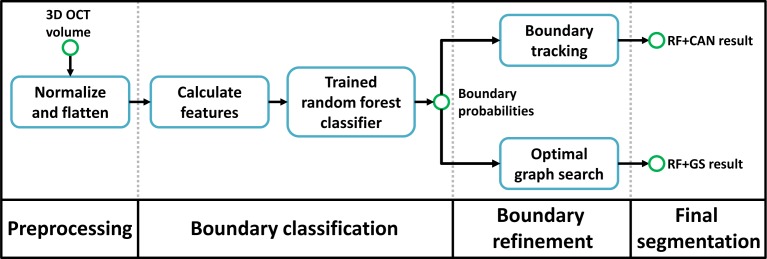
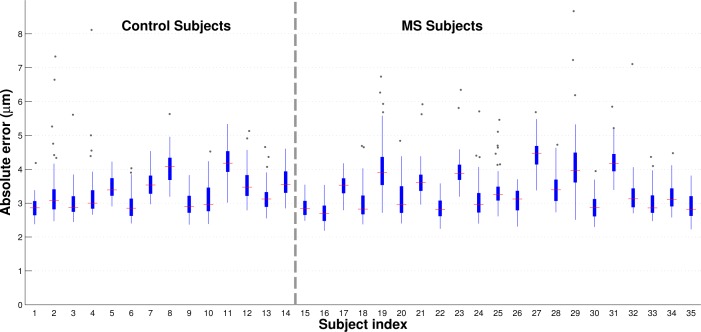
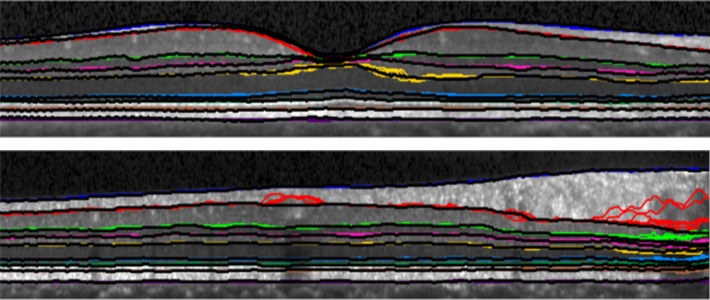
Optical coherence tomography (OCT) has proven to be an essential imaging modality for ophthalmology and is proving to be very important in neurology. OCT enables high resolution imaging of the retina, both at the optic nerve head and the macula. Macular retinal layer thicknesses provide useful diagnostic information and have been shown to correlate well with measures of disease severity in several diseases. Since manual segmentation of these layers is time consuming and prone to bias, automatic segmentation methods are critical for full utilization of this technology. In this work, we build a random forest classifier to segment eight retinal layers in macular cube images acquired by OCT. The random forest classifier learns the boundary pixels between layers, producing an accurate probability map for each boundary, which is then processed to finalize the boundaries. Using this algorithm, we can accurately segment the entire retina contained in the macular cube to an accuracy of at least 4.3 microns for any of the nine boundaries. Experiments were carried out on both healthy and multiple sclerosis subjects, with no difference in the accuracy of our algorithm found between the groups.
光学相干断层扫描(OCT)已被证明是眼科必不可少的成像方式,并且在神经学领域也显示出非常重要的作用。OCT能够对视神经乳头和黄斑处的视网膜进行高分辨率成像。黄斑视网膜层厚度提供了有用的诊断信息,并且已被证明与多种疾病的疾病严重程度指标密切相关。由于手动分割这些层既耗时又容易产生偏差,因此自动分割方法对于充分利用这项技术至关重要。在这项工作中,我们构建了一个随机森林分类器,用于分割通过OCT获取的黄斑立方图像中的八个视网膜层。随机森林分类器学习各层之间的边界像素,为每个边界生成准确的概率图,然后对其进行处理以确定边界。使用该算法,我们可以将黄斑立方体内包含的整个视网膜准确分割,对于九个边界中的任何一个,分割精度至少为4.3微米。我们对健康受试者和多发性硬化症受试者都进行了实验,发现两组之间我们算法的精度没有差异。