Department of Immunology and Medicine, Armed Forces Research Institute of Medical Sciences, Bangkok, Thailand.
Malar J. 2013 Jul 12;12:239. doi: 10.1186/1475-2875-12-239.
Performance of the histidine-rich protein-2 enzyme-linked immunosorbent assay (HRP-2 ELISA) and malaria SYBR Green I fluorescence (MSF) drug sensitivity tests were directly compared using Plasmodium falciparum reference strains and fresh ex vivo isolates from Cambodia against a panel of standard anti-malarials. The objective was to determine which of these two common assays is more appropriate for studying drug susceptibility of "immediate ex vivo" (IEV) isolates, analysed without culture adaption, in a region of relatively low malaria transmission.
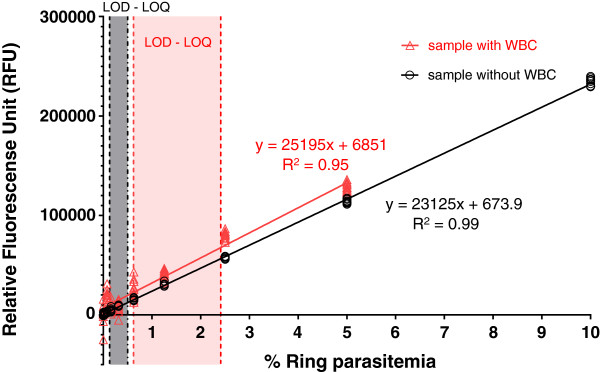
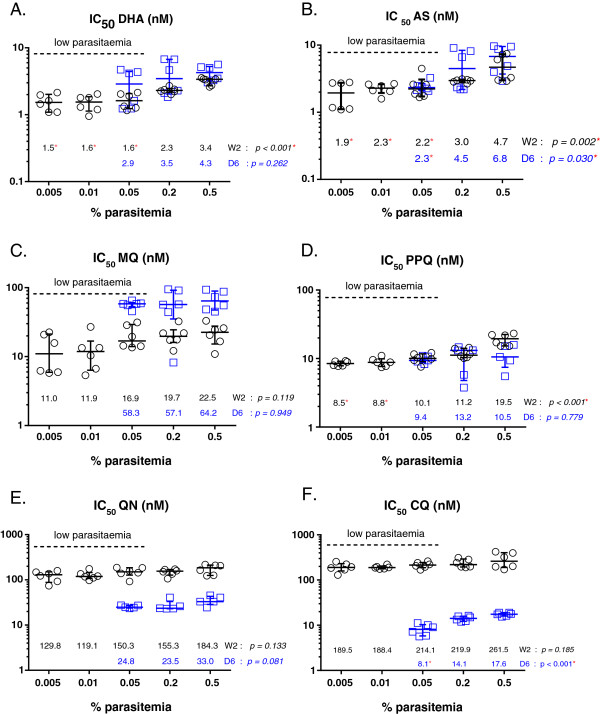
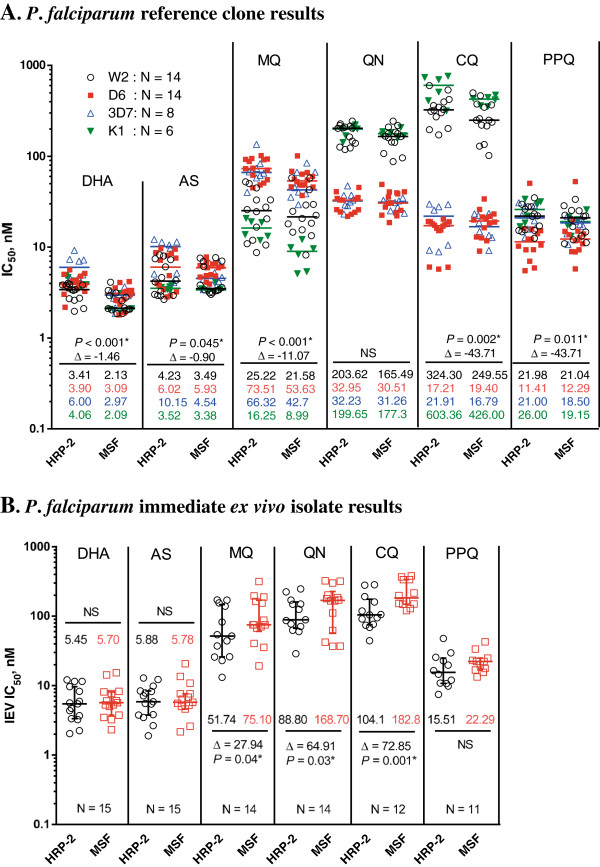
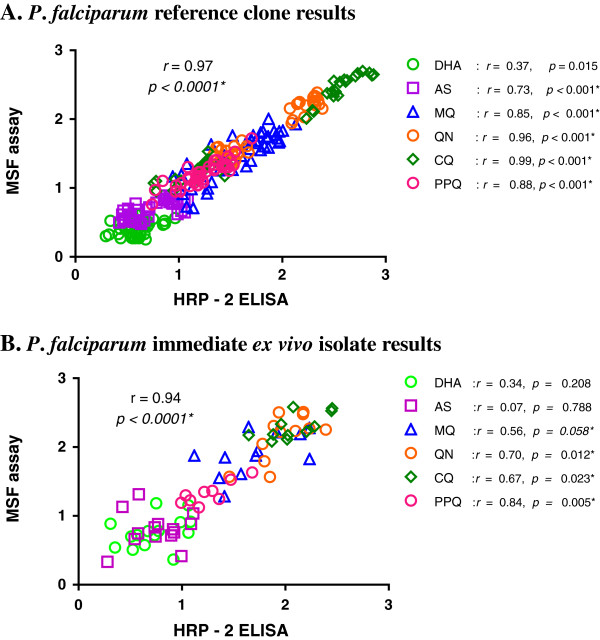
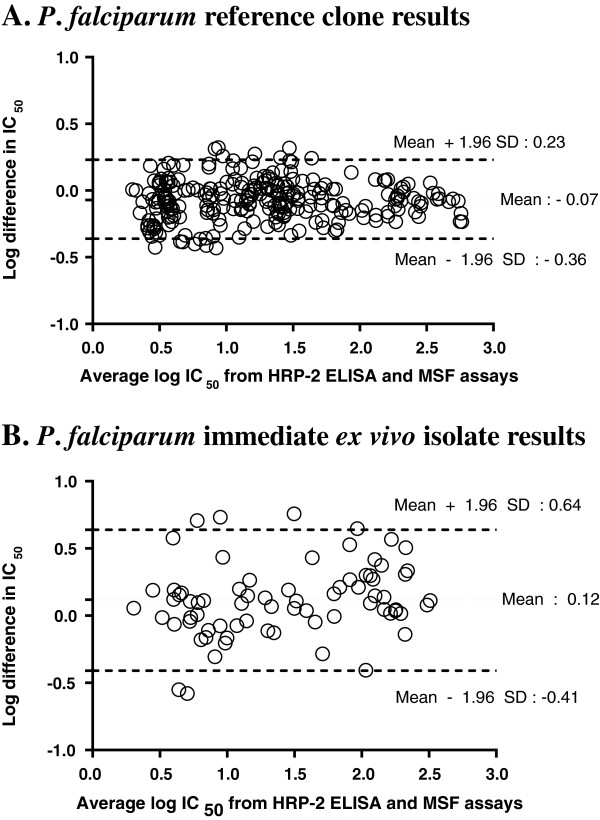
Using the HRP-2 and MSF methods, the 50% inhibitory concentration (IC50) values against a panel of malaria drugs were determined for P. falciparum reference clones (W2, D6, 3D7 and K1) and 41 IEV clinical isolates from an area of multidrug resistance in Cambodia. Comparison of the IC50 values from the two methods was made using Wilcoxon matched pair tests and Pearson's correlation. The lower limit of parasitaemia detection for both methods was determined for reference clones and IEV isolates. Since human white blood cell (WBC) DNA in clinical samples is known to reduce MSF assay sensitivity, SYBR Green I fluorescence linearity of P. falciparum samples spiked with WBCs was evaluated to assess the relative degree to which MSF sensitivity is reduced in clinical samples.
IC50 values correlated well between the HRP-2 and MSF methods when testing either P. falciparum reference clones or IEV isolates against 4-aminoquinolines (chloroquine, piperaquine and quinine) and the quinoline methanol mefloquine (Pearson r = 0.85-0.99 for reference clones and 0.56-0.84 for IEV isolates), whereas a weaker IC50 value correlation between methods was noted when testing artemisinins against reference clones and lack of correlation when testing IEV isolates. The HRP-2 ELISA produced a higher overall success rate (90% for producing IC50 best-fit sigmoidal curves), relative to only a 40% success rate for the MSF assay, when evaluating ex vivo Cambodian isolates. Reduced sensitivity of the MSF assay is likely due to an interference of WBCs in clinical samples.
For clinical samples not depleted of WBCs, HRP-2 ELISA is superior to the MSF assay at evaluating fresh P. falciparum field isolates with low parasitaemia (<0.2%) generally observed in Southeast Asia.
使用富组氨酸蛋白-2 酶联免疫吸附试验(HRP-2 ELISA)和疟疾 SYBR Green I 荧光(MSF)药物敏感性检测,直接比较恶性疟原虫参考株和柬埔寨新鲜离体分离株对标准抗疟药物的药物敏感性。目的是确定这两种常见检测方法中哪一种更适合研究相对低疟疾传播地区未经培养适应的“即时离体”(IEV)分离株的药物敏感性。
使用 HRP-2 和 MSF 方法,确定了恶性疟原虫参考克隆(W2、D6、3D7 和 K1)和柬埔寨多药耐药区 41 例 IEV 临床分离株对一系列抗疟药物的 50%抑制浓度(IC50)值。使用 Wilcoxon 匹配对检验和 Pearson 相关分析比较两种方法的 IC50 值。确定了两种方法在参考克隆和 IEV 分离株中的最低寄生虫血症检测下限。由于已知人类白细胞(WBC)DNA 会降低 MSF 检测的敏感性,因此评估了用 WBC 污染的恶性疟原虫样本中 SYBR Green I 荧光的线性度,以评估 MSF 敏感性在临床样本中降低的相对程度。
当使用 4-氨基喹啉(氯喹、哌喹和奎宁)和喹啉甲醇甲氟喹(参考克隆的 Pearson r=0.85-0.99,IEV 分离株的 0.56-0.84)测试 P. falciparum 参考克隆或 IEV 分离株时,HRP-2 和 MSF 方法的 IC50 值相关性良好,而当使用青蒿素类药物测试参考克隆时,方法间的 IC50 值相关性较弱,当测试 IEV 分离株时则无相关性。与 MSF 检测相比,HRP-2 ELISA 检测柬埔寨离体分离株时,总体成功率(产生 IC50 最佳拟合 S 型曲线的成功率为 90%)更高。MSF 检测的敏感性降低可能是由于白细胞在临床样本中的干扰。
对于未耗尽白细胞的临床样本,HRP-2 ELISA 在评估东南亚常见的低寄生虫血症(<0.2%)新鲜恶性疟原虫野外分离株时优于 MSF 检测。