University Hospital, Legon, University of Ghana, P, O, Box LG 79, Legon, Accra, Ghana.
Infect Dis Poverty. 2012 Dec 24;1(1):13. doi: 10.1186/2049-9957-1-13.
The impact of the human immunodeficiency virus (HIV) on tuberculosis (TB), and the implications for TB and HIV control, is a public health challenge in Ghana - almost a quarter (23%) of all TB cases were HIV positive in 2010. The integration of TB/HIV services has therefore emerged as an essential component of the national response to TB and HIV. The aim is to reduce fragmentation, improve access, enhance efficiency and improve quality of care. Ghana's TB/HIV policy comprises three linked sets of activities: effective implementation of the Stop TB Strategy for TB control, improved HIV prevention and care, and the implementation of additional TB/HIV activities. Different models of service delivery with increasing integration of TB/HIV activities are expected to provide greater access to more comprehensive care. The objective of this paper is to assess the impact of TB/HIV integration on TB treatment outcomes and to explore the usefulness of TB treatment outcomes as TB/HIV indicators.
A before-and-after study to observe the introduction of TB/HIV activities into TB programmes in three hospitals with different levels of integration was conducted. Anonymised patient data was collated from TB registers from each facility, and analysed to determine if TB treatment outcomes changed significantly after integration.
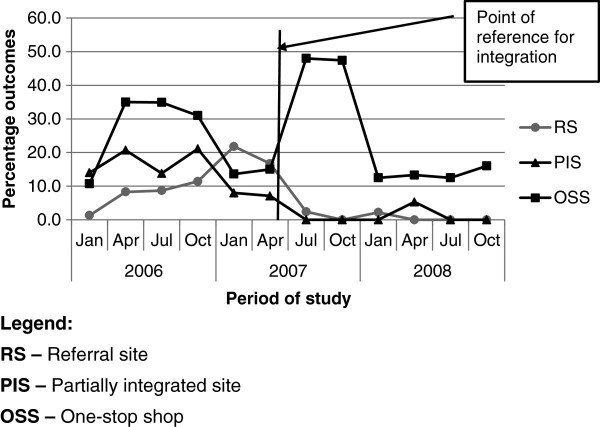
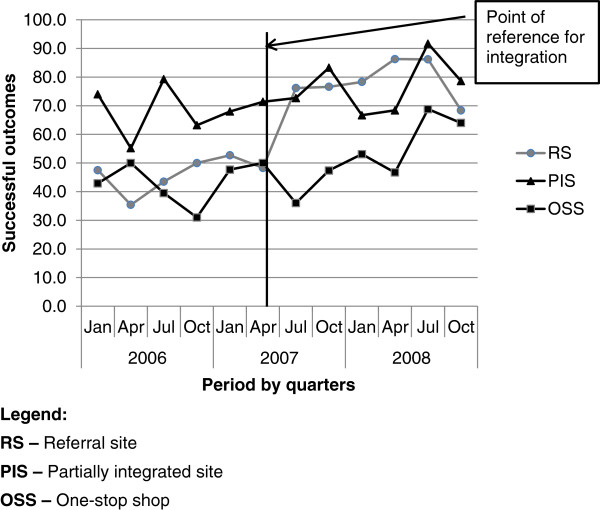
TB treatment success was 50% (95% CI 49 - 52) prior to, and 69% (95% CI 65 - 73) after, integration (Χ2 43.96, p < 0.00). Treatment success increased from 43% to 53% at the one-stop shop (OSS), from 69% to 78% at the partially integrated site (PIS) and substantially from 46% to 78% at the referral site (RS) (Χ2 64.54; p<0.01). Defaults and cases transferred out reduced from 14.3% and 15.3% prior to integration, to 1.4% and 9.0% after integration, respectively, accounting for a significant increase in treatment success. Death rates remained high at 18% in all cases studied and 25% in HIV-associated cases after integration.
TB/HIV integration may improve TB treatment success, but its exact impact is difficult to ascertain due to non-specificity and design limitations. TB mortality may be more useful as an indicator for monitoring TB/HIV activities in Ghana.
人类免疫缺陷病毒(HIV)对结核病(TB)的影响,以及对结核病和 HIV 控制的影响,是加纳面临的公共卫生挑战-2010 年,所有结核病病例中有近四分之一(23%)为 HIV 阳性。因此,结核病/艾滋病综合服务已成为国家对结核病和 HIV 应对措施的重要组成部分。目的是减少分散,改善获得途径,提高效率并改善护理质量。加纳的结核病/艾滋病政策包括三个相互关联的活动:有效实施结核病控制的《停止结核病战略》,改善艾滋病毒预防和护理以及开展更多的结核病/艾滋病活动。不同的服务提供模式,结核病/艾滋病活动的融合程度不断提高,有望为更多人提供更全面的护理。本文的目的是评估结核病/艾滋病综合服务对结核病治疗结果的影响,并探讨结核病治疗结果作为结核病/艾滋病指标的有用性。
对三家医院进行了一项前后对比研究,以观察不同融合程度的结核病/艾滋病活动引入结核病规划中的情况。从每个机构的结核病登记簿中收集匿名患者数据,并进行分析以确定融合后结核病治疗结果是否有显著变化。
整合前,结核病治疗成功率为 50%(95%CI 49-52),整合后为 69%(95%CI 65-73)(Χ2 43.96,p <0.00)。一站式服务(OSS)的治疗成功率从 43%上升到 53%,部分整合站点(PIS)从 69%上升到 78%,转诊站点(RS)从 46%大幅上升到 78%(Χ2 64.54;p <0.01)。整合前,违约和转出病例分别占 14.3%和 15.3%,整合后分别降至 1.4%和 9.0%,这导致治疗成功率显著提高。所有研究病例的死亡率仍居高不下,整合后为 18%,艾滋病毒相关病例为 25%。
结核病/艾滋病综合服务可能会提高结核病治疗成功率,但由于特异性和设计限制,其确切影响难以确定。结核病死亡率可能更适合作为监测加纳结核病/艾滋病活动的指标。