Department of Medical Physics and Bioengineering, University College London, London, UK.
Neurocritical Care Unit, University College Hospitals, London, UK.
Adv Exp Med Biol. 2013;789:353-359. doi: 10.1007/978-1-4614-7411-1_47.
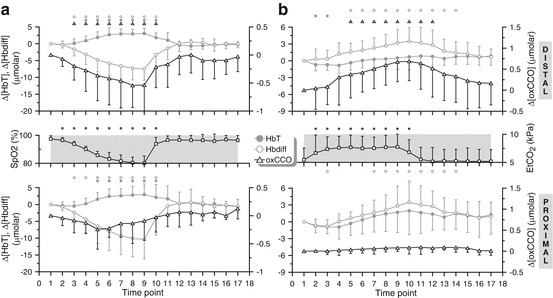
Transcranial near-infrared spectroscopy (NIRS) provides an assessment of cerebral oxygen metabolism by monitoring concentration changes in oxidised cytochrome c oxidase Δ[oxCCO]. We investigated the response of Δ[oxCCO] to global changes in cerebral oxygen delivery at different source-detector separations in 16 healthy adults. Hypoxaemia was induced by delivery of a hypoxic inspired gas mix and hypercapnia by addition of 6 % CO2 to the inspired gases. A hybrid optical spectrometer was used to measure frontal cortex light absorption and scattering at discrete wavelengths and broadband light attenuation at 20, 25, 30 and 35 mm. Without optical scattering changes, a decrease in cerebral oxygen delivery, resulting from the reduction in arterial oxygen saturation during hypoxia, led to a decrease in Δ[oxCCO]. In contrast, Δ[oxCCO] increased when cerebral oxygen delivery increased due to increased cerebral blood flow during hypercapnia. In both cases the magnitude of the Δ[oxCCO] response increased from the detectors proximal (measuring superficial tissue layers) to the detectors distal (measuring deep tissue layers) to the broadband light source. We conclude that the Δ[oxCCO] response to hypoxia and hypercapnia appears to be dependent on penetration depth, possibly reflecting differences between the intra- and extracerebral tissue concentration of cytochrome c oxidase.
经颅近红外光谱(NIRS)通过监测氧化细胞色素 c 氧化酶 Δ[oxCCO]的浓度变化来评估脑氧代谢。我们研究了在 16 名健康成年人中,不同源探测器分离时,脑氧输送全局变化对 Δ[oxCCO]的响应。通过输送低氧吸入气体混合物和向吸入气体中添加 6%CO2 来诱导低氧血症和高碳酸血症。混合光学光谱仪用于在离散波长下测量额皮质的光吸收和散射,以及在 20、25、30 和 35mm 处测量宽带光衰减。在没有光学散射变化的情况下,由于低氧期间动脉血氧饱和度降低导致脑氧输送减少,导致 Δ[oxCCO]减少。相比之下,当由于高碳酸血症导致脑血流增加导致脑氧输送增加时,Δ[oxCCO]增加。在这两种情况下,Δ[oxCCO]响应的幅度从靠近探测器(测量浅层组织层)到远离探测器(测量深层组织层)到宽带光源增加。我们得出结论,Δ[oxCCO]对缺氧和高碳酸血症的反应似乎取决于穿透深度,可能反映了细胞色素 c 氧化酶在颅内和颅外组织浓度之间的差异。