Department of Epidemiology, Harvard School of Public Health, Boston, MA.
J Am Heart Assoc. 2013 Jul 18;2(4):e000092. doi: 10.1161/JAHA.113.000092.
Evidence regarding the role of dairy fat intake in cardiovascular disease (CVD) has been mixed and inconclusive. Most earlier studies have used self-reported measures of dietary intake and focused on relatively racially homogeneous populations. Circulating biomarkers of dairy fat in a multiethnic cohort provide objective measures of dairy fat intake and facilitate conclusions relevant to populations with different diets and susceptibility to CVD.
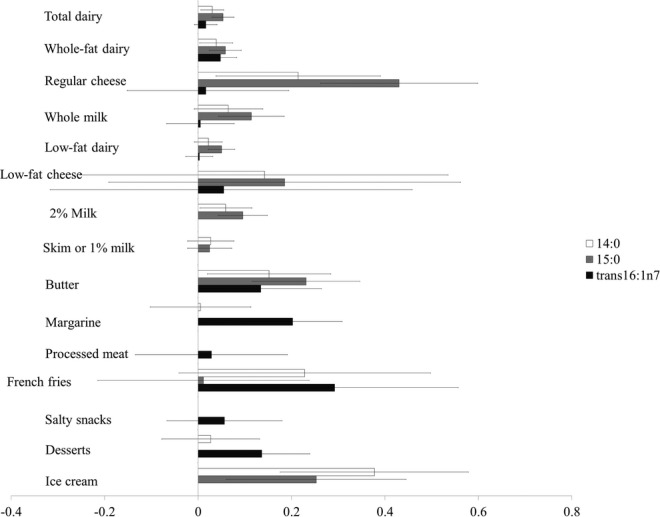
In a multiethnic cohort of 2837 US adults aged 45 to 84 years at baseline (2000-2002), phospholipid fatty acids including 15:0, 14:0, and trans-16:1n7 were measured using standardized methods, and the incidence of CVD prospectively adjudicated. Self-reported whole-fat dairy and butter intakes had strongest associations with 15:0, rather than 14:0 or trans-16:1n7. In multivariate models including demographics and lifestyle and dietary habits, each SD-unit of 15:0 was associated with 19% lower CVD risk (hazard ratio [95% CI] 0.81 [0.68 to 0.98]) and 26% lower coronary heart disease (CHD) risk (0.74 [0.60 to 0.92]). Associations were strengthened after mutual adjustment for 14:0 and trans-16:1n-7 and were similar after adjustment for potential mediators. Plasma phospholipid 14:0 and trans-16:1n-7 were not significantly associated with incident CVD or CHD. All findings were similar in white, black, Hispanic, and Chinese American participants.
Plasma phospholipid 15:0, a biomarker of dairy fat, was inversely associated with incident CVD and CHD, while no association was found with phospholipid 14:0 and trans-16:1n-7. These findings support the need for further investigation of CVD effects of dairy fat, dairy-specific fatty acids, and dairy products in general.
关于摄入乳制品脂肪与心血管疾病(CVD)之间关系的证据一直存在争议,且尚无定论。大多数早期研究都使用自我报告的饮食摄入量测量方法,并集中在相对种族单一的人群中。在一个多民族队列中,使用磷脂脂肪酸(包括 15:0、14:0 和反式 16:1n7)作为乳制品脂肪摄入量的客观测量指标,这为具有不同饮食和易患 CVD 风险的人群提供了更有意义的结论。
在一个由 2837 名年龄在 45 至 84 岁的美国成年人组成的多民族队列中(2000-2002 年),使用标准化方法测量了包括 15:0、14:0 和反式 16:1n7 在内的磷脂脂肪酸,前瞻性地判定 CVD 的发病情况。全脂乳制品和黄油的摄入量与 15:0 关联最强,而不是 14:0 或反式 16:1n7。在包含人口统计学、生活方式和饮食习惯的多变量模型中,15:0 的每标准差单位与 CVD 风险降低 19%(风险比 [95%CI]0.81[0.68 至 0.98])和冠心病(CHD)风险降低 26%(0.74[0.60 至 0.92])相关。在对 14:0 和反式 16:1n-7 进行相互调整后,关联得到了加强,在对潜在中介物进行调整后,关联仍然相似。血浆磷脂 14:0 和反式 16:1n-7 与 CVD 或 CHD 事件均无显著关联。在白人、黑人、西班牙裔和华裔美国人参与者中,所有发现均相似。
血浆磷脂 15:0 是乳制品脂肪的生物标志物,与 CVD 和 CHD 的发病呈负相关,而磷脂 14:0 和反式 16:1n-7 则没有这种关联。这些发现支持进一步研究乳制品脂肪、乳制品特定脂肪酸以及一般乳制品对 CVD 的影响。