The George Institute for Global Health, Faculty of Medicine, University of New South Wales, Sydney, Australia.
School of Medicine, The University of Western Australia, Crawley, Australia.
PLoS Med. 2021 Sep 21;18(9):e1003763. doi: 10.1371/journal.pmed.1003763. eCollection 2021 Sep.
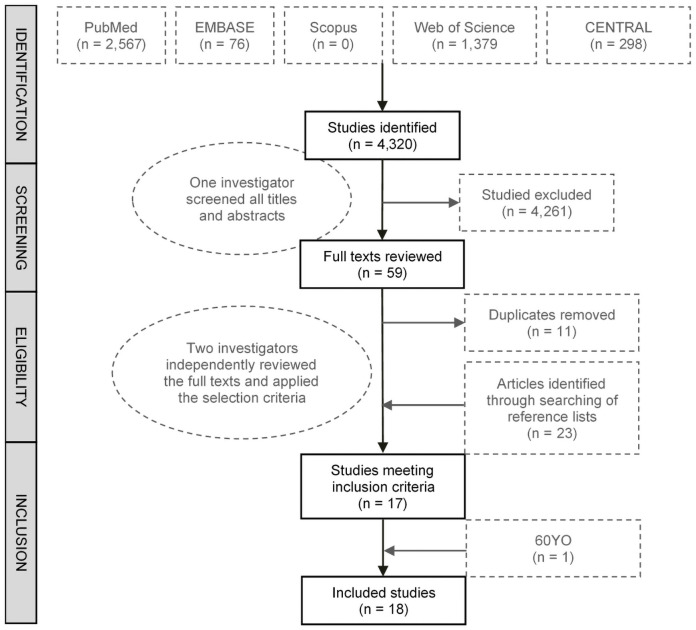
We aimed to investigate the association of serum pentadecanoic acid (15:0), a biomarker of dairy fat intake, with incident cardiovascular disease (CVD) and all-cause mortality in a Swedish cohort study. We also systematically reviewed studies of the association of dairy fat biomarkers (circulating or adipose tissue levels of 15:0, heptadecanoic acid [17:0], and trans-palmitoleic acid [t16:1n-7]) with CVD outcomes or all-cause mortality.
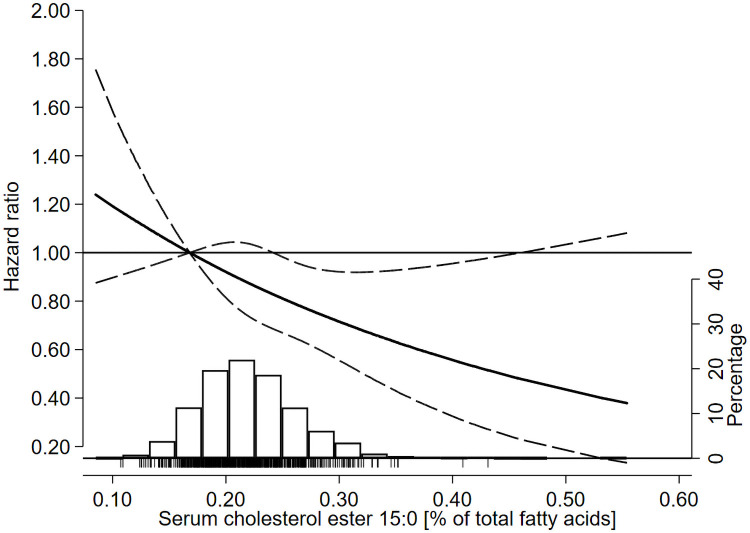
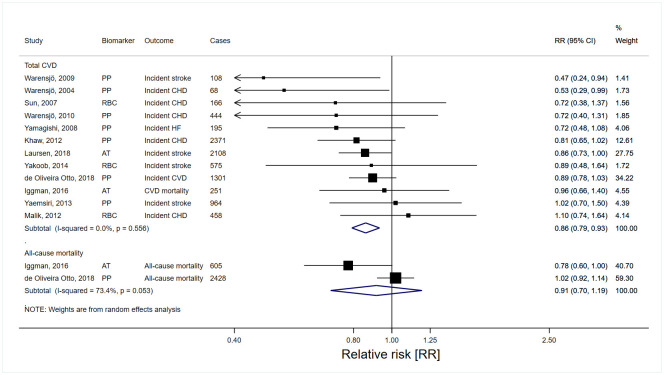
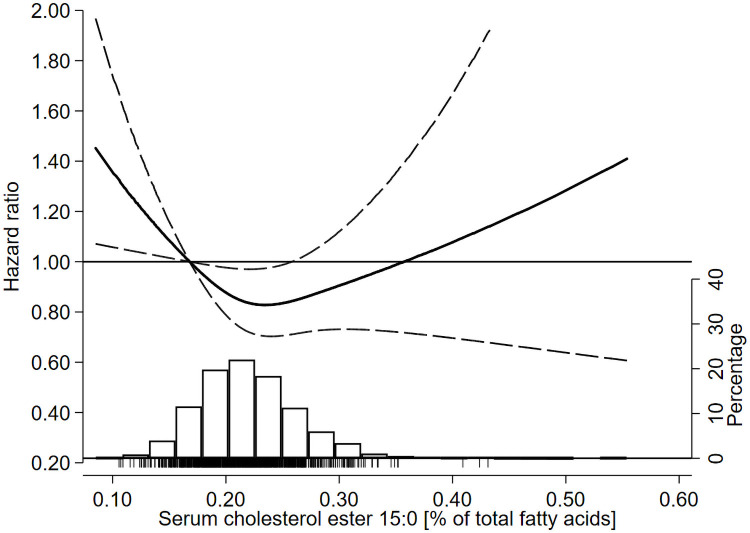
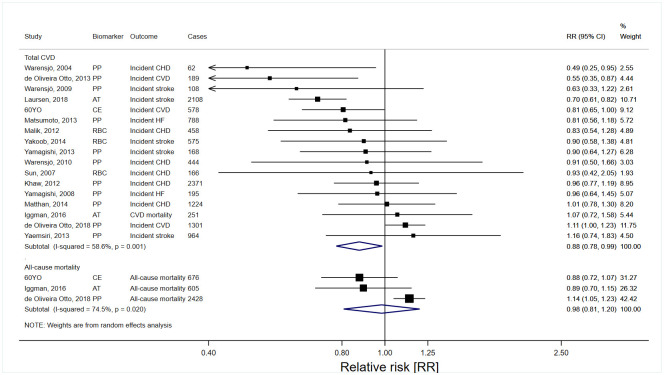
We measured 15:0 in serum cholesterol esters at baseline in 4,150 Swedish adults (51% female, median age 60.5 years). During a median follow-up of 16.6 years, 578 incident CVD events and 676 deaths were identified using Swedish registers. In multivariable-adjusted models, higher 15:0 was associated with lower incident CVD risk in a linear dose-response manner (hazard ratio 0.75 per interquintile range; 95% confidence interval 0.61, 0.93, P = 0.009) and nonlinearly with all-cause mortality (P for nonlinearity = 0.03), with a nadir of mortality risk around median 15:0. In meta-analyses including our Swedish cohort and 17 cohort, case-cohort, or nested case-control studies, higher 15:0 and 17:0 but not t16:1n-7 were inversely associated with total CVD, with the relative risk of highest versus lowest tertile being 0.88 (0.78, 0.99), 0.86 (0.79, 0.93), and 1.01 (0.91, 1.12), respectively. Dairy fat biomarkers were not associated with all-cause mortality in meta-analyses, although there were ≤3 studies for each biomarker. Study limitations include the inability of the biomarkers to distinguish different types of dairy foods and that most studies in the meta-analyses (including our novel cohort study) only assessed biomarkers at baseline, which may increase the risk of misclassification of exposure levels.
In a meta-analysis of 18 observational studies including our new cohort study, higher levels of 15:0 and 17:0 were associated with lower CVD risk. Our findings support the need for clinical and experimental studies to elucidate the causality of these relationships and relevant biological mechanisms.
我们旨在研究血清十五烷酸(15:0)与心血管疾病(CVD)和全因死亡率之间的关系,15:0 是奶制品脂肪摄入的生物标志物。我们还系统地综述了奶制品脂肪生物标志物(循环或脂肪组织中 15:0、十七烷酸[17:0]和反式棕榈油酸[t16:1n-7])与 CVD 结局或全因死亡率之间的关系。
我们在 4150 名瑞典成年人(51%为女性,中位年龄 60.5 岁)的基线血清胆固醇酯中测量了 15:0。在中位随访 16.6 年期间,使用瑞典登记处确定了 578 例 CVD 事件和 676 例死亡。在多变量调整模型中,15:0 呈线性剂量反应方式与较低的 CVD 风险相关(五分位距每增加一个单位,风险比为 0.75;95%置信区间为 0.61,0.93,P=0.009),且与全因死亡率呈非线性关系(P 值为非线性关系=0.03),死亡率风险在中位数 15:0 左右出现低谷。在包括我们的瑞典队列和 17 项队列、病例对照或巢式病例对照研究的荟萃分析中,较高的 15:0 和 17:0 但不是 t16:1n-7 与总 CVD 呈负相关,最高与最低三分位的相对风险分别为 0.88(0.78,0.99)、0.86(0.79,0.93)和 1.01(0.91,1.12)。在荟萃分析中,奶制品脂肪生物标志物与全因死亡率无关,尽管每个生物标志物的研究都≤3 项。研究局限性包括这些生物标志物无法区分不同类型的奶制品,以及荟萃分析中的大多数研究(包括我们的新队列研究)仅在基线时评估了生物标志物,这可能增加了暴露水平分类错误的风险。
在包括我们新队列研究的 18 项观察性研究的荟萃分析中,较高的 15:0 和 17:0 水平与较低的 CVD 风险相关。我们的发现支持临床和实验研究阐明这些关系的因果关系和相关的生物学机制的必要性。