London School of Hygiene and Tropical Medicine, London, United Kingdom.
PLoS One. 2013 Jul 18;8(7):e68825. doi: 10.1371/journal.pone.0068825. Print 2013.
To prepare for future HIV prevention trials, we conducted prospective cohort studies among women working in food and recreational facilities in northern Tanzania. We examined the prevalence and incidence of HIV and HSV-2, and associated risk factors.
Women aged 18-44 years working in food and recreational facilities were screened to determine their eligibility for the studies. Between 2008-2010, HIV-negative women were enrolled and followed for 12 months. At enrolment and 3-monthly, we collected socio-demographic and behavioural data, and performed clinical examinations for collection of biological specimens that were tested for reproductive tract infections. Risk factors for HIV and HSV-2 incidence were investigated using Poisson regression models.
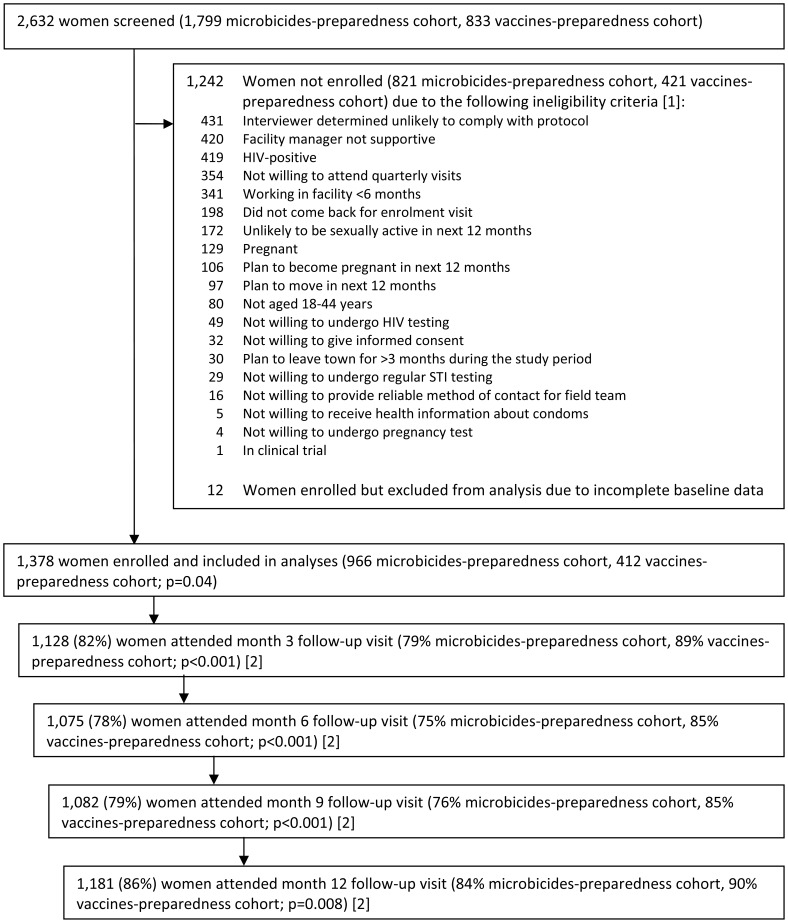
We screened 2,229 and enrolled 1,378 women. The median age was 27 years (interquartile range, IQR 22, 33), and median duration working at current facility was 2 years. The prevalences of HIV at screening and HSV-2 at enrolment were 16% and 67%, respectively. Attendance at the 12-month visit was 86%. HIV and HSV-2 incidence rates were 3.7 (95% confidence interval, CI: 2.8,5.1) and 28.6 (95% CI: 23.5,35.0)/100 person-years, respectively. Women who were separated, divorced, or widowed were at increased risk of HIV (adjusted incidence rate ratio, aRR = 6.63; 95% CI: 1.97,22.2) and HSV-2 (aRR = 2.00; 95% CI: 1.15,3.47) compared with married women. Women reporting ≥3 partners in the past 3 months were at higher HIV risk compared with women with 0-1 partner (aRR = 4.75; 95% CI: 2.10,10.8), while those who had reached secondary education or above were at lower risk of HSV-2 compared with women with incomplete primary education (aRR = 0.42; 95% CI: 0.22,0.82).
HIV and HSV-2 rates remain substantially higher in this cohort than in the general population, indicating urgent need for effective interventions. These studies demonstrate the feasibility of conducting trials to test new interventions in this highly-mobile population.
为了筹备未来的艾滋病预防试验,我们在坦桑尼亚北部从事食品和娱乐设施工作的女性中开展了前瞻性队列研究。我们检测了 HIV 和单纯疱疹病毒 2 (HSV-2)的流行率和发病率,并分析了相关的危险因素。
我们筛选了年龄在 18-44 岁之间、在食品和娱乐设施工作的女性,以确定她们是否有资格参加研究。在 2008-2010 年期间,我们招募了 HIV 阴性的女性,并对其随访 12 个月。在入组时和每 3 个月时,我们收集社会人口统计学和行为数据,并进行临床检查,以采集用于生殖道感染检测的生物标本。我们使用泊松回归模型来分析 HIV 和 HSV-2 发病率的相关危险因素。
我们共筛查了 2229 名女性,招募了 1378 名女性。中位年龄为 27 岁(四分位间距,IQR 22,33),中位在当前机构工作时间为 2 年。筛查时的 HIV 流行率和入组时的 HSV-2 流行率分别为 16%和 67%。12 个月随访的出席率为 86%。HIV 和 HSV-2 的发病率分别为 3.7(95%置信区间,CI:2.8,5.1)和 28.6(95% CI:23.5,35.0)/100 人年。与已婚女性相比,离婚、分居或丧偶的女性感染 HIV(调整发病率比,aRR=6.63;95% CI:1.97,22.2)和 HSV-2(aRR=2.00;95% CI:1.15,3.47)的风险更高。与有 0-1 个性伴侣的女性相比,过去 3 个月报告有≥3 个性伴侣的女性感染 HIV 的风险更高(aRR=4.75;95% CI:2.10,10.8),而接受过中等教育或以上教育的女性感染 HSV-2 的风险低于未完成小学教育的女性(aRR=0.42;95% CI:0.22,0.82)。
在这个队列中,HIV 和 HSV-2 的发病率仍然显著高于一般人群,这表明急需有效的干预措施。这些研究表明,在这个高度流动的人群中进行新干预措施试验是可行的。