• 文献检索
  • 文档翻译
  • 深度研究
  • 学术资讯
  • Suppr Zotero 插件Zotero 插件
  • 邀请有礼
  • 套餐&价格
  • 历史记录
应用&插件
Suppr Zotero 插件Zotero 插件浏览器插件Mac 客户端Windows 客户端微信小程序
定价
高级版会员购买积分包购买API积分包
服务
文献检索文档翻译深度研究API 文档MCP 服务
关于我们
关于 Suppr公司介绍联系我们用户协议隐私条款
关注我们

Suppr 超能文献

核心技术专利:CN118964589B侵权必究
粤ICP备2023148730 号-1Suppr @ 2026

文献检索

告别复杂PubMed语法,用中文像聊天一样搜索,搜遍4000万医学文献。AI智能推荐,让科研检索更轻松。

立即免费搜索

文件翻译

保留排版,准确专业,支持PDF/Word/PPT等文件格式,支持 12+语言互译。

免费翻译文档

深度研究

AI帮你快速写综述,25分钟生成高质量综述,智能提取关键信息,辅助科研写作。

立即免费体验

中国江西省星子县血吸虫病的空间格局:环境因素的影响。

Spatial pattern of schistosomiasis in Xingzi, Jiangxi Province, China: the effects of environmental factors.

机构信息

Department of Epidemiology, School of Public Health, Fudan University, Shanghai 200032, China.

出版信息

Parasit Vectors. 2013 Jul 24;6:214. doi: 10.1186/1756-3305-6-214.

DOI:10.1186/1756-3305-6-214
PMID:23880253
原文链接:https://pmc.ncbi.nlm.nih.gov/articles/PMC3726341/
Abstract

BACKGROUND

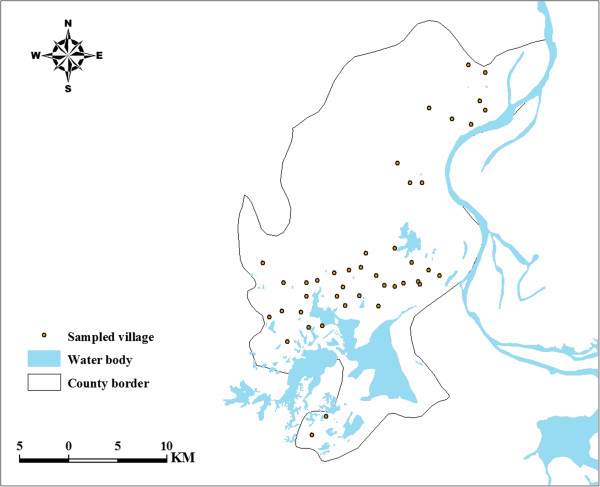
The recent rebounds of schistosomiasis in the middle and lower reaches of the Yangtze River pose a challenge to the current control strategies. In this study, identification of potential high risk snail habitats was proposed, as an alternative sustainable control strategy, in Xingzi County, China. Parasitological data from standardized surveys were available for 36,208 locals (aged between 6-65 years) from 42 sample villages across the county and used in combination with environmental data to investigate the spatial pattern of schistosomiasis risks.

METHODS

Environmental factors measured at village level were examined as possible risk factors by fitting a logistic regression model to schsitosomiasis risk. The approach of ordinary kriging was then used to predict the prevalence of schistosomiasis over the whole county.

RESULTS

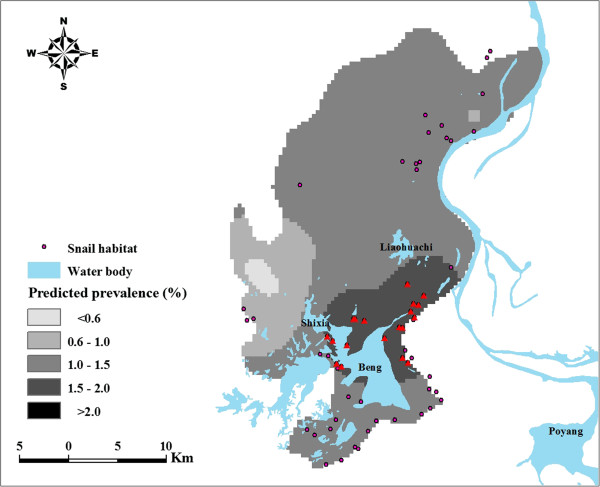
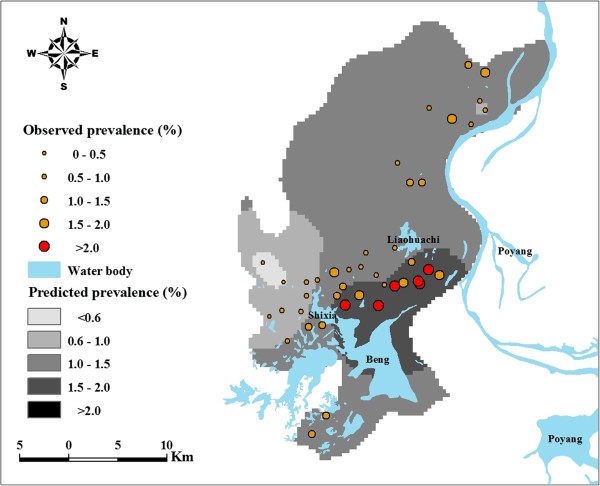
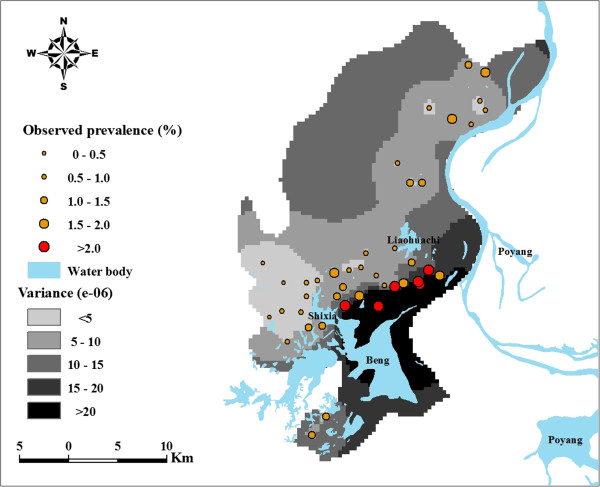
Risk analysis indicated that distance to snail habitat and wetland, rainfall, land surface temperature, hours of daylight, and vegetation are significantly associated with infection and the residual spatial pattern of infection showed no spatial correlation. The predictive map illustrated that high risk regions were located close to Beng Lake, Liaohuachi Lake, and Shixia Lake.

CONCLUSIONS

Those significant environmental factors can perfectly explain spatial variation in infection and the high risk snail habitats delineated by the predicted map of schistosomiasis risks will help local decision-makers to develop a more sustainable control strategy.

摘要

背景

长江中下游地区血吸虫病的近期反弹对当前的控制策略构成了挑战。本研究在中国星子县提出了一种潜在的有针对性的可持续控制策略,即确定有螺环境的高风险区域。结合环境数据,对全县 42 个抽样村的 36208 名(年龄在 6-65 岁之间)当地居民进行了标准化调查的寄生虫学数据,用于调查血吸虫病风险的空间模式。

方法

通过拟合逻辑回归模型,将村级测量的环境因素作为可能的风险因素进行检验,探讨血吸虫病风险。然后采用普通克里金法对全县的血吸虫病流行情况进行预测。

结果

风险分析表明,与感染相关的因素有螺环境和湿地的距离、降雨量、地表温度、日照时间和植被,而感染的残差空间模式无空间相关性。预测图表明,高风险区域靠近滨湖北部、蓼花池和石峡池。

结论

这些显著的环境因素可以很好地解释感染的空间变化,预测的血吸虫病高风险有螺环境图有助于地方决策者制定更可持续的控制策略。
https://cdn.ncbi.nlm.nih.gov/pmc/blobs/f7b1/3726341/873c6aa226f9/1756-3305-6-214-4.jpg
https://cdn.ncbi.nlm.nih.gov/pmc/blobs/f7b1/3726341/1e13f1584eb9/1756-3305-6-214-1.jpg
https://cdn.ncbi.nlm.nih.gov/pmc/blobs/f7b1/3726341/e40f64217663/1756-3305-6-214-2.jpg
https://cdn.ncbi.nlm.nih.gov/pmc/blobs/f7b1/3726341/32bd49ba8946/1756-3305-6-214-3.jpg
https://cdn.ncbi.nlm.nih.gov/pmc/blobs/f7b1/3726341/873c6aa226f9/1756-3305-6-214-4.jpg
https://cdn.ncbi.nlm.nih.gov/pmc/blobs/f7b1/3726341/1e13f1584eb9/1756-3305-6-214-1.jpg
https://cdn.ncbi.nlm.nih.gov/pmc/blobs/f7b1/3726341/e40f64217663/1756-3305-6-214-2.jpg
https://cdn.ncbi.nlm.nih.gov/pmc/blobs/f7b1/3726341/32bd49ba8946/1756-3305-6-214-3.jpg
https://cdn.ncbi.nlm.nih.gov/pmc/blobs/f7b1/3726341/873c6aa226f9/1756-3305-6-214-4.jpg

相似文献

1
Spatial pattern of schistosomiasis in Xingzi, Jiangxi Province, China: the effects of environmental factors.中国江西省星子县血吸虫病的空间格局:环境因素的影响。
Parasit Vectors. 2013 Jul 24;6:214. doi: 10.1186/1756-3305-6-214.
2
Comparison of data-fitting models for schistosomiasis: a case study in Xingzi, China.血吸虫病数据拟合模型比较:以中国星子为例的案例研究
Geospat Health. 2013 Nov;8(1):125-32. doi: 10.4081/gh.2013.60.
3
Assessing environmental factors associated with regional schistosomiasis prevalence in Anhui Province, Peoples' Republic of China using a geographical detector method.运用地理探测器方法评估中华人民共和国安徽省与地区血吸虫病流行率相关的环境因素。
Infect Dis Poverty. 2017 Apr 17;6(1):87. doi: 10.1186/s40249-017-0299-x.
4
Long-term impact of the World Bank Loan Project for schistosomiasis control: a comparison of the spatial distribution of schistosomiasis risk in China.长期影响的世界银行贷款项目防治血吸虫病:比较的空间分布的血吸虫病在中国的风险。
PLoS Negl Trop Dis. 2012;6(4):e1620. doi: 10.1371/journal.pntd.0001620. Epub 2012 Apr 17.
5
Dynamics of spatiotemporal distribution of schistosomiasis in Hubei Province, China.中国湖北省血吸虫病时空分布动态
Acta Trop. 2018 Apr;180:88-96. doi: 10.1016/j.actatropica.2018.01.004. Epub 2018 Jan 10.
6
Identifying Spatial Clusters of Schistosomiasis in Anhui Province of China: A Study from the Perspective of Application.中国安徽省血吸虫病空间聚集性识别:基于应用视角的研究
Int J Environ Res Public Health. 2015 Sep 18;12(9):11756-69. doi: 10.3390/ijerph120911756.
7
Spatial analysis of Schistosomiasis in Hubei Province, China: a GIS-based analysis of Schistosomiasis from 2009 to 2013.中国湖北省血吸虫病的空间分析:基于地理信息系统(GIS)的2009年至2013年血吸虫病分析
PLoS One. 2015 Apr 7;10(4):e0118362. doi: 10.1371/journal.pone.0118362. eCollection 2015.
8
Spatio-temporal transmission and environmental determinants of Schistosomiasis Japonica in Anhui Province, China.中国安徽省日本血吸虫病的时空传播及环境决定因素
PLoS Negl Trop Dis. 2015 Feb 6;9(2):e0003470. doi: 10.1371/journal.pntd.0003470. eCollection 2015 Feb.
9
[Administrative village-based spatial distribution specificity of and its relationship with water systems in Hubei Province].[湖北省行政村层面的空间分布特征及其与水系的关系]
Zhongguo Xue Xi Chong Bing Fang Zhi Za Zhi. 2019 Sep 25;31(4):374-381. doi: 10.16250/j.32.1374.2018296.
10
Village-based spatio-temporal cluster analysis of the schistosomiasis risk in the Poyang Lake Region, China.鄱阳湖地区以村落为基础的血吸虫病时空聚集性分析。
Parasit Vectors. 2017 Mar 8;10(1):136. doi: 10.1186/s13071-017-2059-y.

引用本文的文献

1
Predicting Climate Change Impact on the Habitat Suitability of the Intermediate Host in the Yangtze River Economic Belt of China.预测气候变化对中国长江经济带中间宿主栖息地适宜性的影响。
Biology (Basel). 2024 Jun 27;13(7):480. doi: 10.3390/biology13070480.
2
Unraveling trends in schistosomiasis: deep learning insights into national control programs in China.揭示血吸虫病趋势:深度学习洞察中国国家控制规划。
Epidemiol Health. 2024;46:e2024039. doi: 10.4178/epih.e2024039. Epub 2024 Mar 13.
3
Environmental Determinants for Snail Density in Dongting Lake Region: An Ecological Study Incorporating Spatial Regression.

本文引用的文献

1
A diagnostic challenge for Schistosomiasis japonica in China: consequences on praziquantel-based morbidity control.在中国,日本血吸虫病的诊断面临挑战:对基于吡喹酮的发病率控制的影响。
Parasit Vectors. 2011 Oct 7;4:194. doi: 10.1186/1756-3305-4-194.
2
Use of Bayesian geostatistical prediction to estimate local variations in Schistosoma haematobium infection in western Africa.应用贝叶斯地质统计学预测来估计西非地区埃及血吸虫感染的局部变化。
Bull World Health Organ. 2009 Dec;87(12):921-9. doi: 10.2471/BLT.08.058933. Epub 2009 Jul 27.
3
Schistosomiasis in the People's Republic of China: the era of the Three Gorges Dam.
洞庭湖地区钉螺密度的环境决定因素:纳入空间回归的生态研究。
Am J Trop Med Hyg. 2022 Nov 14;107(6):1178-1184. doi: 10.4269/ajtmh.22-0238. Print 2022 Dec 14.
4
Spatial Analysis of Schistosomiasis in Hunan and Jiangxi Provinces in the People's Republic of China.中华人民共和国湖南省和江西省血吸虫病的空间分析
Diseases. 2022 Oct 19;10(4):93. doi: 10.3390/diseases10040093.
5
Models for predicting bulinids species habitats in southwestern Nigeria.尼日利亚西南部椎实螺物种栖息地预测模型。
Parasite Epidemiol Control. 2022 May 30;18:e00256. doi: 10.1016/j.parepi.2022.e00256. eCollection 2022 Aug.
6
Predictive Risk Mapping of Schistosomiasis in Madagascar Using Ecological Niche Modeling and Precision Mapping.利用生态位建模和精确绘图对马达加斯加血吸虫病进行预测性风险绘图
Trop Med Infect Dis. 2022 Jan 19;7(2):15. doi: 10.3390/tropicalmed7020015.
7
Dynamic evolution of schistosomiasis distribution under different control strategies: Results from surveillance covering 1991-2014 in Guichi, China.不同防治策略下血吸虫病分布的动态演变:中国贵池 1991-2014 年监测结果。
PLoS Negl Trop Dis. 2021 Jan 6;15(1):e0008976. doi: 10.1371/journal.pntd.0008976. eCollection 2021 Jan.
8
Asian Schistosomiasis: Current Status and Prospects for Control Leading to Elimination.亚洲血吸虫病:当前状况及实现消除的控制前景
Trop Med Infect Dis. 2019 Feb 26;4(1):40. doi: 10.3390/tropicalmed4010040.
9
The Three Gorges Dam: Does the Flooding Time Determine the Distribution of Schistosome-Transmitting Snails in the Middle and Lower Reaches of the Yangtze River, China?三峡大坝:洪水时间是否决定了中国长江中下游地区血吸虫传播钉螺的分布?
Int J Environ Res Public Health. 2018 Jun 21;15(7):1304. doi: 10.3390/ijerph15071304.
10
River networks as ecological corridors: A coherent ecohydrological perspective.作为生态廊道的河网:一个连贯的生态水文视角
Adv Water Resour. 2018 Feb;112:27-58. doi: 10.1016/j.advwatres.2017.10.005.
中国的血吸虫病:三峡大坝时代。
Clin Microbiol Rev. 2010 Apr;23(2):442-66. doi: 10.1128/CMR.00044-09.
4
Distinct genetic diversity of Oncomelania hupensis, intermediate host of Schistosoma japonicum in mainland China as revealed by ITS sequences.中国大陆日本血吸虫中间宿主湖北钉螺的 ITS 序列揭示的遗传多样性差异。
PLoS Negl Trop Dis. 2010 Mar 2;4(3):e611. doi: 10.1371/journal.pntd.0000611.
5
Location of active transmission sites of Schistosoma japonicum in lake and marshland regions in China.中国湖泊和沼泽地区日本血吸虫活跃传播位点的定位
Parasitology. 2009 Jun;136(7):737-46. doi: 10.1017/S0031182009005885. Epub 2009 May 6.
6
Identifying high-risk regions for schistosomiasis in Guichi, China: a spatial analysis.中国贵池地区血吸虫病高危区域识别:一项空间分析
Acta Trop. 2008 Sep;107(3):217-23. doi: 10.1016/j.actatropica.2008.04.027. Epub 2008 May 15.
7
Bayesian modelling of geostatistical malaria risk data.疟疾病理风险数据的贝叶斯地理统计建模
Geospat Health. 2006 Nov;1(1):127-39. doi: 10.4081/gh.2006.287.
8
Bayesian spatio-temporal modeling of Schistosoma japonicum prevalence data in the absence of a diagnostic 'gold' standard.贝叶斯时空模型在缺乏诊断“金标准”的情况下对日本血吸虫病流行数据的建模。
PLoS Negl Trop Dis. 2008 Jun 11;2(6):e250. doi: 10.1371/journal.pntd.0000250.
9
Epidemiology of schistosomiasis in the People's Republic of China, 2004.2004年中华人民共和国血吸虫病流行病学
Emerg Infect Dis. 2007 Oct;13(10):1470-6. doi: 10.3201/eid1310.061423.
10
Bridges to sustainable tropical health.通往可持续热带健康的桥梁。
Proc Natl Acad Sci U S A. 2007 Oct 9;104(41):16038-43. doi: 10.1073/pnas.0700900104. Epub 2007 Oct 3.