State Key Laboratory of Brain and Cognitive Science; Institute of Biophysics; Chinese Academy of Sciences; Beijing, China.
Cell Adh Migr. 2013 Jul-Aug;7(4):333-44. doi: 10.4161/cam.25521. Epub 2013 Jun 27.
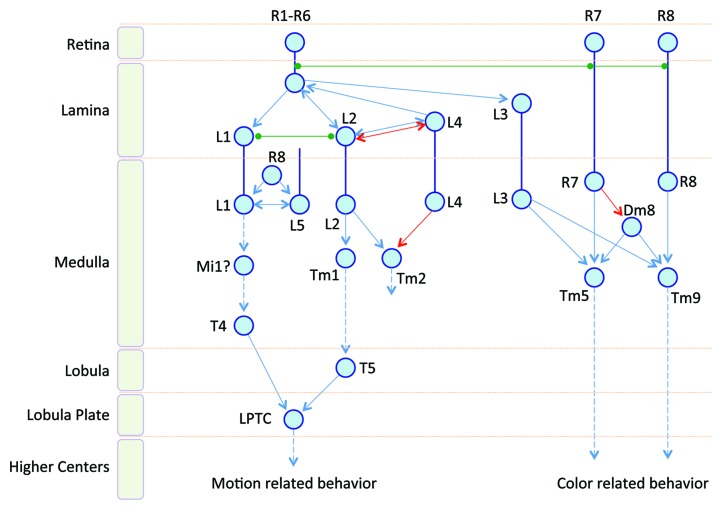
A compact genome and a tiny brain make Drosophila the prime model to understand the neural substrate of behavior. The neurogenetic efforts to reveal neural circuits underlying Drosophila vision started about half a century ago, and now the field is booming with sophisticated genetic tools, rich behavioral assays, and importantly, a greater number of scientists joining from different backgrounds. This review will briefly cover the structural anatomy of the Drosophila visual system, the animal's visual behaviors, the genes involved in assembling these circuits, the new and powerful techniques, and the challenges ahead for ultimately identifying the general principles of biological computation in the brain.
一个紧凑的基因组和一个微小的大脑使果蝇成为理解行为神经基础的主要模型。大约半个世纪前,神经遗传学开始努力揭示果蝇视觉背后的神经回路,现在这个领域正蓬勃发展,拥有复杂的遗传工具、丰富的行为分析,而且更重要的是,越来越多来自不同背景的科学家加入其中。这篇综述将简要介绍果蝇视觉系统的结构解剖、动物的视觉行为、组装这些回路涉及的基因、新的强大技术,以及最终确定大脑中生物计算一般原理所面临的挑战。