Kell Douglas B, Goodacre Royston
School of Chemistry and Manchester Institute of Biotechnology, The University of Manchester, 131 Princess Street, Manchester M1 7DN, UK.
School of Chemistry and Manchester Institute of Biotechnology, The University of Manchester, 131 Princess Street, Manchester M1 7DN, UK.
Drug Discov Today. 2014 Feb;19(2):171-82. doi: 10.1016/j.drudis.2013.07.014. Epub 2013 Jul 26.
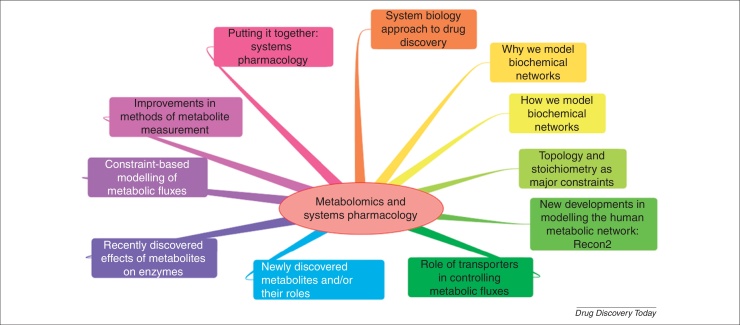
Metabolism represents the 'sharp end' of systems biology, because changes in metabolite concentrations are necessarily amplified relative to changes in the transcriptome, proteome and enzyme activities, which can be modulated by drugs. To understand such behaviour, we therefore need (and increasingly have) reliable consensus (community) models of the human metabolic network that include the important transporters. Small molecule 'drug' transporters are in fact metabolite transporters, because drugs bear structural similarities to metabolites known from the network reconstructions and from measurements of the metabolome. Recon2 represents the present state-of-the-art human metabolic network reconstruction; it can predict inter alia: (i) the effects of inborn errors of metabolism; (ii) which metabolites are exometabolites, and (iii) how metabolism varies between tissues and cellular compartments. However, even these qualitative network models are not yet complete. As our understanding improves so do we recognise more clearly the need for a systems (poly)pharmacology.
新陈代谢代表了系统生物学的“关键环节”,因为相对于转录组、蛋白质组和酶活性的变化,代谢物浓度的变化必然会被放大,而这些变化可由药物调节。因此,为了理解这种行为,我们需要(并且越来越多地拥有)包含重要转运蛋白的人类代谢网络的可靠共识(群体)模型。小分子“药物”转运蛋白实际上就是代谢物转运蛋白,因为药物与从网络重建和代谢组测量中已知的代谢物具有结构相似性。Recon2代表了当前最先进的人类代谢网络重建;它尤其可以预测:(i)先天性代谢缺陷的影响;(ii)哪些代谢物是外排代谢物,以及(iii)代谢在不同组织和细胞区室之间如何变化。然而,即使是这些定性的网络模型也尚未完善。随着我们理解的提高,我们也更清楚地认识到系统(多)药理学的必要性。