School of Computer Science and Manchester Institute of Biotechnology, The University of Manchester, Manchester, United Kingdom.
PLoS One. 2013;8(2):e54201. doi: 10.1371/journal.pone.0054201. Epub 2013 Feb 5.
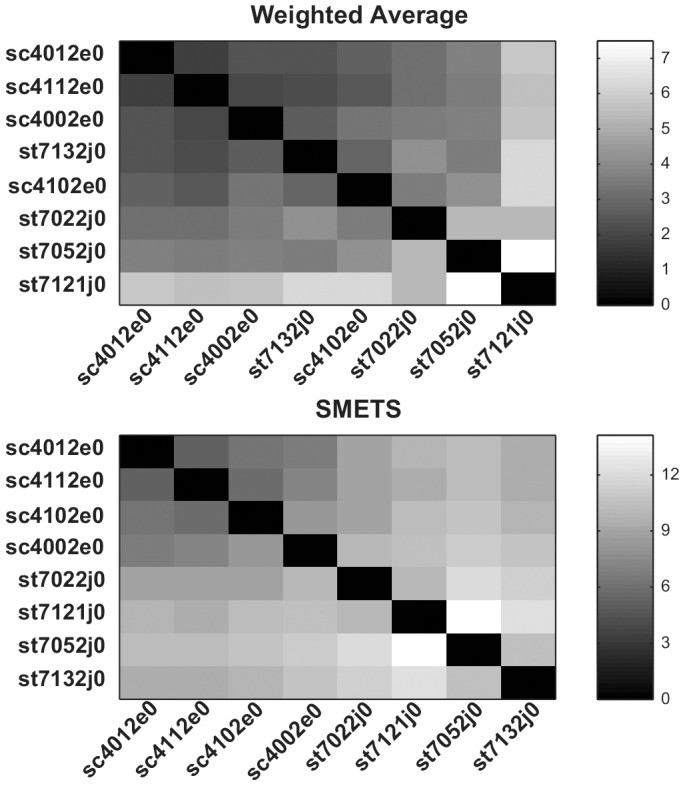
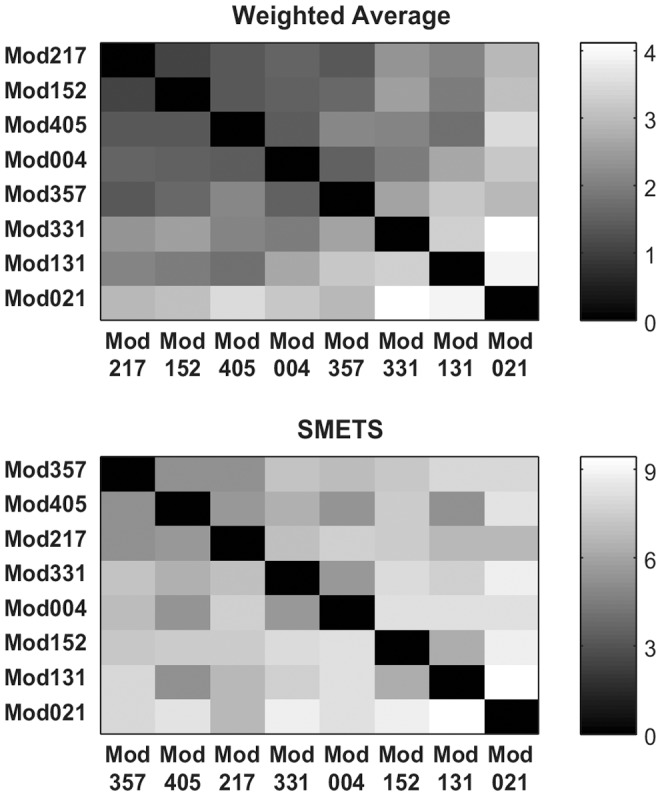
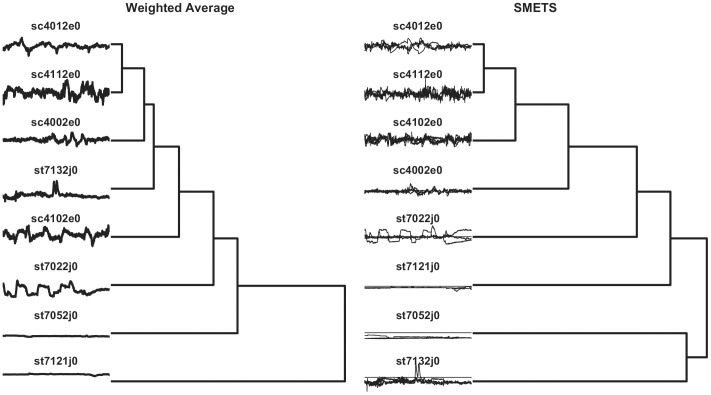
In many situations it is desirable to compare dynamical systems based on their behavior. Similarity of behavior often implies similarity of internal mechanisms or dependency on common extrinsic factors. While there are widely used methods for comparing univariate time series, most dynamical systems are characterized by multivariate time series. Yet, comparison of multivariate time series has been limited to cases where they share a common dimensionality. A semi-metric is a distance function that has the properties of non-negativity, symmetry and reflexivity, but not sub-additivity. Here we develop a semi-metric--SMETS--that can be used for comparing groups of time series that may have different dimensions. To demonstrate its utility, the method is applied to dynamic models of biochemical networks and to portfolios of shares. The former is an example of a case where the dependencies between system variables are known, while in the latter the system is treated (and behaves) as a black box.
在许多情况下,基于行为对动态系统进行比较是可取的。行为的相似性通常意味着内部机制的相似性或对共同外在因素的依赖性。虽然有广泛使用的方法来比较单变量时间序列,但大多数动态系统的特点是多变量时间序列。然而,对多变量时间序列的比较仅限于它们具有共同维度的情况。半度量是一种距离函数,它具有非负性、对称性和自反性,但不具有次可加性。在这里,我们开发了一种半度量——SMETS——它可以用于比较可能具有不同维度的时间序列组。为了展示其效用,该方法应用于生化网络的动态模型和股票投资组合。前者是一个已知系统变量之间依赖关系的例子,而后者则将系统视为黑盒(并表现为黑盒)。