National Institute of Public Health, University of Southern Denmark, Copenhagen, Denmark.
PLoS One. 2013 Jul 24;8(7):e69860. doi: 10.1371/journal.pone.0069860. Print 2013.
After the worldwide steep increase in child and adolescent overweight and obesity during the last decades, there is now evidence of a levelling off in the prevalence in many countries in the Western world.
To examine whether there still is a plateau in the prevalence of overweight and obesity in Danish children and adolescents, or whether the prevalence is decreasing or rising again.
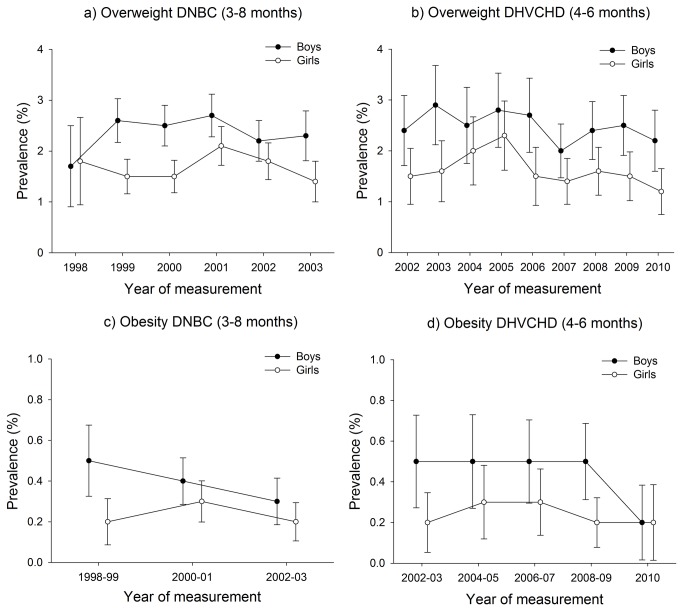
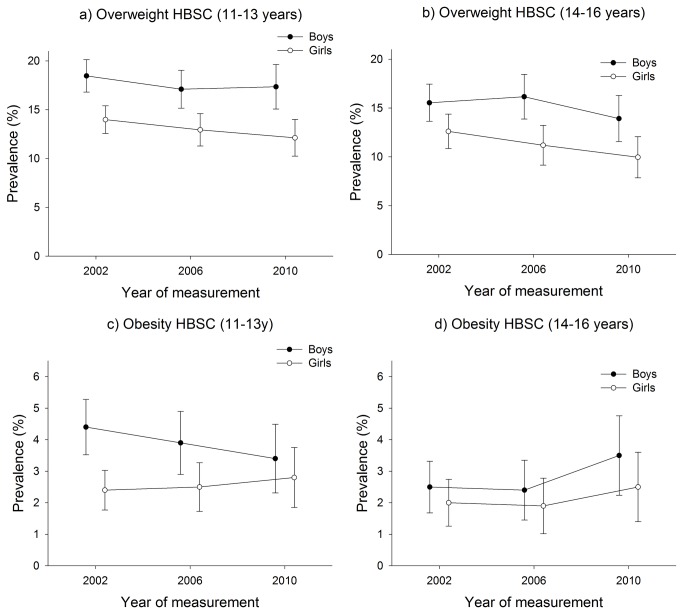
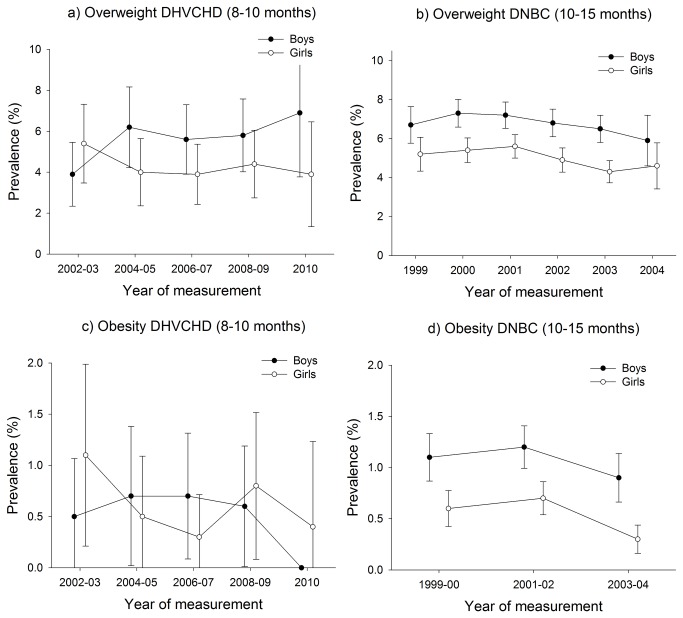
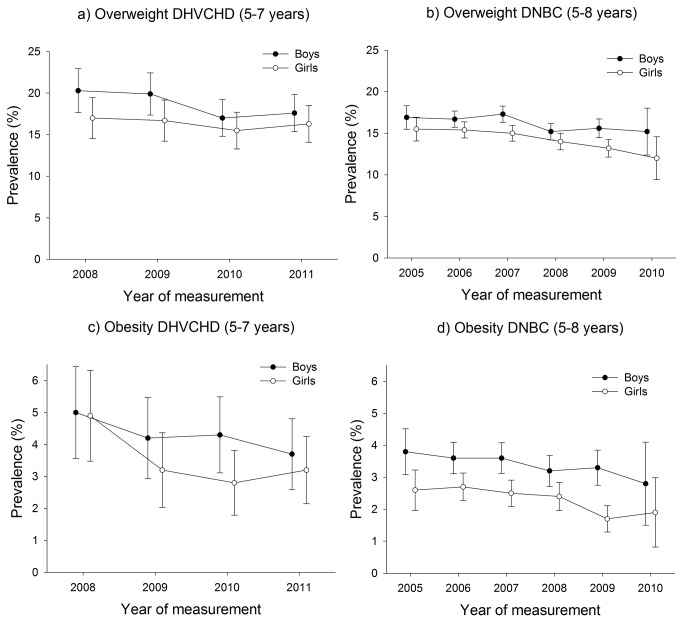
THE TRENDS IN THE PREVALENCE RATES WERE BASED ON THREE DATA SETS PROVIDING COMPARABLE REPEATED ESTIMATES: 1) the Danish Health Visitors Child Health Database (DHVCHD) with measurements on infant and childhood height and weight from 2002 to 2011 (n up to 39,984), 2) the Danish National Birth Cohort (DNBC) with maternal reports of measured infant and childhood height and weight from 1998 to 2010 (n up to 56,826) and 3) the Danish part of the Health Behaviour in School-aged Children survey (HBSC) with self-reported information on adolescent height and weight from the years 2002 to 2010 (n = 16,557). Overweight and obesity were categorized according to WHO growth standards. Trends were assessed by repeated point estimates and linear regression analyses providing regression coefficients for changes in per cent per year with 95% confidence intervals (CI).
The prevalence rates of overweight and obesity for infants, children and adolescents showed a mixed pattern of decline, stability and increase (ranging from -1.10 through 0.29 per cent per year with CI's from -3.10 through 2.37). Overall, there were no consistent statistically significant trends upwards or downwards, although some significant downward trends in childhood and adolescence were observed.
This study, based on data from 1998 through 2011, showed that the prevalence rates of overweight and obesity among Danish infants, children and adolescents were largely still on a plateau with tendencies for a decline among children and adolescents.
在过去几十年中,全球儿童和青少年超重和肥胖率急剧上升,而现在在西方许多国家,超重和肥胖的流行率已趋于平稳。
研究丹麦儿童和青少年的超重和肥胖流行率是否仍处于平稳状态,或者流行率是在下降还是再次上升。
该研究基于三个提供可比重复估计的数据集:1)丹麦健康访问者儿童健康数据库(DHVCHD),其中包含 2002 年至 2011 年的婴儿和儿童身高和体重测量值(n 多达 39984);2)丹麦全国出生队列(DNBC),其中包含 1998 年至 2010 年母亲报告的婴儿和儿童身高和体重测量值(n 多达 56826);3)丹麦部分健康行为在学龄儿童调查(HBSC),其中包含 2002 年至 2010 年青少年自我报告的身高和体重信息(n=16557)。超重和肥胖根据世卫组织生长标准进行分类。趋势通过重复点估计和线性回归分析进行评估,为每年百分比的变化提供回归系数,置信区间(CI)为 95%。
婴儿、儿童和青少年超重和肥胖的流行率呈下降、稳定和上升的混合模式(范围从每年-1.10%到 0.29%,CI 从-3.10%到 2.37%)。总体而言,没有一致的统计学意义上的上升或下降趋势,尽管在儿童和青少年中观察到一些显著的下降趋势。
本研究基于 1998 年至 2011 年的数据,表明丹麦婴儿、儿童和青少年超重和肥胖的流行率在很大程度上仍处于平稳状态,儿童和青少年的流行率呈下降趋势。