Allergen Group, Woolcock Institute of Medical Research, Sydney, New South Wales, Australia.
PLoS One. 2013 Jul 24;8(7):e69900. doi: 10.1371/journal.pone.0069900. Print 2013.
The bed is commonly regarded as the main site of house dust mite exposure; however this has not been directly established by continuous measurements. The objective of this study was to determine the pattern of personal exposure to mite aeroallergen over 24 hours.
12 adults each collected 9 sequential samples (8 during the day, mean 115 mins, and one overnight, mean 514 mins) over 24 hours using a portable air-pump (2L/min) connected to an IOM filter located on the shoulder during the day and on the bed head overnight. Samples were analysed for mite allergen Der p 1 by ELISA. Location and activity were recorded. A mixed model analysis was performed to determine exposure as a function of 14 categories of activity.
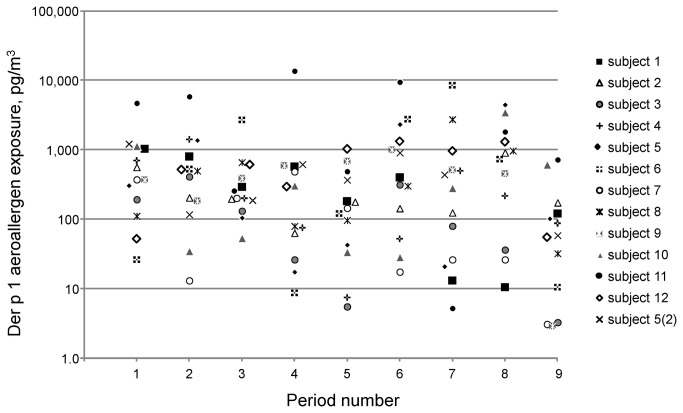
Personal aeroallergen exposure differed widely over time, both within and between subjects. The highest average exposure (1117 pg/m(3), 95% CI: 289-4314) occurred on public transport and the lowest overnight in bed (45 pg/m(3), 95% CI: 17-17), which contributed only 9.8% (95% CI: 4.4%-15.1%) of total daily exposure. Aeroallergens were not related to bed reservoirs.
The study challenges the current paradigm that the bed is the main site of HDM exposure and instead suggests most exposure occurs in association with domestic activity and proximity to other people. Effective mite interventions, designed to improve asthma outcomes, need to first identify and then address the multiple sources of aeroallergen exposure.
床通常被认为是尘螨暴露的主要场所;然而,这并没有通过连续测量来直接证实。本研究的目的是确定 24 小时内人体对螨过敏原的暴露模式。
12 名成年人每人在 24 小时内连续采集 9 个样本(白天采集 8 个,平均 115 分钟,夜间采集 1 个,平均 514 分钟),使用便携式气泵(2L/min)通过位于肩部的 IOM 过滤器采集白天的样本,位于床头的过滤器采集夜间的样本。使用 ELISA 方法分析 IOM 滤膜上的螨过敏原 Der p 1。记录位置和活动情况。采用混合模型分析方法,根据 14 类活动确定暴露情况。
个体过敏原暴露在时间上差异很大,无论是在个体内还是个体间。最高的平均暴露量(1117pg/m3,95%CI:289-4314)发生在公共交通工具上,最低的夜间在床上(45pg/m3,95%CI:17-17),仅占全天暴露量的 9.8%(95%CI:4.4%-15.1%)。过敏原与床没有关系。
该研究对目前的范式提出了挑战,即床是尘螨暴露的主要场所,而不是建议大多数暴露发生在与家庭活动和与他人接近有关。为改善哮喘结果而设计的有效尘螨干预措施,需要首先识别并解决多种过敏原暴露源。